


WWW.THECOLLECTOR.COM
Why the Monroe Doctrine Was Enforced by the Royal Navy
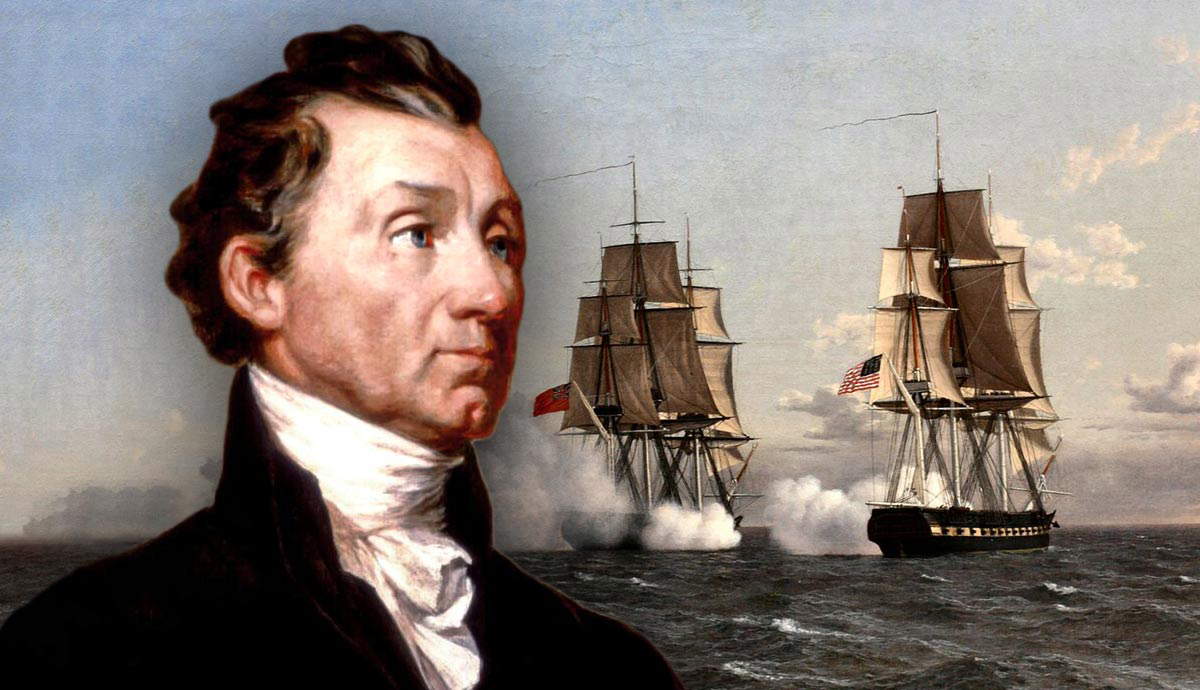
American foreign policy shifted on December 2, 1823, when President James Monroe announced the Monroe Doctrine in his yearly address to Congress. President Monroe reaffirmed that European colonial expansion in the Western Hemisphere would be considered a hostile actto the US, while alsopledging non-intervention in European matters. Despite this bold declaration, the US lacked the military, especially naval, strength to enforce it. Instead, the British Royal Navy played a decisive role in upholding the doctrine throughout much of the 19th century, aligning it with Britains own economic and political interests in the Americas.Why & How the Monroe Doctrine Was BornPortrait of James Monroe, by Samuel F. B. Morse, 1819. Source: The White House Historical Association/White House CollectionThe origins of the Monroe Doctrine can be found as early as 1783, when the United States declared the policy of isolationism following the American Revolution.American historian Samuel Eliot Morison pointed out that:as early as 1783, then, the United States adopted the policy of isolation and announced its intention to keep out of Europe. The supplementary principle of the Monroe Doctrine, that Europe must keep out of America, was still over the horizon.By 1823, the Latin American Republics had achieved long-awaited independence and diplomatic recognition from the United States. These territories had been under Spains colonial rule for centuries. The Napoleonic Wars and the subsequent invasion of Spain in 1808 weakened Spains colonial control, laying the foundation for the Spanish colonies to seek independence. In the following years, the waves of the independence movement spread across Latin America.When Napoleon Bonaparte was defeated in 1815, the Congress of Vienna did not take into consideration the independence struggles in Latin America. However, the United States saw the opportunity to support the revolutions in the Western hemisphere. The Congress of Vienna intended to restore the balance of power in Europe, reinstate monarchies, and prevent the spread of revolutionary movements. On the other hand, the United States, influenced by its own revolutionary past and economic interests, viewed the colonies independence movement as a way to weaken European dominance in the Americas.Illustration shows Uncle Sam holding a large magnifying glass labeled National Vanity which he is using to examine a battleship flying an American flag labeled U.S. Navy. He also holds papers labeled Monroe Doctrine, by Udo Keppler, 1908. Source: Library of Congress, Washington DCThe formation of the Holy Alliance on September 23, 1815, changed the power dynamics. The alliance, composed of the European powers of Austria, Prussia, and Russia, aimed to strengthen monarchism in post-Napoleonic Europe. To achieve this goal, the Holy Alliance authorized the use of military force to re-establish the rule of the Bourbon dynasty over Spain and its colonies. At the same time, France had already agreed to re-establish monarchy in Spain in exchange for control over Cuba.As a constitutional monarchy, Great Britain did not join the Holy Alliance, whose members supported the principle of absolutism. Instead, British Foreign Secretary George Canning proposed to American President James Monroe a joint Anglo-American action that would constrain the Holy Alliances influence in the Western Hemisphere.The British proposal was dictated by several calculations. In particular, as a great European power, Britain sought to maintain its current colonies as well as expand territorially to meet the increasing demand for new markets and sustain its quick industrialization. While the Spanish Empire struggled to survive, and France was still weak from the Napoleonic Wars, Britain remained the only European power able to influence the power dynamics with the United States, whether through support or coercion.In 1821, the Russian Empire also entered the contest between the powers set on gaining influence in the Western hemisphere with the Ukase (proclamation), claiming territorial sovereignty over northwestern North America (present-day Alaska) and most of the Pacific Northwest. Under this proclamation, the Russian Empire also forbade non-Russian ships from approaching the coast.John Quincy Adams, the US Secretary of State from 1817 to 1825. Source: Wikimedia Commons/US Department of StateSimultaneously, the Monroe administration was negotiating with Spain to purchase Florida to increase its influence in the region. The negotiation resulted in the Transcontinental Treaty, signed in 1821. Following this, the United States proceeded to recognize the Latin American republics of Argentina, Chile, Peru, Colombia, and Mexico as independent states in 1822.While the United States sought to keep the old European colonial powers out of the Americas, the Monroe administration recognized that the United States lacked the necessary military strength to achieve this goal. As the historian Caitlin Fitz pointed out: Great Britain was the preeminent global power, while the United States was little more than a second-ring show in the high-strung Atlantic circus.Although President Monroe did not turn downBritish suggestion to join forces to deter European colonialism in the Western hemisphere,Secretary of State John Quincy Adams disagreed,claiming that It would be more candid as well as more dignified to avow our principles explicitly to Russia and France, than to come in as a cockboat in the wake of the British man-of-war.Despite these concerns, the conflux of interests between the two countries, ensuring the stability and independence of Latin American republics while preventing European intervention, led to the creation of the Monroe Doctrine, proclaimed by the United States, but enforced by the Royal Navy of Great Britain.The Monroe DoctrineCartoon of the Monroe Doctrine showing Uncle Sam armed with a rifle to defend Latin America from the European powers, by Victor Gillam, 1896. Source: Wikimedia Commons/Library of Congress, Washington DCIn his yearly address to Congress on December 2, 1823, President James Monroe unveiled a new American foreign policy strategy, later known as the Monroe Doctrine. According to this doctrine, the New and Old Worlds, having distinct socio-political systems, should remain divided.James Monroe outlined four key points of the new approach:The United States would refrain from interfering in the internal affairs or the military conflicts between European powers.The United States would recognize and would not be involved in the affairs of the existing European colonies in the Western Hemisphere.The remaining territories of the Western Hemispherewere closed to future colonization.Any attempt by a European power to gain control over any nation in the Western Hemisphere would be viewed as a hostile act against the United States.The address read:In the wars of the European powers in matters relating to themselves we have never taken any part, nor does itcomportwith our policy so to do. It is only when our rights are invaded or seriously menaced that we resent injuries or make preparations for our defense.With the existing colonies or dependencies of any European power, we have not interfered and shall not interfere. But with the governments who have declared their independence and maintained it, and whose independence we have, on great consideration and just principles, acknowledged, we could not view any interposition to oppress them or control in any other manner their destiny, by any European power in any other light than as themanifestationof an unfriendlydispositiontoward the United States.Initially, President Monroes address was not perceived as the foundation of a foreign policy doctrine but rather as an answer to the security challenges and the compromise between passive and aggressive policy options in light of the rising threat of the re-colonization of the newly independent republics in Latin America by the reactionary European powers.Portrait of John Quincy Adams, by Gilbert Stuart, 1818. Source: The White House Historical AssociationAccording to author Leonard Axel Lawson, avoiding entering the Anglo-American alliance and instead declaring the unilateral Monroe Doctrine was part of Secretary Adamss diplomatic game. In his book The Relation of British Policy to the Declaration of the Monroe Doctrine (1922), Lawson argues:England possessed, at that time, a navy as large as the combined navies of all the other powers of the world; and, insofar as the existence of the British navy compelled respect for those interests, it also compelled respect for and observance of the Monroe Doctrine.Indeed, Secretary of State Adams, in explaining his position regarding the relation with Great Britain, declared: My reliance upon the cooperation of Great Britain rested not upon her principles but upon her interests.By adopting the Monroe Doctrine, the United States needed a formidable maritime presence, especially a powerful navy, to safeguard the vast coastline of the Americas from European colonial powers intervention. The British Royal Navy would play a decisive role in enforcing the doctrine throughout the 19th century, even if it acted out of self-interest in expanding and maintaining trade relations.The British Royal Navys Role in Enforcing the Monroe DoctrineBattle between the English frigate Shannon and the American frigate Chesapeake, by Villy Fink Isaksen, 1836. Source: Ministry of Culture of DenmarkIn the 19th century, the British Royal Navy maintained a dominant presence in key strategic regions, particularly the Atlantic Ocean, the Caribbean Sea, and the South Atlantic, to prevent European intervention in the Americas and to deploy rapidly in case of a threat.One such example was the Falkland Islands Dispute in 1833, when Britain deployed its fleet to curb Argentinas claim over the islands. While Argentina was not a European nation, Great Britain illustrated its intention to uphold the Monroe Doctrine with this move.Similarly, when France invaded Mexico and installed Emperor Maximilian I, a French-backed monarch, in December 1860,Britain decided to withdraw its support for France in 1866. Without British diplomatic and naval support, France was forced to retreat from Mexico.The event effectively deterred future French ambitions in the region and reinforced the Monroe Doctrine.Theodore Roosevelts Corollary & the End of British Royal Navy DominancePrint showing President Theodore Roosevelt as a constable standing between Europe, Latin America, Asia, and Africa with a truncheon labeled The New Diplomacy, by Dalrymple Louis, 1905. Source: Library of Congress, Washington DCDuring the second half of the 19th century, the United States emerged as a leading naval power.By this time, the United States had undergone a rapid industrialization process and expanded its economy and infrastructure through global trade. Regarding territorial expansion, in 1867, the United States acquired strategic locations such as Alaska. However, the Spanish-American War of 1898 appeared to be a turning point. The United States emerged victorious and gained control over former Spanish territories, including Puerto Rico, Guam, and the Philippines. This victory demonstrated American military strength and capabilities.This period also saw the influence of Alfred Thayer Mahans naval theories, which emphasized the importance of a strong navy for acquiring and maintaining global influence. Alfred Thayer Mahans naval theories inspired Theodore Roosevelt who emerged as a leading maritime strategist. After 1901, when Roosevelt became the president of the United States, he linked the Monroe Doctrine to his new foreign policy approach.In this context, he secured the construction of the Panama Canal connecting the Atlantic and Pacific oceans and sent 16 battleships, also known as the Great White Fleet, on a world tour.The introduction of the Roosevelt Corollary to the Monroe Doctrine in 1904 marked the beginning of the United States actively enforcing the doctrine itself, rather than relying on the British fleet. The Roosevelt Corollary ensured that the United States could intervene in the internal affairs of the Latin American countries if necessary. Throughout the 20th century, the United States would play a decisive role in world politics as a new global power.
0 Comments
0 Shares
2 Views

 Arabic
 French
 Spanish
 Portuguese
 Deutsch
 Turkish
 Dutch
Dutch
 Italiano
 Russian
 Romaian
 Portuguese (Brazil)
 Greek
Greek