What Was the Most Powerful Dynasty in Ancient China?
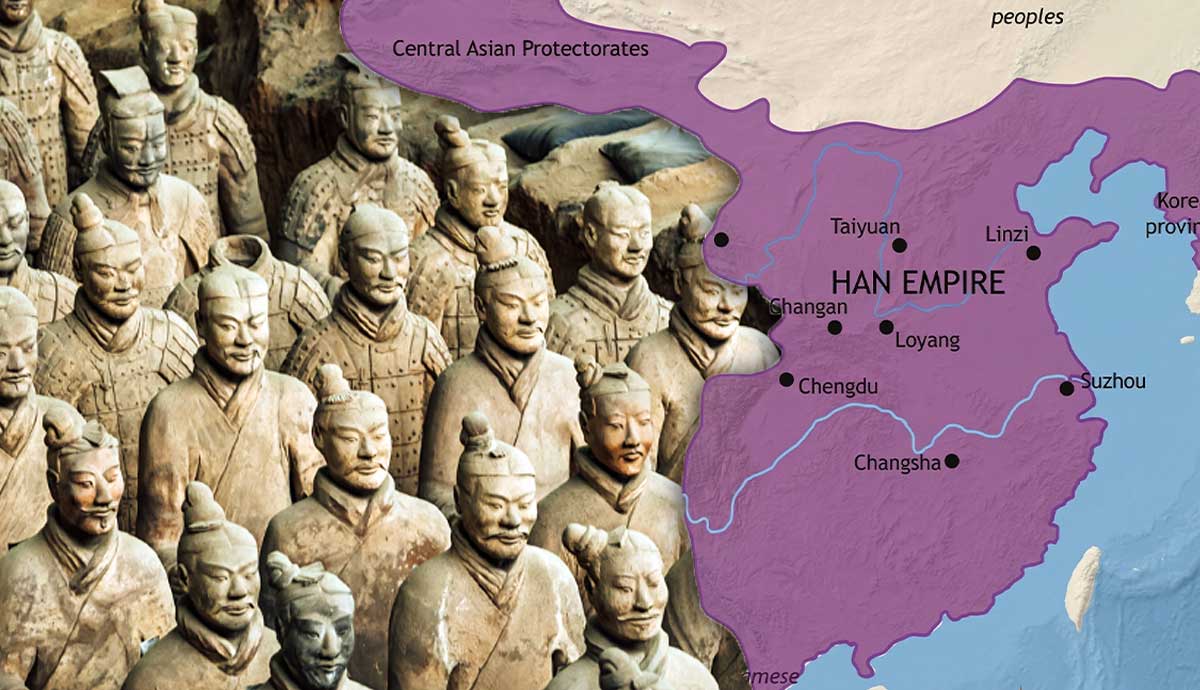
The Western Han dynasty in 2 ADHistorians and scholars frequently debate which imperial house in Ancient China held the most influence in the history of East Asia, and the debate often leads to a discussion regarding the Tang Dynasty and the Han Dynasty. Understandably, the Tang Dynasty which ruled the region from 618 AD to 907 AD is widely regarded as the golden age of Chinese civilization. However, the Han Dynasty also had many unique accomplishments.Why the Han Dynasty Is in the DiscussionMap of the Han Dynasty around 60 BC. Source: Wikimedia CommonsThe Han Dynasty existed from 206 BC to 220 AD, lasting for over four centuries. According to historical records, it established the foundational culture of the nation to the point that the majority ethnic group in China today is still referred to as the Han. Another major reason for its historical significance was its vastness. The Han Empire rivaled Rome in terms of sheer size and population.According to a census undertaken in 2 AD, the empire had a recorded population of about 60 million people. Furthermore, the Han Dynasty is credited with formally establishing the Silk Road which connected Africa, Europe, and Asia for centuries, through trade.The Rise of the Tang EmpirePortrait of Emperor Taizong of Tang on a Ming dynasty hanging scroll, after a contemporary painting by Yan Liben. National Palace Museum, Taipei, TaiwanThe Tang Empire emerged after the short-lived Sui Dynasty and preceded the Five Dynasties and Ten Kingdoms period. The Tang empire controlled a vast territory that extended deep into Central Asia, covering approximately 4.13 million square miles. Today, it is credited for maintaining one of the most formidable militaries in the ancient world and having one of the richest cultures of its era.The Li family founded the Tang dynasty in 618 AD after the collapse of the Sui regime. Li Yuan was the first emperor and he reigned as Emperor Gaozu until 626 AD. His son, Li Shimin, ascended to the throne in 627 AD after killing his two brothers in an event known as the Xuanwu Gate Incident. Li Shimin assumed the title of Emperor Taizong and ruled until 649 AD. It is worth noting that Emperor Taizong is considered by many historians to be one of the greatest monarchs in history. This is because of his military campaigns against the Eastern Tujue and his refinement of the legal code created in 624 AD by his father. The code served as the basis for future legal systems in China and in places such as Japan and Vietnam.The Tang Dynasty PeakMing Dynasty portrait of Emperor XuanzongThe Tang dynasty reached its apex during the reign of Emperor Xuanzong who ruled from 712 AD to 756 AD. The period is often referred to as the High Tang. A famous census in the year 754 AD revealed that the empire had about 10 million households and a total population of approximately 53 million people. Historians believe that the actual population was likely higher as many people avoided registration in order to evade taxes. The economy flourished during the early 8th century because of the stability brought about by the Silk Road and the introduction of new agricultural techniques.18th-century Qing dynasty illustration of Wu ZetianAnother unique aspect of the Tang era was the rise of the only legitimate female leader in the history of China Wu Zetian. Wu Zetian was a concubine of Emperor Taizong and later the wife of his son, Emperor Gaozong. She effectively ruled the empire for decades before she officially took the title of emperor in 690 AD. The empress established her own dynasty which she named the Zhou Dynasty and she ruled until she was forced to abdicate in 705 AD. Notably, she maintained the empires influence in the Korean peninsula and patronized Buddhism to legitimize her rule. Her reign interrupted the Tang lineage for fifteen years.The Spread of Chinese CultureThe Abbasid Caliphate in c.850The might of the Tang military allowed the dynastys culture to spread far beyond the borders of the empire as it maintained a system of protectorates in the western regions to secure its trade routes. The Battle of Talas in 751 AD marked the limit of the western expansion when Tang forces fought against the Abbasid Caliphate.In a change of fortunes, the defeat at Talas halted the westward advance. The era is also famous for its poetry and art. Poets such as Li Bai and Du Fu rose in the Tang era and produced thousands of poems that are still studied by students today. The Complete Tang Poems, which is a collection that was compiled later, contains over 48,000 poems written by more than 2200 Tang authors.




 Arabic
 French
 Spanish
 Portuguese
 Deutsch
 Turkish
 Dutch
Dutch
 Italiano
 Russian
 Romaian
 Portuguese (Brazil)
 Greek
Greek