


ALLTHATSINTERESTING.COM
Iran Air Flight 655, The Civilian Plane Shot Down By An American Warship In 1988
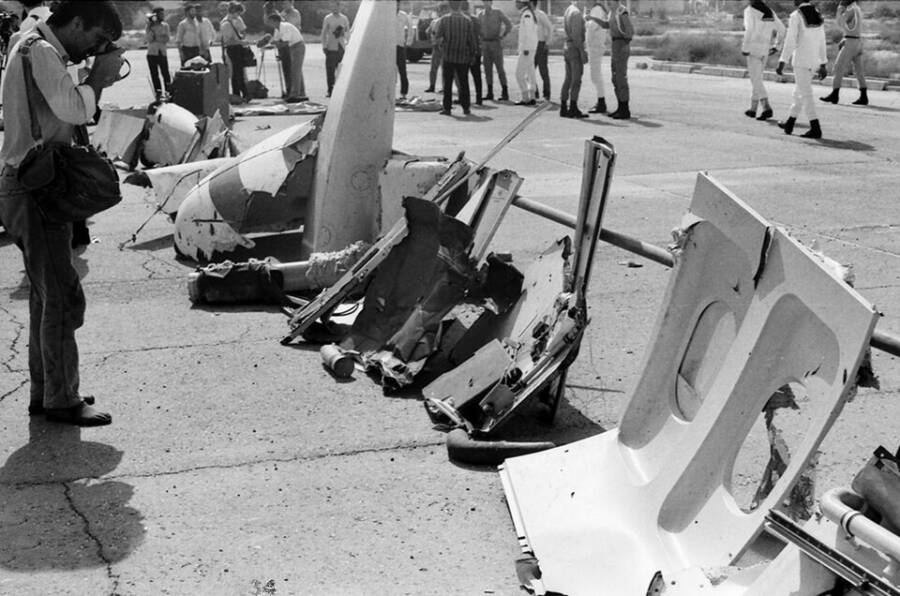
Wikimedia CommonsWreckage from Iran Air Flight 655.On July 3, 1988, Iran Air Flight 655 took off from Bandar Abbas Airport en route for Dubai. It should have been a short, uneventful flight. But seven minutes into its journey, a United States Navy warship opened fire on the plane knocking it out of the sky and killing all 290 people onboard. Though the U.S. military called the incident a tragic and regrettable accident, the downing of Iran Air Flight 655 triggered an international firestorm. Iran sued the United States in the International Court of Justice in 1989, and the U.S. ultimately agreed to pay a huge settlement to the victims families.But in the years that followed, the memory of the doomed Iran Air Flight 655, and its 290 victims, remained a painful one in Iran.The United States And The Iran-Iraq WarThe shooting down of Iran Air Flight 655 took place at the tail-end of the Iran-Iraq War, which had begun eight years earlier in 1980. During the war, the United States quietly supported the Iraqis with money, intelligence, and equipment. And by the summer of 1988, the U.S. Navy had also begun to play a more active role in the Persian Gulf, protecting merchant ships. Tensions in the region were high. The year before, in May 1987, an Iraqi jet had mistaken the frigate USS Stark as an Iranian vessel and opened fire, killing 37 crewmen. Roughly a year later, in April 1988, the frigate USS Samuel B. Roberts was severely damaged after striking in Iranian mine. This led the U.S. to launch a retaliatory mission known as Operation Praying Mantis, which attacked several Iranian naval targets and sank an Iranian ship. And on the morning of July 3, 1988, USS Vincennes, captained by William C. Rogers III, was engaged in multiple skirmishes in the region. Public DomainThe USS Vincennes, armed with a guided missile system, deployed to the Persian Gulf during the Iran-Iraq War. According to reporting from The New York Times in 1988, USS Vincennes was patrolling the Strait of Hormuz when it engaged with a number of Iranian gunboats. In the middle of this firefight, Iran Air Flight 655, with 290 people onboard, prepared to take off from Bandar Abbas Airport.The Downing Of Iran Air Flight 655At 10:17 a.m., Iran Air Flight 655 took off 30 minutes behind schedule. It was headed for Dubai, a short flight which should have taken just 28 minutes. According to the Washington Post in 1988, many Iranians flew to Dubai on the weekends to buy luxury goods like electronics and jewelry, and the flight had a number of families onboard, including 65 children. Reiner Geerdts/Wikimedia CommonsIran Air Flight 655 was an Airbus A300, seen here in 1987.As a subsequent U.S. Navy investigation confirmed, Iran Air Flight 655 had correctly identified itself as a civilian aircraft on air traffic control frequencies, and it was flying along a commercial air corridor .But when the plane appeared on the USS Vincennes radar, its crew immediately suspected that it was hostile. After all, the U.S. Navy ship was currently engaged in a gun battle, the plane had taken off from Bandar Abbas (which was used by military and civilian aircrafts), and radio warnings to the airplane had gone unanswered. That said, the crew of Iran Air Flight 655 may not have received the warnings, as it was likely not monitoring the right channel. And even if the crew did see them, they might have not realized that the ship was communicating with them and not another plane.Indeed, officers on the Vincennes worried that the aircraft was actually an Iranian F-14 fighter jet. With just minutes to make a decision, and with no response from the plane, Rogers gave the order to fire. The warship then fired two surface-to-air missiles, which struck the commercial aircraft. Iran Air Flight 655 broke apart, and plummeted into the water below. How The U.S. And Iran Responded To The TragedyAfter the downing down of Iran Air Flight 655, American military leaders defended Rogers decision to shoot down the commercial airliner. The Chairman of the Joint Chiefs of Staff, Admiral William J. Crowe Jr., stated at a press conference that the Vincennes had acted to protect itself, remarking that the commanding officer had a very heavy obligation to protect his ship, his people and that If a country is going to wage combat operations in a certain areas and then send a commercial airliner into the area during that, of course its an accident waiting to happen.Josn Oscar Sosa / Department of Defense/Department of DefenseChairman of the Joint Chiefs of Staff Admiral William Crowe and Secretary of Defense Frank Carlucci addressing the downing of Iran Air Flight 655.Meanwhile, President Ronald Reagan called the downing of the aircraft a terrible human tragedy, in a statement, but reiterated that the USS Vincennes had been firing to protect itself against possible attack.Ultimately, the Department of Defense concluded that The USS Vincennes did not purposely shoot down an Iranian commercial airliner, declaring that Rogers reasonably believed the plane was hostile and a threat to his ship.The report also declared that Iran must share the responsibility for the tragedy by hazarding one of their civilian aircrafts by allowing it to fly a relatively low altitude air route in close proximity to hostilitiesWikimedia CommonsWreckage from Iran Air Flight 655.But Iran saw things completely differently: the USS Vincennes had entered Iranian territorial waters, fired on Iranian ships, and then shot down a commercial airliner carrying 290 civilians, most of whom were Iranian. Many Iranians did not believe that a U.S. warship, equipped with the latest technology, could mistake a commercial airline for an F-14 fighter jet.Iranian Foreign Minister Ali Akbar Velayati claimed that the downing of the plane was a capital crime committed by U.S. troops. He added: The United States is responsible for the consequences of its barbaric massacre of innocent passengers.The Aftermath Of The Downing Of Iran Air Flight 655Public DomainIran issued a stamp to commemorate the disastrous attack. Though at first the downing of Iran Air Flight 655 seemed like it could intensify and widen the Iran-Iraq War, it ultimately helped bring the conflict to a close. The United Nations declared that the war needed to end before more lives were lost and Iran, fearing that the United States might officially join the war on the side of Iraq, soon agreed to a ceasefire.But Iran continued to seek justice for the victims of the doomed aircraft. In May 1989, it sued the United States in the International Court of Justice. In 1996, the U.S. agreed to a settlement of $61.8 million to the victims families (more than $100 million today) though the Americans did not admit liability. The downing of civilian Iran Air Flight 655 on 3 July was a tragic and regrettable accident, declared the Chairman of the Joint Chiefs of Staff in an investigative report in August 1988. [A]s is so often the case in a combat environment, there were a number of contributing factors.That said, the downing of Iran Air Flight 655 has remained an open wound in Iran. When President Donald Trump threatened to target 52 sites in Iran in 2020, for each of the Americans taken hostage in Iran in 1979, Iranian President Hassan Rouhani tweeted in response: Those who refer to the number 52 should also remember the number 290. #IR655.The tragedy of Iran Air Flight 655 deepened the rift between the US and Iran. Next, check out photos from the Iranian Revolution, and then look at images of the 1990 Persian Gulf War. The post Iran Air Flight 655, The Civilian Plane Shot Down By An American Warship In 1988 appeared first on All That's Interesting.
0 Commentaires
0 Parts
35 Vue

 English
 Arabic
 Spanish
 Portuguese
 Deutsch
 Turkish
 Dutch
Dutch
 Italiano
 Russian
 Romaian
 Portuguese (Brazil)
 Greek
Greek