


WWW.THECOLLECTOR.COM
The Pope Who Allegedly Made a Deal With the Devil
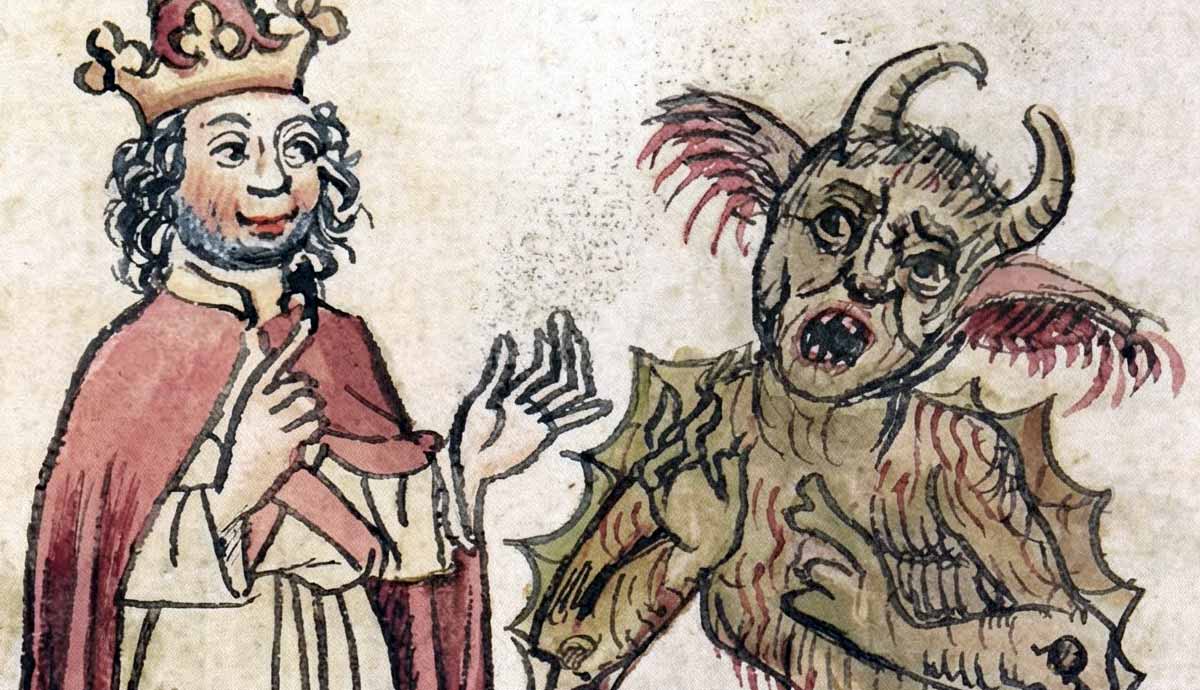
According to legend, if you are in St. John Lateran basilica in Rome and you hear the rattling of bones coming from one of the tombs flanking the nave, the Pope is about to die. The rattling bones belong to Pope Sylvester II, who reigned from 999 to 1003. Sylvester developed a legendary status in the years after his death with rumors that he was a sorcerer with a thirst for forbidden knowledge.Sylvester IIs Early LifeStatue of Pope Sylvester II, in Aurillac, France. Source: Wikimedia CommonsGerbert of Aurillac was most likely born between 945 and 950 AD in southern France. As a boy, he was enrolled in a monastery school where he learned the three subjects that were foundational to a classical-style education: grammar, logic, and rhetoric. This grouping of subjects, known as the trivium, was not meant to be the end of the educational journey, as once the trivium was mastered, the quadrivium would build upon the knowledge of those subjects. The quadrivium consisted of the fields of math, geometry, music, and astronomy.By the time that Gerbert was being educated, the teaching of those upper subjects had become practically extinct in France. In order to expand his knowledge and sate his curious mind, one had to travel far afield to seek instruction in the quadrivium, which is exactly what Gerbert did. He departed from the monastery and made his way south, across the Pyrenees, to Spain.Secret Knowledge in SpainPope Sylvester II and the Devil, miniature from Martinus Oppaviensis Chronicon pontificum et imperatorum, 1460. Source: Society of Classical poetsGerbert was a quick study and soon mastered the subjects he had set out to learn. But, Spain was rich in knowledge, some perilous to ones immortal soul.While learning the art of using the abacus, he came across a muslim philosopher whom he befriended. It is important to remember that at this time, the majority of Spain was controlled by the Caliphate of Cordoba, the last holdout of the Umayyad Dynasty after the Abbasid revolution in 750. His friendship with the philosopher led to him learning a great deal, for the philosopher was generous with his knowledge. But, according to legend, there was one book that the philosopher refused to show Gerbert, no matter how great his pleading. Gerbert appealed to their friendship, but the philosopher refused. Gerbert appealed to the love of God, but the philosopher refused. Gerbert offered him material riches, but the philosopher did not budge.So, Gerbert turned to a more duplicitous plan to get the book that eluded him.He seduced the philosophers daughter, and one night they got the philosopher drunk. They plied him with wine and, once he was unconscious from the amount of drink, they stole the book from under his pillow. Gerbert then fled into the night. Alone. Leaving the philosophers daughter behind once he acquired what he truly desired.The philosopher would not give up the book, which contained all the secrets of his art, so easily. He used his extensive knowledge of the stars to track Gerbert. Though this was no mere navigation. The philosopher was able to use the stars to mystically divine Gerberts location. Gerbert realized what was happening and hatched a plan.In order to make himself invisible to the philosophers divination, Gerber suspended himself under a bridge. Hanging from the bridge, not touching earth or water, he was able to elude his pursuer.A Deal With the DevilHell scene stained glass from Strasbourg Cathedral. Source: Wikimedia CommonsThough he was able to elude the philosopher with his clever trick, Gerbert knew that he would not be able to keep the charade up forever. Sooner or later, the philosopher would find him and take his revenge. Luckily for Gerbert, through the dark arts of astrology and necromancy he learned in Spain, he knew exactly what would protect him once and for all.On the Spanish coast, Gerbert summoned the devil himself in a dark ritual. He said that his soul would be Satans for all eternity if the fallen one would protect him from the philosopher. The devil agreed and, his soul pledged to the lord of darkness, Gerbert was able to be transported across the Mediterranean to the coast of France.Gerbert, knowing that there were always terms to infernal pacts, constructed a mechanical head that would be able to answer yes or no questions with perfect accuracy.Gerbert asked the head if he would become Pope, to which it answered yes.After further questioning, Gerbert asked the head if he would die before he sang Mass in Jerusalem. The head answered no.So, Gerbert had his answer. He would be protected from Satan claiming his soul as long as he stayed away from the holy land. With this knowledge Gerbert could proceed with confidence, knowing that he would achieve the highest office in Christendom.Climbing the LadderEmperor Otto III as depicted in Bayerische Staatsbibliothek, 999 AD. Source: Wikimedia CommonsUpon returning to his homeland, Gerbert began to teach. He reintroduced the subjects of the quadrivium to France and taught the abacus as a means of computation.In his years of teaching, he had two pupils who would go on to inhabit positions of great power. First was Robert, prince of France. After his accession to the French throne, King Robert appointed Gerbert as archbishop of Rheims. While there, Gerbert continued to show his brilliance (or perhaps his infernal knowledge) by constructing a mechanical clock as well as a hydraulic organ powered by heated water.The second of his pupils was the future Holy Roman Emperor Otto III. This is particularly important because in this period, the pope was not chosen by the conclave that we are familiar with today. The pope was appointed by the Holy Roman Emperor himself. It was thus Gerberts good fortune that he was able to make such an impression on the man who would have the power to fill that position.After Otto became Holy Roman Emperor, Gerbert was appointed first as archbishop of Ravenna and then, in 999, pope.He took the name of Sylvester II.Sylvesters Sudden DeathSeated statue of Empress Helena, 2nd century, reworked in the 4th century to resemble Constantines mother. Source: Wikimedia CommonsOne Sunday, Pope Sylvester was preparing to say mass at the basilica of Santa Croce. To this day, the basilica houses relics thought to be from the Passion of Jesus Christ, brought to Rome by the mother of Constantine, Helena, in the 4th century.Unfortunately for Pope Sylvester, he either did not know or did not realize that Helena also brought to Rome soil from Jerusalem itself. That is why the full name of the basilica is Santa Croce in Gerusalemme. Technically, when Sylvester sang mass in Santa Croce, he was doing so in Jerusalem.So, the devil would have his due that day.Accounts differ on what happened. The more tame say that Sylvester began to feel unwell as soon as the mass had ended. Realizing what was happening, he desperately asked that his hand and tongue be separated from his body as they had blasphemed God. When he died later that day, it was discovered that his request was that his body be dismembered and separated before burial. Perhaps in some last-ditch effort to protect his soul from Hell.Another version of the story says that Hell itself opened in Santa Croce and Satan and his demons came to collect their owed soul in person. The devil plucked out Sylvesters eyes, and the demons played with them in the church nave.Burial in St. John Lateran BasilicaPapal throne, St. John Lateran Basilica. Source: Wikimedia CommonsSylvester was hastily buried in St. John Lateran Basilica.The inscription in Latin on his tomb reads:Iste locus Silvestris membra sepulti venturo Domino conferet ad sonitum, in English, This place will yield to the sound the limbs of buried Sylvester, at the advent of the Lord.The Latin was often read as This place will make a sound, rather than yield to the sound.This alternate reading gave rise to the belief that when the Lord comes to claim the soul of his servant, the bones themselves come together and rattle. As if Satan himself was clapping at the demise of the successor of St Peter.What is the Source of Sylvester IIs Life Story?Interior of Malmesbury Abbey. Source: Wikimedia CommonsThe fanciful story of Pope Sylvester and his deal with the devil was a popular one throughout the Middle Ages. But where did it come from? And what did he do in order to be remembered as such a diabolical figure?The primary source used for this particular version of the story comes from the English monk William of Malmesbury. In his book De Rebus Gestis Regnum Anglorum (On the Deeds of the Kings of the English), written over 100 years after Sylvesters death, William takes a short digression to tell this story about his diabolical allegiance.He does not cite a specific source for these claims; he just states that these facts are generally related about him. As further evidence, he says that in an old volume containing the names and years of all the popes, he found that Sylvesters entry said, Silvester, who was also called Gerbert, ten months; this man made a shameful end. Of course, he only says it was an old book, and does not say what the name of it was.Interestingly, William himself writes that, some may regard all this as a fiction because it was often said of scholars that if they excelled at science, they served the devil.So, if William was getting these claims from generally known facts, who was the originator of these claims?The Legacy of Pope Sylvester IISaint Bernard Vanquishing the Devil, 15th century, German, 15th century. Source: The Met, New YorkWhile it is difficult to say exactly, it appears that the claim can be traced back to Cardinal Beno of San Martino e Silvestro, who claimed in an explosive pamphlet that Sylvester consorted with dark powers. Why would he make such a claim? Again, it is difficult to say for certain, but Beno was writing during the Investiture Controversy and was aligned with the Holy Roman Emperor. His pamphlet was an attempt to bolster the status of the emperors position in the controversy against the pope.Accusations of papal sorcery were not uncommon in the Medieval Period, but the legend surrounding Sylvester endured far longer. Perhaps this was because of the general distrust of the sciences and knowledge acquired from non-Christians. The legend of his rattling bones certainly also added to the mystique surrounding Sylvester.In the mid-1600s, Sylvesters tomb was opened during renovations to the Lateran basilica. It was said that his body bore no signs of decay, that he was as intact as the day he died centuries earlier. Then, the necromantic spell broke and his body disintegrated into ash. Even hundreds of years later, the legend was strong enough that it was still being added to.ConclusionTreaty on the geometry of Gerbert of Aurillac, Bavaria, 12th century. Source: University of Pennsylvania LibraryThe tale of the pope who sold his soul to the devil is certainly a good one. It is the kind of folk tale that is often told of the powerful. There is often an inherent distrust of authority figures, whom people believe must be in league with dark forces to amass all that they have. It can be seen in the modern era with conspiracy culture and the legends of the Illuminati and their dark allegiances.If you are in Rome, be sure to seek out Sylvester IIs tomb in the Lateran Basilica. Think of him not only as his legend, but as a scholar who brought knowledge back to Christian Europe that had been forgotten for centuries. Think of him as an insatiably curious mind who, in the best tradition of academics throughout time, had a voracious need to understand how the world worked.But also, keep your ears peeled. If you hear the sound of rattling bones, be sure to turn on the news, as there might be a new pope soon.
0 Commentarii
0 Distribuiri
17 Views

 English
 Arabic
 French
 Spanish
 Portuguese
 Deutsch
 Turkish
 Dutch
Dutch
 Italiano
 Russian
 Portuguese (Brazil)
 Greek
Greek