A Metal Detectorist In Switzerland Just Found A Nine-Inch Bronze Axe That Dates Back 3,500 Years
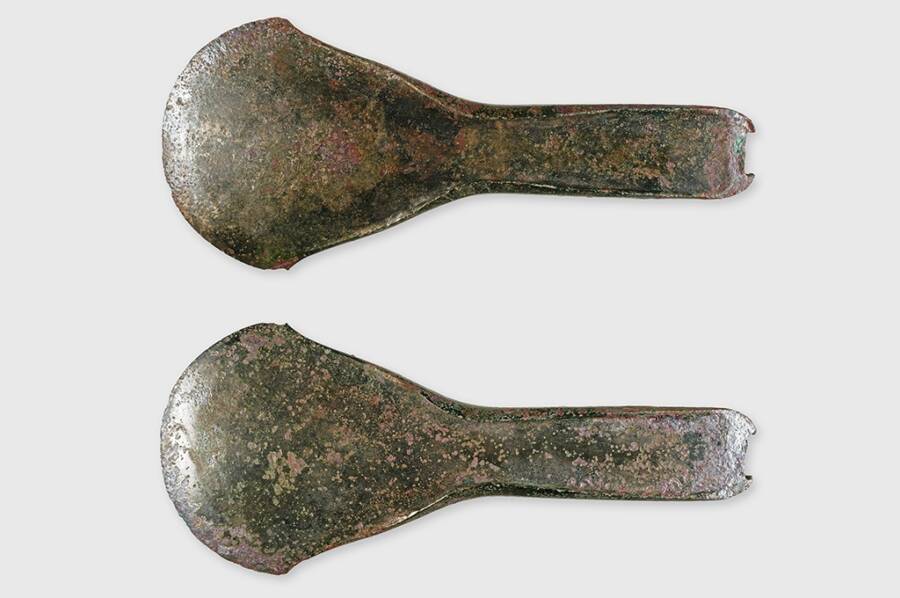
Nicole Gebhard. Archeology BasellandThe front and back of the Bronze Age axe found in Switzerland.While walking through the dense woods near Burg im Leimental, Switzerland, a volunteer surveyor recently came across a bronze axe. This astonishing relic is believed to be some 3,500 years old and archaeologists suspect that it may have been some kind of ceremonial offering to an unknown deity.Indeed, this bronze axe is not the only Bronze Age object thats been found in the area over the past 100 years. Archaeologists are still trying to figure out whether the axe was a standalone offering or possibly part of a larger treasure hoard.The Bronze Age Axe Found By A Volunteer Archaeologist In SwitzerlandAccording to a statement from Archaeology Baselland, the bronze axe was discovered by Sacha Schneider, a volunteer surveyor, in the Swiss village of Burg im Leimental, in 2024. Schneider had taken his metal detector onto the castle rock, a steep, wooded slope beneath Biederthal Castle. While searching the slope, Schneider found the bronze axe as well as a dress pin.Andreas Fischer. Archeology BasellandThe steep, dense landscape where the bronze axe was discovered by a volunteer surveyor.The bronze axe is massive at almost nine inches long, and it belongs to the flanged variety, characterized by its raised sides. Its more specifically known as a Grenchen type axe, named after the discovery of a large Bronze Age cache of axes, swords, and sickles that had previously been found in the nearby Swiss town of Grenchen in 1998.Both it and the dress pin date back to the Middle Bronze Age, around 1500 B.C.E. And archaeologists suspect that they were buried on purpose. Indeed, its likely that these objects were left as an offering to a deity by Bronze Age people more than three millennia ago.Other Bronze Age Objects Found In Burg im Leimental And What Their Purpose May Have BeenAs Archaeology Baselland noted in their statement, a number of other Bronze objects have been found in the region over the past two centuries. In the same area of castle rock where Schneider found the bronze axe and dress pin, a bronze sickle was also found in 1858. Archaeologists suspect that these may have been left by Bronze Age people, who sometimes buried bronze objects as offerings for unknown deities.Nicole Gebhard. Archeology BasellandA collection of the Bronze objects found on castle rock in Burg im Leimental: an axe, a dress pin, and a sickle.The phenomenon of hoards the deposition of multiple metal objects was widespread in the Bronze Age, the statement explains. Sometimes, more than a hundred objects were deposited in a very small area. Often, various objects such as tools, weapons, and jewelry were found mixed together. Research assumes that such hoards were deliberately buried. In most cases, they are interpreted as votive offerings to unknown deities.The bronze axe was found in a rocket pocket filled with earth, and thus could have been a single offering instead of part of a hoard. Other such individual offerings have been found before, in rock crevices or even in the water. But because other bronze objects have been found in the area, archaeologists arent sure if the axe was an individual offering, or if it was part of a larger hoard that became spread out over the years, possibly due to looting.Indeed, though Burg im Leimental is a peripheral place today, tucked along the border between Switzerland and France, it may have been more central during the Bronze Age. Not only is it situated in a fertile region, with connections to the Rhine and Rhone valleys, but other Bronze Age objects found in Grenchen in Switzerland and Biederthal in France suggest the presence of Bronze Age people in the region thousands of years ago.While we know little about these people today, including which gods they may have worshipped, they did leave behind clues that hint at their mysterious history. Discoveries like the bronze axe offer fascinating insights into their craftsmanship, religious beliefs, and movements across the Bronze Age world.After reading about the Bronze Age axe that was found by a volunteer surveyor in Switzerland, discover the sad story of Ueli Steck, the mountaineer known as the Swiss Machine who sadly fell to his death near Mount Everest. Then, learn about Paul Grninger, the Swiss border commander who falsified documents in order to save thousands of Jews during World War II.The post A Metal Detectorist In Switzerland Just Found A Nine-Inch Bronze Axe That Dates Back 3,500 Years appeared first on All That's Interesting.




 English
 Arabic
 French
 Spanish
 Portuguese
 Deutsch
 Turkish
 Dutch
Dutch
 Italiano
 Russian
 Romaian
 Greek
Greek