


WWW.THECOLLECTOR.COM
Why We Are Still Obsessed With Ancient Egypt
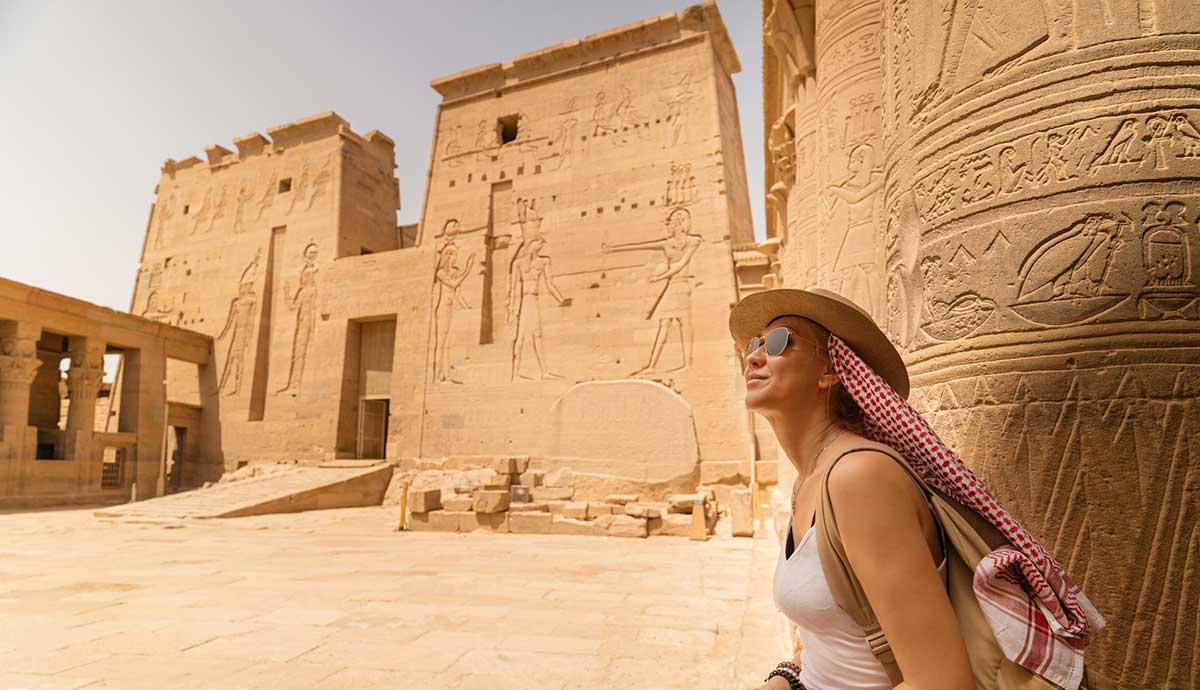
Temple of Isis (Temple of Philae) in the ancient city of Aswan, Egypt.Ancient Egyptian culture was so expansive that those reading this article are living closer to the time of Cleopatra (39-30 BCE) than Cleopatra lived to the construction of the Great Pyramids (c. 2600 BCE); and Egyptian civilization goes back even further than that. With its ancient monuments that have stood the test of time, tombs filled with golden treasures, elaborate hieroglyphic language, and a complex pantheon of gods, Egypt is considered one of the worlds most fascinating cultures. But how did we learn about ancient Egyptian culture, much of which has been lost in the conquest by the Romans, the Islamic Arab Empire, and the Ottoman Empire? This is the story of the rediscovery of Egypts past and the rise of modern Egyptomania.Early Students of Egyptian HistorySquat decorated ware jar depicting spirals, Predynastic Egypt, c. 3850-2960 BCE. Source: Metropolitan Museum of ArtThe oldest records from Egypt date back to approximately 3150 BCE. Egyptian civilization lasted for millennia, continuing even through foreign conquest by the likes of the Hyksos, Persians, and Greeks. The last pharaoh of Egypt was Cleopatra VII, who died in 30 BCE, after which Egypt was annexed by Rome. The Egyptian language was slowly subsumed by Greek, and hieroglyphics were phased out of general knowledge. By the end of the 4th century CE, understanding of hieroglyphics was lost until the discovery of the Rosetta Stone allowed them to be decoded in the 19th century.The earliest attempts to uncover Egypts ancient history were made by the Egyptians themselves. During the 18th Dynasty (c. 14th century BCE), about two thousand years into Egypts history, the pharaoh Thutmose IV organized an excavation of the Great Sphinx, located at the foot of the Great Pyramids of Giza, which had become buried over the centuries. Others, such as Khaemweset, a son of Rameses II, oversaw the restoration of temples and monuments that were already ancient in the 13th century BCE.Obelisk of Nebsen, c. 2323-2100 BCE. Source: Metropolitan Museum of ArtAncient Greek and Roman historians were also fascinated by Egypt and did their best to piece together the countrys long history. Herodotus devoted a significant portion of his Histories to Egypt, as did other scholars such as Strabo and Diodorus Siculus. The Romans were also fascinated by Egyptian culture and either copied Egyptian monuments or just transported the real thing. Many obelisks were taken from Egypt and placed in the heart of Rome, and many Egyptian gods were incorporated into the Roman belief system.After Rome fell, fascination with Egypt continued. European travelers to the land of the Nile were eager to visit places mentioned in the Bible, especially places allegedly visited during the flight to Egypt and locations overseen by the patriarch Joseph. Islamic scholars would also study the temples, monuments, and other artifacts that were left behind and did what they could to translate Egyptian documents into Arabic. Although hieroglyphs were undecipherable, the language was preserved through the Coptic population. The first objective scientific analysis of Egyptian history occurred in the 1600s when English antiquarian John Greaves measured the Pyramids.Napoleon Arrives in EgyptBonaparte Before the Sphinx, Jean-Leon Jerome, 1886. Source: Wikimedia CommonsIn 1798, Napoleon Bonaparte invaded Egypt, which was then ruled by the Ottoman Empire. While his main objective was to hamper British trade coming from India, the expedition was not exclusively military. Along with the army, Napoleon brought a small host of scholars, scientists, and engineers who would study the ancient land and record as much as possible. Whether he did this because of Enlightenment values to preserve knowledge or for cynical propaganda purposes is unknown. Regardless, they got to work, and modern Egyptology was born. Though Napoleon would eventually be forced to flee, the effect of this expedition on the history of Egypt cannot be overstated. These scholars established the Institut dEgypte, a repository of learning that still exists, although it was affected by a 2011 fire, and many priceless works were lost.Archaeology and scientific study were still in their infancy at the time, but these scientists did what they could. They compiled as much information as possible, studied what texts they could, measured monuments and temples, and mapped out the region. Their efforts produced volumes of work, including the four-volume Mmoires sur lgypte published between 1798 and 1801. This would be incorporated into the massive thirty-nine-volume Description de lgypte, which had its first volume published in 1809 and the final in 1829. The works cover not only Egyptian history, but also the topography, wildlife, modern demographics, and culture.The Rosetta StoneThe Rosetta Stone, 196 BCE. Source: British MuseumIf there was one frustration for these early scholars, it was the mystery of the hieroglyphics. Attempts at deciphering them began centuries earlier. In the 1600s, Athanasius Kircher, a Jesuit priest, deduced that the pictographs were phonetic in nature. Other than that, little insight could be gleaned from the hieroglyphics that adorned the temples and monuments that were scattered across Egypt. The combined mystery and beauty of the Egyptian hieroglyphs inspired those interested in the esoteric and the occult. Egyptian imagery was adopted by European secret societies, such as the Freemasons, and magical societies, such as the Hermetic Order of the Golden Dawn.In 1799, Pierre-Franois Bouchard, a French military engineer working near Rosetta, now Rashid, was tasked with repairing Fort Julien, which was built on the remains of a much older Mameluke fortress. During the building process, he discovered a large piece of black granodiorite that had writing on it. He turned the stone over to the authorities. Almost immediately after its discovery, it was hoped that the stone could help decipher hieroglyphics. On the stone were the pictographs, as well as demotic, a simpler cursive form of hieroglyphics, and ancient Greek. Prints were made of the inscriptions and sent back to France, and scholars got to work.Portrait of Jean-Francois Champollion, by Leon Cogniet, 1831. Source: Wikimedia CommonsBritain captured what is now known as the Rosetta Stone in 1801, and it was brought to Britain along with many other artifacts. As early as 1802, casts were made of the writings and distributed throughout Britain, where scholars also tried to translate the ancient script. The Greek text was translated easily, serving as a basis. In 1822, Jean-Franois Champollion had a breakthrough and was able to decipher the script. With this discovery, or re-discovery, it was as if a lock was broken and the wonders of Egypts past could now be explored in their fullest.The Rosetta Stone is known today as the key to unlocking the mysteries of Ancient Egyptian history. The text itself is more mundane. Dated to the early 2nd century BCE at the decree of Ptolemaic ruler Ptolemy V, it stated that certain taxes were to be lowered or abolished altogether. It also praised the king for his benevolence in freeing prisoners and outlawing conscription into the military, as well as pointing out the donations given to temples out of the kindness of the kings heart. It was displayed at the entrance of a temple for all to see. In short, one of the most important finds from ancient Egypt is a public relations text.The Egyptian Court at Crystal Palace at Sydenham, London, 1860, via Architectural DigestDeciphering the hieroglyphics also revealed that many of the hieroglyphic texts from Egypt, imagined to be exotic and mystical, were much more mundane. They were royal names, funerary formulae, and boastful accounts of military campaigns. Nevertheless, interest in Egypt did not diminish. There was a period of Victorian Egyptomania, with Egyptian revival architecture and the production of many works inspired by Egypt, such as Percy Bysshe Shelleys Ozymandias and Boleslaw Prus Pharaoh. Even John Smith claimed that The Book of Abraham was discovered in Egyptian papyri.Adventurers and AcademicsTube of Mummy brown in a coffin. Source: Wikimedia CommonsThe translation of the Rosetta Stone was the first pebble in the avalanche of modern interest in Egyptian history. Explorers and scholars from Europe poured into Egypt, which was allowed by Muhammad Ali, the Ottoman governor of the country. For the next couple of decades, artifacts were taken from Egypt by adventurers and placed in European museums or private collections in what amounted to blatant plundering rather than serious scholarship. Graves were robbed, objects stolen, and even the mummies, the most iconic part of ancient Egyptian culture, were removed from the country.A cottage industry was set up where locals sold artifacts they found to Europeans, no different than selling trinkets to tourists. The lack of respect for the artifacts was so blatant that, at one point, mummies were not studied for their historic significance, but ground up for use as a pigment. Mummy brown was made from the ancient corpses that were ground up, mixed with white pitch and myrrh, and sold to artists.By the late 19th century, it was apparent that these adventurers were doing more harm than good, and a more formal approach was needed. The Egyptian Museum was established in 1835 to attempt to rein in the rampant plundering of ancient artifacts.Some artifacts from Petries excavationsIn 1880, British archaeologist Flinders Petrie developed controlled archaeological methods. Previously, archaeology involved digging up objects, and that was about it. Now, the process would be a careful and controlled expedition, with every aspect carefully recorded, such as the exact location, the depth at which the objects were found, their positioning, and their relation to other artifacts, all carefully cataloged and cross-referenced with other findings. By using these careful methods, a much clearer and coherent picture could emerge. Most subsequent expeditions followed these principles, which form the basis of modern archaeology.Curse of the MummyHoward Carter observing the coffin still covered in black pitch-like mass. Source: Griffith Institute, OxfordBy far the most famous discovery in Egyptology was the discovery of Tutankhamens tomb in 1922. Financed by Lord Carnarvon, archaeologist Howard Carter, a protege of Flinders Petrie, was working in the Valley of the Kings when he and his workers stumbled upon a hidden staircase. Following them, they found the unopened tomb that contained wonderful things. This discovery brought Egyptology into mainstream headlines, instantly turning Carter into a celebrity. Egypt still retained its mystery, with stories of the curse of the mummys tomb circulating.Since then, Egyptology continues to grow as a popular field of study, with departments at museums and universities funding expeditions to rediscover what was once lost. Since then, archaeologists have discovered the once-lost New Kingdom golden city of Aten, the underwater city of Heracleion, and the tomb of Thuthmose II. It is believed that many more secrets and treasures lie beneath the sands, just waiting to be discovered.
0 التعليقات
0 المشاركات
24 مشاهدة

 English
 French
 Spanish
 Portuguese
 Deutsch
 Turkish
 Dutch
Dutch
 Italiano
 Russian
 Romaian
 Portuguese (Brazil)
 Greek
Greek