


WWW.THECOLLECTOR.COM
Why the Battle of Lundys Lane Stopped the US Conquest of Canada
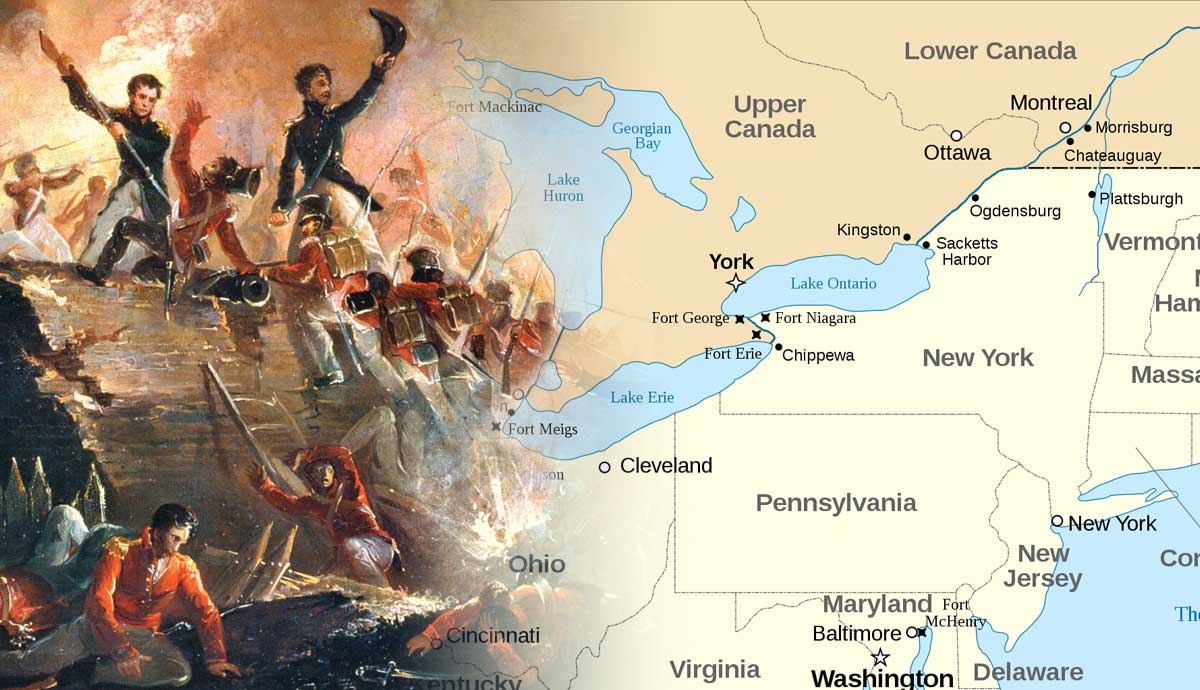
The conquest of Canada was meant to be simple. American forces would cross the border as liberators and spread the ideals of 1776 northward without a shot fired in anger. The reality proved far bloodier, and never more so than in the July darkness of 1814 where murderous cannons boomed in sight of the frothing falls of Niagara.A Mere Matter of MarchingThomas Jefferson, presidential portrait, by Rembrandt Peale, 1801. Source: The White HouseFor a battle its size, Lundys Lane was a massacre. It came after two years of war on the Niagara frontier. Two long years since the United States and Great Britain went to war. Two years since Thomas Jefferson obnoxiously declared that the American conquest of British Canada would be a mere matter of marching. This excessive optimism on the part of a former president was not only ill considered but was grounded in outright ignorance of the task. Indeed, two centuries on and the statement is laughable to modern ears. To an experienced soldier-scholar of the caliber of John Elting, Jeffersons hubris echoed wider American temperaments that flew in the face of actual military preparedness.No other conflict in Americas history, Elting argued, saw the nation so unready and so ill-prepared, as the War of 1812 (Elting, Amateurs to Arms, p. 1). The Regular army was minuscule, its officers were overwhelmingly political appointees, and lacked a unifying doctrine to ground regimental action. Even drill was not standardized, and in the hard arenas of Canadian battlefields, American soldiers would pay a dear price for a nations folly. Never was that price greater than amongst the graves crowning a hillside near the rushing waters of Niagara Falls.Waged in the twilight hours of July 24, 1814, either side of a country track known as Lundys Lane, American, British and Canadians slaughtered one another with such vigor it remains one of the bloodiest battles of the entire Napoleonic era in terms of casualty ratios. The sacrifice of American lives was not enough to crown this final invasion of Canada with strategic success. Nevertheless, it has often been said of the American army on the Niagara that summer, that it came of age after two hard years of struggle.Defeat After DefeatThe Northern Theater of the War of 1812. Source: Wikimedia CommonsThe struggle for Canada began ruinously in the fall of 1812. A planned multiple pronged assault into Canada faltered because of a lack of supplies and the unwillingness of many American militiamen to serve beyond the boundaries of the United States. Only on the Niagara that October was any invasion attempted. It slammed into determined resistance on the heights of Queenston, a summit that witnessed the surrender of almost a thousand trapped Americans.Amongst the men led into captivity that day was a tall Virginian named Winfield Scott. Then a lieutenant colonel of artillery, Scott took command of the beleaguered American forces on the Canadian side of the river. With most of the American militia unwilling to support his stand, Scott grudgingly surrendered but bore the lessons of this defeat with him forevermore.Brave as they were, American soldiers possessed no unifying drill nor doctrine to unite them in common action. Regiments may as well have been individual armies such was their lack of coordination, but it was a full two years before Scott had his opportunity to rectify such shortcomings. In the meantime, aggressive assaults into Upper Canada in 1813 likewise met their end without gaining much more than hard earned experience for the soldiers forced to wage them.Bust of Winfield Scott by William Rush, 1814. Source: Wikimedia CommonsBut these defeats were offset by gains elsewhere. Further to the west, an American naval squadron triumphed over its British adversaries for control of Lake Erie in September 1813, which opened the door to an invasion of Ontario that fall.In October, American forces under the energetic General William Henry Harrison routed the British and their Indigenous allies along the River Thames, killing the great Shawnee war leader Tecumseh in the process. Simultaneously in the American southeast, Andrew Jackson was busily reducing the power of the British backed redstick Creeks in a war that was to doom the Indigenous peoples of the southeast to land confiscation and forcible relocation.Peripheral victories such as these did not bring Washington to its ultimate goal of conquering the north. A conquest that could begin nowhere else but the bloodied waters of the Niagara River. And in the summer of 1814, an American army once again stood poised to cross them in force.The Left DivisionGeneral Jacob Jennings Brown by John Wesley Jarvis, 1815. Source: New York City HallThe army had been reorganized after its earlier reverses. Dubbed the Left Division, it came under the able hands of Major General Jacob Brown and combined the strength of three brigades, two of battle hardened Regulars who knew well the bitterness of defeat, and another of New Yorker and Pennsylvanian militiamen willing to step into the breach alongside warriors of the six nations of the Haudenosaunee, equally willing to fight alongside those who had disposed them of their ancestral lands.These disparate units were to be molded into a single unified force by the efforts of Winfield Scott. An avid student of military history who paid close attention to ongoing developments in Europe, Scott set up a camp of instruction that spring for his brigade. From the ground up, squad by squad, like an 1812 Von Steuben, Scott infused his units with a common drill centered upon the French Regulations of 1791.As the division took shape, Scotts system was replicated in its sister brigade under Brigadier General Eleazar Ripley, as well as the volunteers of General David Porters third brigade. Most of the Regulars had been schooled in the hard campaigning of the previous two years, so while Scotts training was rigid, he was not molding raw materials. The Americans were veterans, able in combat and now united in action. How far they had come since the gloomy months of 1812 was to be seen shortly after they crossed the river on July 3.The Road to Lundys LaneUS Troops at the Battle of Chippewa. Painting by H. Charles McBarron, Jr. Source: US Army Center of Military HistoryFort Erie, on Niagaras southern shore, succumbed without a shot being fired. This stalwart bastion anchored American movements throughout the coming weeks. Under the overall command of General Jacob Brown, the Left division began the march northward towards Fort George and promptly ran into the British marshalled near Chippewa Creek on July 5.Materializing in the woods below the creek, where the light infantry and native allies of both sides grappled amongst the trees with musket, bayonet and tomahawk, the battle of Chippewa exploded onto the pancake flatness bordering the river. Here under the reeking smoke of a half hour of sustained slaughter, Scotts brigade met the might of the British armys right division and cut it apart.Clearly, the Americans had learned a thing or two since the previous year. But in this victory Scotts brigade suffered almost three hundred casualties of their own. Reinforcements arrived in the following days and with the division brought back up to strength Brown moved north. His advance promptly stalled.Map of the Niagara Frontier from The Pictorial Field Book of the War of 1812 by Ben Lossing, 1896. Source: Archives of OntarioThe fault rested on the shoulders of the British, who refused to be drawn into another fight, and upon the American naval squadron on Lake Erie, which refused to sail up the Niagara to support Browns efforts to batter through the gates of Fort George and press deeper into the Canadian interior. Three weeks of fruitless skirmishing forced Brown to withdraw towards Chippewa. It was then the British gave chase.Reinforced and refashioned under the command of Lieutenant General Sir Gordon Drummond, the Canadian born son of a Scottish laird with three decades of military service behind him, the British aimed to drive the Americans from Canadian soil forevermore. What they got was an unexpected fight across a country track which to this day still bears the name of Lundys Lane within sight of the roaring Niagara Falls.Here on the summit of a hill crowned by a cemetery and Methodist meeting house, Drummond pushed forward a brigade on July 24, 1814. Unlimbering their artillery, the British sighted their guns against the Portage Road running north from the American camp at Chippewa, blackened barrels protruding from among the tombstones. Around 7:15 p.m. these guns roared to life as the first of Winfield Scotts infantry deployed in line of battle on the fields below.Chaos and Carnage in the DarknessBattle of Lundys Lane by Alonzo Chappel, 1859. Source: Six Nations Public Library, OhswekenThe battle Brown had sought weeks before erupted without his knowledge. Believing the British pickets sniping at his camp were unsupported, he dispatched Scotts brigade to rid the area of them. Advancing along the portage road with the British parties fleeing before him, Scotts men emerged onto the open ground west of the road in full sight of the British artillery.Stunned by the presence of the Redcoats barring the way forward, Scott immediately threw his four battalions into line of battle, his own artillery furiously answering the British challenge. Attacking this position unsupported across open ground with a steep climb and an enemy of unknown strength to his front was a risk, yet to disengage his brigade whilst under fire was equally difficult, and not in Scotts style.The enemy was before him in strength, and the tall Virginian decided to attack him at once. While messengers rushed back to Brown at Chippewa, Scott threw his brigade forward in a bullheaded advance that got nowhere near the British guns. Instead, their advance faltered as cannon fire tore into them, losses compounded by Scotts inexplicable decision to halt them well beyond effective musket range. For the next hour Scotts men stubbornly maintained their position, neither attacking nor retreating but simply dying.The darkness that enclosed them around 9 p.m. was a gift, as was the sudden arrival of Brown with the rest of the Left Division. Had Drummond, whose forces were steadily building up as reinforcements marched to the sound of the guns, launched an immediate counterattack against Scotts brigade, it is likely it would have been annihilated before Brown arrived to save him. With one brigade swept from the field the American commander would have been obliged to admit defeat. As it was, Scotts impetuous stand served as a marker around which Brown could deploy amidst the darkness.Repulsion of the British at Fort Erie by E. C. Watmough, 1841. Source: Wikimedia CommonsThe British still retained the hill in strength. The battle dissolved into a confused mess in the darkness. Decisive action cut through the confusion, action incarnated in the figure of Jacob Brown. The British were on the hill, and he would throw them off it.With Ripleys brigade forming in line to Scotts battered front and Porters volunteers anchoring their left, Brown ordered a charge up the hillside. In the darkness of night, the British did not see the Americans until they were almost upon them.In the carnage that followed regiments closed to within shouting distance, the flashes of musketry and cannon fire lighting up the hillside. The fighting was so close that the enemies could see the faces of their foes. Shoving every man he could into this uphill assault, Brown succeeded in capturing the battery at the point of the bayonet and drove the British from their guns.Two counterattacks followed as Drummond ordered a general advance along his whole line. Two British counterattacks were smothered by withering American volleys tearing great gaps in the British ranks as the killing continued until midnight.In the intervening hours, senior officers on both sides became casualties, only adding to the confusion and disorder. Scott and Brown were wounded and evacuated from the field, leaving Ripley in overall command of the Americans. After Drummond retired bleeding profusely from a wound to the neck, his subordinate was unwilling to fling his men against the American wall and pulled the British back out of range.Stalemate and PeaceSigning of the Treaty of Ghent, Christmas Eve, 1814, by Charles Amedee Forestier, 1914. Source: Smithsonian American Art MuseumThe quiet that followed was eerie. Ripley, shellshocked, and stunned by the staggering losses of the Left Division, decided to withdraw back towards the camp. An enraged Brown would order him back, but by the time the Americans returned, the British had once again gained possession of the ruined hillside. After so much bloodshed to little avail, Brown decided to let them keep it.While the battle of Lundys Lane was a tactical stalemate, Browns withdrawal killed the momentum of the US invasion. The Americans would tenaciously defend Fort Erie in the face of a determined British siege and only abandon it in October. Thus ended the last major American invasion of Canada.By years end, diplomats meeting in present-day Belgium concluded the Treaty of Ghent to end the war. The last American invasion of Canada proved the United States had come of age as a fighting force, but the cost in men had left them unable to pursue the lofty goals for which they died. Jeffersons mere matter of marching had failed to take into account the significant amount of dying that went with it.BibliographyElting, John. Amateurs to Arms! A Military History of the War of 1812 (New York: Da CapoPress, 1995).Graves, Donald E. Where Right and Glory Lead!: The Battle of Lundys Lane, 1814 (Montreal:Robin Brass Studio Inc., 1997).
0 Yorumlar
0 hisse senetleri
11 Views

 English
 Arabic
 French
 Spanish
 Portuguese
 Deutsch
 Dutch
Dutch
 Italiano
 Russian
 Romaian
 Portuguese (Brazil)
 Greek
Greek