


ALLTHATSINTERESTING.COM
The Story Of Ronald McNair, The Pioneering Black Astronaut Who Died In The Challenger Disaster
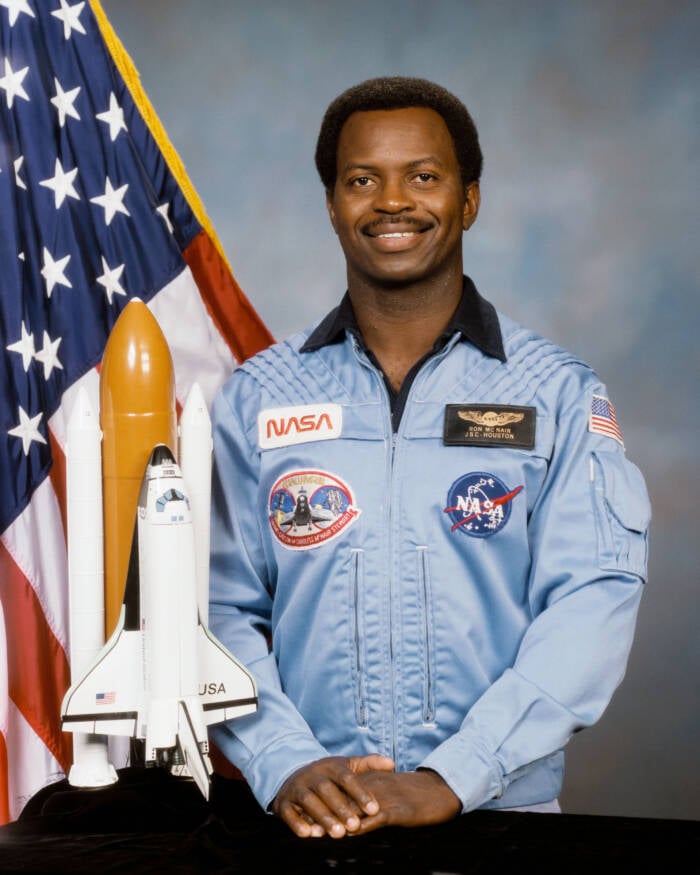
NASA/JSCRonald McNair made his first space voyage in 1984, becoming the second Black American in space. On Jan. 28, 1986, millions of Americans turned on their TVs to watch the launch of the Space Shuttle Challenger. But shortly after the shuttle lifted off, what should have been a jubilant moment turned to horror when the Challenger exploded. All seven astronauts aboard were killed, including 35-year-old mission specialist and physicist Ronald McNair.McNair, the second Black astronaut to go to space, was also a father of two, a black belt in karate, and saxophone player in fact, hed been hoping to record the first piece of original music in space during the mission. But perhaps the most impressive thing about McNair was how he fought racism in his youth to become a well-respected physicist and astronaut. This is the remarkable story of Ronald McNair, the Black physicist who sadly perished during the Challenger disaster. From The Jim Crow South To Physics At MITBorn on Oct. 21, 1950, Ronald McNair grew up in the Jim Crow South. He spent his childhood in the segregated town of Lake City, South Carolina, where his mother taught high school and his father was an auto body technician. The family was poor, without electricity or running water, and McNair made extra money picking cotton. I gained qualities in that cotton field, he later said. I got tough. I learned to endure. I refuse to quit.McNair was also curious and intelligent from a young age. According to reporting from The New York Times in 1986, McNair was able to read words by the age of three. When he was a little older, he decided he wanted to learn more about science, and walked a mile to the local public library.MIT Black HistoryRonald McNair as a grad student at MIT in the 1970s.But the white librarian told McNair that he wasnt allowed in the library and ordered him to leave. When he refused, the librarian called the police, who told the librarian, Why dont you just give the kid the books?As a teenager, McNair also began watching Star Trek. His brother Carl explained in an interview that McNair was inspired by the shows multiracial cast, which made it seem possible for a Black man to become an astronaut.Star Trek showed the future where there were black folk and white folk working together, Carl McNair recalled to Storyful in 2013. That motivated Ronald to become an astronaut.After Ronald McNair graduated as the valedictorian of his high school class, he set a goal for himself to get a Ph.D. in 10 years. He soon earned a physics degree at North Carolina Agricultural and Technical State University, and went on to earn a Ph.D. in physics from MIT at the age of 26. McNair became a research scientist at Californias Hughes Research Laboratories. And in 1978, McNair applied to NASA as an astronaut candidate.Ronald McNair, The Second Black Astronaut In SpaceNASA received over 8,000 applicants for its astronaut program, and chose just 35 people. McNair was one of them.The 1978 class at NASA broke records. In addition to Ronald McNair, the group included Sally Ride, who would become the first American woman in space, and Guion Guy Bluford, the first Black astronaut.NASANASAs 1978 class included Ronald McNair, Guion Bluford, and Fred Gregory.Once he joined NASA, McNair spent a year in the training program. His first space flight launched on Feb. 3, 1984, making McNair the second Black astronaut to go to space. He was in charge of deploying communications satellites and flight testing the Manned Maneuvering Unit. While in orbit, McNair also memorably played his saxophone.NASADuring his first space mission, Ronald McNair played the saxophone. He also brought his instrument on the Challenger. An experienced astronaut, Ronald McNair had spent 191 hours in space when he was selected for the Challenger mission in 1986. How Ronald McNair Died During The Challenger DisasterIn addition to Ronald McNair, the crew of the Challenger also included Ellison Onizuka, the first Japanese-American in space, and Judith Resnick, the second American woman in space. Astronauts Gregory Jarvis and Michael Smith were also part of the crew led by mission commander Francis Scobee, and a teacher named Christa McAuliffe had also joined the mission as part of President Ronald Reagans Teacher in Space Project.Getty ImagesRonald McNair was one of seven people chosen for the Challenger mission. The Challenger was set to take-off on Jan. 28, 1986, but Ronald McNair had a bad feeling about the launch, and shared his doubts with his brother Carl.[Ronald] said, The weather is not looking good and things are icing up,' Carl recalled, according to the Keene Sentinel. I dont think we are going to launch.'However, the Challenger launch went forward despite the near-freezing temperatures. And, 73 seconds after take-off, the shuttle exploded. Corbis/VCG/Getty ImagesThe seven-person crew of the Challenger walking to the launchpad. As it got higher and higher, the solid rocket booster started to veer off, and I didnt know how I knew. But I knew they were gone, Carl said. I stood there with tears streaming down my eyes, saying Oh my God, oh my God what so many people were saying in unison around the world.All seven members of the crew died.A later investigation pointed to a faulty O-ring, damaged from the cold temperatures. NASA had been warned about the potential for disaster by multiple engineers but had sadly ignored the warnings. The Remarkable Legacy Of The Worlds Second Black AstronautRonald McNair was 35 years old when he died. He left behind a wife, Cheryl, and two children, Reginald and Joy.After McNairs death, Congress created the Ronald E. McNair Post-Baccalaureate Achievement Program to support low-income, first generation, and underrepresented students attending doctoral programs. McNairs family also founded the DREME Foundation to bring STEM education to schools. National ArchivesRonald McNairs family created a foundation to bring STEM programs to schools. As for the library that once refused to let nine-year-old McNair check out books? Its now home to the Ronald E. McNair Life History Center. After reading about the impressive life of Ronald McNair, the Black astronaut and physicist who sadly died during the Challenger disaster, discover the story behind the Soyuz 11 disaster, the failed Soviet response to the Moon Landing. Or, look through these stunning images of outer space that were taken by the Hubble Space Telescope. The post The Story Of Ronald McNair, The Pioneering Black Astronaut Who Died In The Challenger Disaster appeared first on All That's Interesting.
0 Kommentare
0 Geteilt
40 Ansichten

 English
 Arabic
 French
 Spanish
 Portuguese
 Turkish
 Dutch
Dutch
 Italiano
 Russian
 Romaian
 Portuguese (Brazil)
 Greek
Greek