


ALLTHATSINTERESTING.COM
The Heartbreaking Story Of David Kirby And His Deathbed Photo That Transformed How The World Viewed AIDS Patients
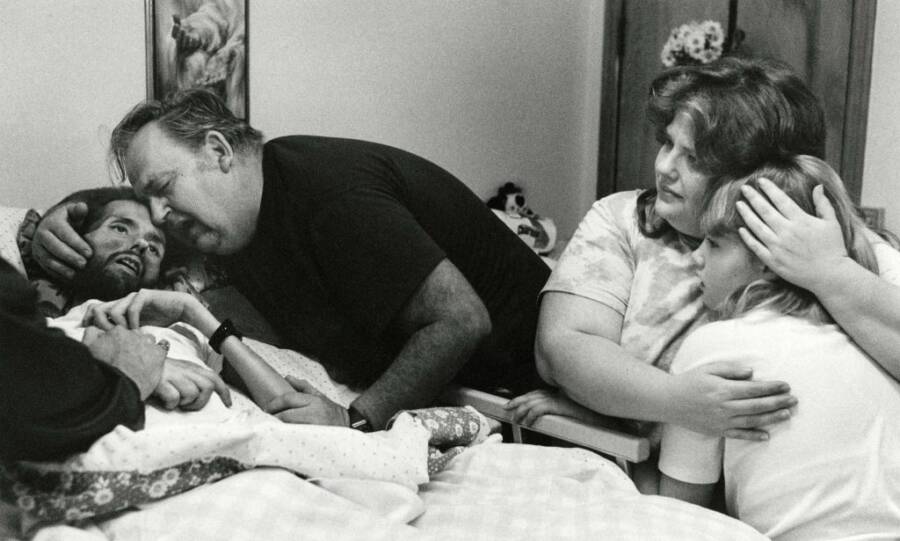
Therese FrareDavid Kirby, near death, lies in bed with his family by his side. May 5, 1990.In November 1990, a gaunt, dying man appeared in the pages of LIFE magazine. His name was David Kirby.Kirby had been a fierce AIDS activist in the 1980s and then he was diagnosed with HIV. He was in the final stages of the disease in the spring of 1990 when journalism student Therese Frare began photographing his battle with AIDS.That May, Frare captured a photo of Kirby on his deathbed surrounded by his loved ones. He died shortly after it was taken, and his familys grief was palpable through the haunting black-and-white snapshot.And when LIFE published the photo in November, the image and the tragic tale behind it revealed the true devastation of the AIDS epidemic. This is the story of David Kirby, the man in the picture that changed the face of AIDS.The Short But Impactful Life Of AIDS Activist David KirbyDavid Kirby was born in 1957 and raised in a small town in Ohio. As a gay teenager in the 1970s, he found life in the Midwest difficult.Kirbys family reacted negatively after he revealed his orientation to them. With his personal relationships strained and no obvious way forward for him in Ohio, Kirby set off for the West Coast at 18 and settled into life in the gay scene of Los Angeles. He fit in well there, and he soon became an activist for the queer community, attending rallies and protests to support gay rights.Unfortunately for David Kirby, and for millions of others, Los Angeles gay scene was an epicenter of the burgeoning HIV/AIDS epidemic. The first scientific description of what we now call AIDS was published as a series of case studies of Los Angeles residents who were treated at the UCLA Medical Center.Therese FrareDavid Kirbys mother holds a picture of him from about 10 years before his death, when he was a healthy young man.Kirby arrived in town just as the disease was taking off but before anybody knew what was happening. Its unclear when exactly Kirby was infected, but by the early 1980s, clusters of unusual cancers and respiratory illnesses were cropping up among gay men in every major city in America.By the late 1980s, Kirby had been diagnosed with HIV. Without effective treatments or even a clear idea of how the virus was killing its victims, the disease was a death sentence and a swift one, at that. Most patients passed away within a few years of the onset of symptoms.Kirby decided that he wanted to die at home, and he reached out to his family to ask if he could come back to Ohio. His loved ones greeted him with open arms but not everyone did.Unraveling The AIDS MythUpon his return to the Midwest, David Kirby underwent treatment at a local hospital. However, healthcare workers in his small town were terrified of him. Medics burned everything in the ambulance that transported him to the hospital, and staff members who brought food menus around to admitted patients wouldnt let Kirby touch the paper, instead reading him his choices from the doorway.Therese FrareDavid Kirby in hospice care shortly before his death.It was humiliating and degrading, Kirbys mother, Kay Kirby, told The Seattle Times in 1992, like he was a leper and nobody wanted to be near him. We just tried to let him know we were here for him.AIDS was widely misunderstood at the time. People thought they could contract the disease simply by touching a patient, and the general lack of knowledge sparked panic in the general public. For instance, around the time of Kirbys diagnosis, an Indiana middle school student named Ryan White was expelled from school after a blood transfusion left him HIV-positive. Perhaps as a result of this stigma, funding was shamefully deficient in the early stages of the epidemic, and activists worked both to dispel the myths and fears surrounding HIV/AIDS and to encourage more support for research. They also tried to fight absurd public health measures, such as barring children from school and, in at least one case (presented in all seriousness in a 1986 New York Times editorial by William F. Buckley), tattooing a warning onto the buttocks of known AIDS patients.Therese FrareDavid Kirby on his deathbed surrounded by his caregiver Peta, father Bill, and sister Susan.In this atmosphere of fear and borderline superstition, Kirby and other AIDS activists gave lectures, wrote articles, and appeared on television to reach as many people as they could in their attempts to demystify the illness and encourage empathy for the people suffering from it.But it was a deathbed photo of David Kirby that did more for the cause he was so passionate about than any of his actions during his lifetime.The Picture That Changed The Face Of AIDSBy 1989, Kirbys condition had worsened to the point that his family could no longer care for him at home. He checked into the Pater Noster House, a hospice facility for AIDS patients in Columbus, Ohio.One of the caregivers there was an HIV-positive volunteer named Peta. The two became close friends, with Peta often visiting Kirby even when not on duty. Then, in the spring of 1990, journalism student Therese Frare started shadowing Peta. With the permission of Kirby and his family, Frare began documenting Kirbys rapid decline.Therese FrarePeta caring for David Kirby at Pater Noster House.From the beginning, Kirby gave his enthusiastic consent to the photos. As an activist, he believed that an accurate photographic record of his death would humanize the AIDS crisis and help people whod never seen the disease to empathize with patients. His only condition was that Frare not personally profit from the photos.Over the weeks that she visited the hospice facility, Frare shot several rolls of film that captured Davids end-of-life health struggles, his familys grief, and the tender care he received from Peta.On May 5, 1990, Peta and Frare were with other patients when they received word that 32-year-old Kirby was dying. His family had gathered by his side, and they invited Frare in to document David Kirbys final moments.Frare took up a discreet spot in the corner of the room and began snapping photos. One of her final shots captured an emaciated Kirby staring off into space as his father cradled his head, crying in anguish, and his sister and niece held each other nearby. Frare submitted the photo to LIFE, and it was published in the magazines November 1990 issue. The image gained international fame, particularly after it was featured in an advertising campaign for the clothing company United Colors of Benetton in 1992.Therese Frare/BenettonThe United Colors of Benetton ad featuring David Kirbys deathbed photo.Many AIDS activists criticized Kirbys family for allowing the ad, but Kay Kirby told The Seattle Times, Its what David would have wanted. You can see the family anguish, and people need to know this is reality.Barb Cordle, another volunteer at Pater Noster House, agreed. David wanted to put a face on AIDS, she said. The picture has done more to soften peoples hearts on the AIDS issue than any other I have ever seen. You cant look at that picture and hate a person with AIDS. You just cant.After reading about David Kirby and the picture that changed the face of AIDS, discover the true story of the woman behind Dorothea Langes famed Migrant Mother photograph. Then, learn how photojournalism cost Kevin Carter his life.The post The Heartbreaking Story Of David Kirby And His Deathbed Photo That Transformed How The World Viewed AIDS Patients appeared first on All That's Interesting.
0 Commentaires
0 Parts
22 Vue

 English
 Arabic
 Spanish
 Portuguese
 Deutsch
 Turkish
 Dutch
Dutch
 Italiano
 Russian
 Romaian
 Portuguese (Brazil)
 Greek
Greek