The Vessels That Changed the History of Naval Warfare
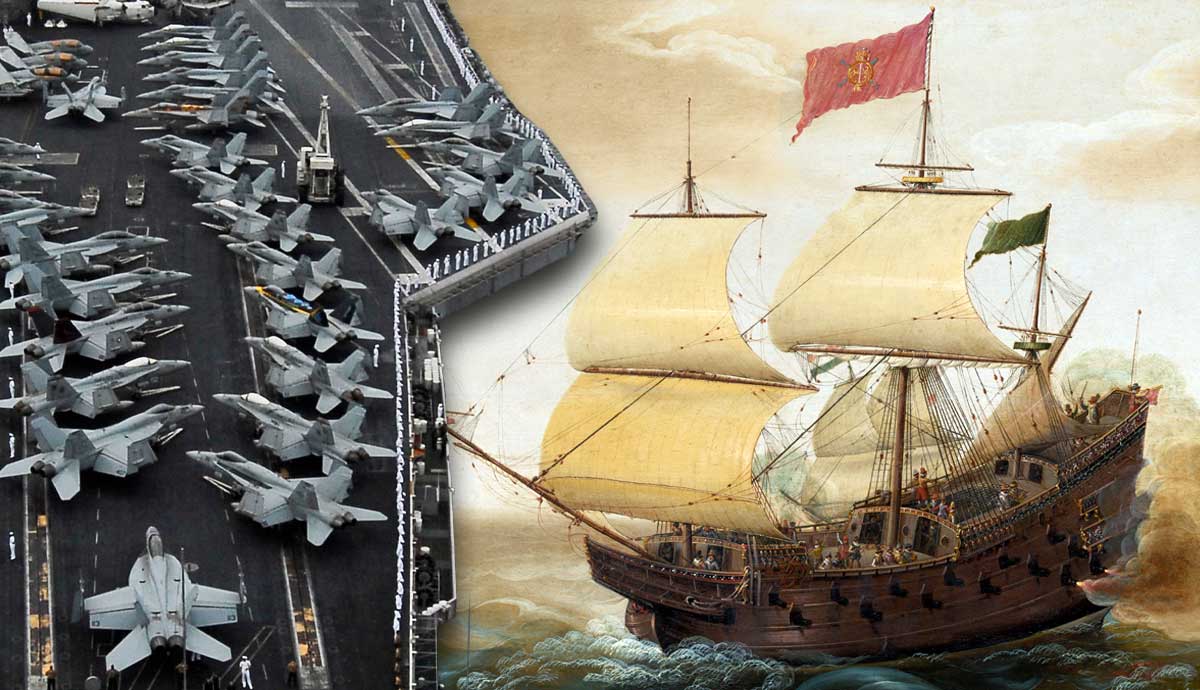
The USS John C. Stennis and Spanish Galleon Firing Guns. Source: National Gallery of ArtThe race is a constant competition of building a better ship than your opponent. That edge could be in guns, armor, displacement, or engines. Gaining that edge did require sacrificing one of those points. Why? Because theyre weighty. Yet sometimes a design appears that forces a complete rethink, an operational change, or a sudden interruption.Changing the Medieval GameOlympias; a reconstruction of a Greek trireme, 1987, via Hellenic NavyIn the Classical Period, oar power ruled the waves. Heavily crewed Greek or Roman triremes dominated the Mediterranean. Imperial Romes fall changed all that. Sail superseded oars, especially in northern Europe. From the north came the Viking longship. This distinctive ship meant fear, as Viking warriors would not be far behind. Norse builders constructed these shallow-hulled vessels for surprise, speed, and reach.Longships proved superb in slipping up rivers, often deep inland. Vikings used the longship to glide along coastlines or beach themselves, foiling any pursuers. This ease of mobility allowed Viking raiders to strike targets of their choosing, giving them a psychological edge. No one knew where or when raids would occur.The longships clinker-built hull (overlapping boards for strength) carried the Vikings in all directions. Whether sailing to Great Britain, Greenland, or big Russian rivers, the Viking longship showed what a great naval design could do.From Coastal Efforts to Empire BuildingA Spanish galleon, via fundacionnaovictoria.orgAs the Middle Ages progressed, so did naval ship designs. Eventually, the Age of Exploration (1400s-1600s) and the Age of Sail (1570-mid 1800s) brought change. Gradual improvements meant better ships. As such, the first galleons came into use around 1570. These true-blue watercraft helped Portugal and Spain become world powers, building massive empires.Galleons performed a dual role in war and commerce. As an imperial backbone, the galleon brought wealth and goods to Europe. As a warship, the galleons speed, better sail arrangement, and broadside style gun arrangement made it a formidable opponent. Their broadsides devastated opponents trying to ram or board galleons.European powers, especially Spain, used the galleon for 150 years. Other countries with large commercial fleets, like England and the Dutch, copied the tried-and-true galleon design.The Industrial Age Creates a Naval ChangeThe CSS Merrimac and USS Monitor in 1862. Source: DM Digital MuseumFor centuries, wood and sail dominated ship construction. Starting in the 1850s, industrialization radically changed naval warfare. New technologies, like steam power and iron armor, made current navies obsolete, sparking an international arms race.These ironclads first referred to iron-covered or armored ships in the 1850s. This later evolved into true ironclads, as during the American Civil War. The first real ironclad battle occurred on March 8th and 9th, 1862, off Hampton Roads, Virginia. Though the U.S. Navy knew of the CSS Virginia, the Confederate ironclads effectiveness stunned them. The Virginia eliminated two warships and damaged a third on March 8th. The era of wooden warships officially ended.On March 9, the U.S. Navys response was the USS Monitor. Designed, built, and launched in 118 days, the Monitor had a low freeboard and a revolving twin-gun turret.The epic, point-blank clash between the two lasted three hours. Despite numerous hits, each boats armor prevented major damage. The inconclusive fight was a Union tactical victory-the blockade continued.Dreadnoughts As the Next StepThe HMS Dreadnought. Source: WikimediaNaval warfares next step came with the HMS Dreadnought. Launched in 1906, this new battleship type represented another break. Steam turbines and an all-big-gun armament design rendered previous mixed-caliber armament warships obsolete. Instead of four guns, the Dreadnought carried ten 12-inch guns in five twin turrets. The ships name even became a dictionary term for a 20th-century battleship!This arrangement maximized the Dreadnoughts broadside. Eight of the ten guns could be brought into use at any time, double that of any contemporary opponent. Like the ironclad, Dreadnought sparked an arms race in Europe, plus the Big Gun Era. For decades, the number of battleships reflected a nations big power status.Power Projection and DominanceUSS John C. Stennis. Source: U.S. NavyWorld War II would significantly change naval warfare, ending the battleships reign. The carrier-based attack of December 7, 1941, with the Pearl Harbor attack, sank 8 battleships. The following battles of Coral Sea and Midway happened hundreds of miles apart; neither fleet sighted the other. No gunfire was exchanged.Aircraft carriers first appeared during the Great War. During the interwar years, all the major sea powers experimented, especially the Imperial Navy. At these battles (and the 1940 Taranto attack), the smaller, cheaper airplanes controlled the battle. Carriers represented power projection, capable of attacking hundreds of miles away. Losses could be high, but still cheaper. Now, armor and firepower mattered less. And like the HMS Dreadnought, carriers started an arms race that continued post-war.




 English
 Arabic
 French
 Spanish
 Portuguese
 Deutsch
 Turkish
 Dutch
Dutch
 Russian
 Romaian
 Portuguese (Brazil)
 Greek
Greek