


WWW.THECOLLECTOR.COM
Why Did the Visigoths Sack Rome?
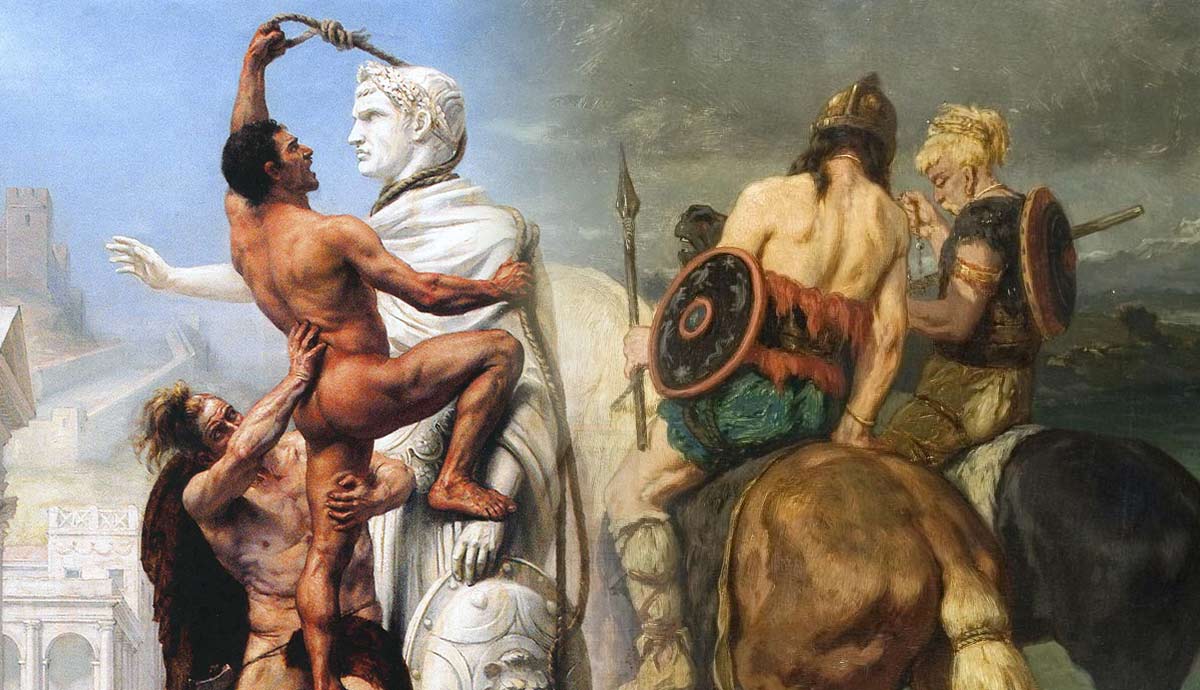
Rome has been sacked numerous times during the long course of its existence. At the beginning of the 5th century CE, it became the target of the Visigoths. How and why this happened were not simply the result of greedy barbarians, but the culmination of severe political drama, unfulfilled promises, and intense feelings of injustice and resentment.The Goths and RomeGoths cross a river by variste Vital Luminais (1821-1896). Source: Wikimedia CommonsThrough several centuries of contact with the Roman Empire, the Goths, a Germanic people, were one of several groups of people, beyond Romes northern border, who progressed culturally, economically, and technologically as a result of Roman influence. They werent, as the popular imagination might suggest, a horde of unwashed, illiterate, and greedy barbarians. Nor were they hell-bent on war and destruction.In the third century CE, the Goths started launching intermittent invasions of Roman territory, driven by economic need as well as the opportunity to take advantage of a Roman Empire weakened by political crises. In 238 CE, a Dacian tribe called the Carpi razed the town of Histria at the mouth of the Danube, marking the start of a new era of relations between Rome and the people considered barbarians. Pressure from tribes in this region, including the Goths, began pushing the limit of Roman control.In 251 CE, at the Battle of Abritus, the Romans were soundly defeated, and Emperor Decius as well as his son, Erennius Etruscus, were killed by a Gothic-Scythian coalition. In 267 CE, the Goths and their allies, including the Heruli, raided down the western Black Sea coast and the Aegean, entering Greece and sacking towns and cities, including Athens, Corinth, Argos, and Sparta. The following year (or perhaps 269 CE), the Romans dealt a catastrophic blow to the Gothic invasion at the Battle of Naissus.Bust of either Valens or Honorius. Source: Wikimedia CommonsThe second half of the fourth century brought major turmoil in the form of the Huns. Hoping to escape the wrath of this powerful enemy, a Gothic tribe, the Thervingi, asked to settle within the borders of the Roman Empire. Emperor Valens of the Eastern Roman Empire approved this, as the Goths could provide a source of recruitment for his armies.However, disaster struck in the form of famine. The Romans refused to give the Goths food or land, and instead forced them to trade their children to avoid starvation. The Romans treated the Goths terribly and refused to live up to their agreement. Justifiably, the Goths revolted. The Gothic War of 376 to 382 CE ensued. At Adrianople in 378 CE, the Goths (the Thervingi and Greuthungi), along with their Alan allies, won a stunning victory against the Romans, in which Emperor Valens was killed.The terms Ostrogoth and Visigoth were later inventions, but it was around this time that a separate identity was forged. The Thervingi formed the core of what became known as the Visigoths, while the Greuthungi formed the core of what became known as the Ostrogoths. There were, however, many Greuthungi who formed part of the Visigoth group, so the distinction isnt clear-cut.The Rise of AlaricThe Battle of Frigidus by Johann Weikhard von Valvasor (1641-1693). Source: Wikimedia CommonsInto this dynamic, a Thervingian boy named Alaric grew up, often spending time with veterans of the Battle of Adrianople. It is suggested he was born around 370 CE, so he would have been 12 at the time of the battle. This is, however, not known for sure.Roman campaigns against the Goths slowed in 382 CE with a peace treaty, the first foedus, between Rome and the Gothic tribes. By the terms of this treaty, in exchange for peace, the Germanic tribes in the region were to provide troops to fight for the Roman army in separate units. Despite the treaty, the relationship between the Romans and the Goths was still volatile, and it is possible that Alaric had taken military action against the Romans in his younger days.Nevertheless, Alaric eventually joined the Romans and rose through the ranks to become a renowned and well-respected military leader, although his primary motivation was the well-being of his people. In this, his service to Rome was a means to an end. In 394 CE, at the Battle of Frigidus, Alaric led the Visigoth contingent of around 20,000 soldiers, fighting for Emperor Theodosius against the rebel Eugenius. Theodosius used the Goths to overwhelm the enemy lines, suffering huge casualties in the process. Having been used in such a callous tactic, Alaric and the Visigoths were demonstrably angered.Alaric receiving gifts from Athenians, an illustration from The story of the greatest nations, from the dawn of history to the twentieth century : a comprehensive history, founded upon the leading authorities, including a complete chronology of the world, and a pronouncing vocabulary of each nation by Edward Sylvester Ellis and Charles F. Horne. Source: Flickr/Wikimedia CommonsIn 395 CE, after the death of Emperor Theodosius, Alaric left the service of the Roman army, citing Romes lack of commitment to the subsidies that were promised to his tribe. He was elected the king of the Visigoths and led his people on a campaign wherein he raided the eastern provinces and even marched on Constantinople, where he was diverted by Roman forces. Alaric then took his forces into Greece in 396 CE and sacked several cities, including Corinth, Megara, Argos, and Sparta. Athens was spared after a ransom was paid by the inhabitants.The Goths in ItalyAlaric, illustrated in the Calleja Rodrguez-Navas encyclopedic Spanish dictionary 1909. Source: Wikimedia CommonsRome recognized the severe danger posed by Alaric and moved their capital from Rome to Ravenna, which was more defensible, in 402 CE. Later in the year, Alaric and his Visigoths invaded the Italian Peninsula, but were driven back by an army led by the famed general, Flavius Stilicho, at the Battle of Pollentia. According to the poet Claudian, who wrote as a propagandist in favor of Stilicho, Alarics wife and children were taken hostage, and much of his amassed plunder was seized. Alaric was again defeated at Verona.Four years later, another Gothic leader, Radagaisus, invaded Italy and was stopped, again by Stilicho. Around this time, Stilicho agreed to recognize Alarics title of magister militum (originally bestowed by the Eastern Roman Emperor Arcadius in 397 CE), the highest military rank in the Late Roman Empire. This was done in a bid to gain Alaric as an ally against other barbarian threats that Stilicho faced. The recognition given by the Eastern Roman Empire to Alaric was not readily accepted by the Western Roman Empire due to the fact that Alaric was, after all, a barbarian. Stilicho believed in working with this reality rather than rejecting the notion of recognition altogether.Alaric was promised a subsidy of 4,000 pounds to supply his army, but this was rejected by the senate. In response in 407 CE, he threatened to invade Italy, and he was bought off by Stilicho, who was pressed on other fronts, and who paid him the full amount (payment was finalized in 408 CE). A year later, Stilicho, who favored negotiating with Alaric, was murdered. This left the door open for forces hostile to Alaric and his Goths to take control.An ivory carving, possibly representing Stilicho. Source: Wikimedia CommonsEmperor Honorius, who had ruled under the regency of Stilicho, came under the heavy influence of his minister, Olympius, who was fervently against the Goths and was likely the one responsible for convincing Honorius to kill Stilicho. He was, however, part of a broader anti-barbarian movement in the senate who feared Stilicho was siding with the Goths, in part due to his Vandal descent. With Stilicho gone, not only did Alaric lose legitimacy and hope for a negotiated settlement, but the Romans lost their most capable general.Suspecting foederati (Barbarian soldiers who fought for Rome) troops to have been in league with Stilicho, Olympius men massacred their families, and the foederati that were loyal to Rome instead rallied around Alaric. In 408, they marched on Rome and enforced a blockade, starving the citizens. The Roman citizens eventually paid a huge ransom, including the release of 40,000 Gothic slaves who then joined Alaric.Over the following year, Honorius reneged on the deal he made with Alaric for lifting the blockade on Rome. Alaric responded by declaring a new emperor, Attalus, and refused to accept the legitimacy of Honorius.Despite this development, Attalus proved a hindrance to Alarics plans, and the latter deposed him and opened negotiations with Honorius again. This period of negotiation, however, was interrupted by an attack from a Gothic-born general named Sarus on Alarics men. The cause of this is unknown, but Sarus was an opponent of Alaric, and Alaric assumed the order came from Ravenna, and decided to march on Rome again.The Sack of RomeThe Sack of Rome in 410 by the Barbarians by Joseph-Nol Sylvestre (1847-1926). Source: Wikimedia CommonsOn August 24, Alaric and his army of 40,000 entered Rome by the Salarian Gate, opened, according to some sources, by treachery. Over the course of the next three days, Rome was pillaged, but considerable constraint was shown. Alaric, a Christian, spared the churches and those seeking refuge inside. Instead, the Goths focused their attention on looting pagan temples and the homes of the rich. The wealthy citizens were the main target; the Aventine was a chaotic spectacle as the Goths and their allies scoured homes, taking whatever riches they could find. Some public buildings were also burned, although this did not characterize the overall nature of the sacking. After three days, the Goths marched out of Rome, heavy with plunder and captives.Compared with other sackings of Rome, the one led by Alaric was relatively mild, yet it had profound implications on history, marking a significant point in the decline of Rome and the shift towards the Middle Ages.The Aftereffects of the Sack of RomeThe burial of Alaric in the bed of the Busentinus by Heinrich Leutemann (1824-1904). Source: Wikimedia CommonsAlarics campaign didnt end with the capture of Rome, and he continued his march down the Italian Peninsula. He planned to take his army to Roman North Africa, but he died of an illness shortly after entering Calabria and was apocryphally buried in the Busentinus River. Surviving the death of their leader, the Visigoth army migrated to Spain, marking the start of the Visigoth Kingdom in the Iberian Peninsula.An apocryphal story from the 6th-century historian Procopius of Caesarea states that when Honorius was informed that Rome had fallen, he misunderstood this to mean his pet chicken, Roma, had died. When he learnt the truth that it was, in fact, the city, Honorius breathed a sigh of relief. The veracity of this anecdote is questionable, but it does highlight the perceived image of Honorius as weak and ineffectual. Of note was the capture of his sister, Galla Placidia, who was taken into Gothic custody before the fall of Rome. She became the wife of Alarics half-brother Ataulf, who succeeded Alaric and later entered into an alliance with Honorius.This was the second time Rome was sacked, but it was the first in eight centuries. In some ways, it could be seen as the beginning of the end for the Roman Empire. It brought the realities of the declining Roman world to the fore, and over the course of the next few decades, Rome would be sacked twice before the Roman Empire ceased to exist as a formal entity in 476. Alarics actions were, in many ways, a sign of the changing times.
0 Kommentare
0 Geteilt
14 Ansichten

 English
 Arabic
 French
 Spanish
 Portuguese
 Turkish
 Dutch
Dutch
 Italiano
 Russian
 Romaian
 Portuguese (Brazil)
 Greek
Greek