


WWW.THECOLLECTOR.COM
9 Largest Armies That Shook the Medieval World
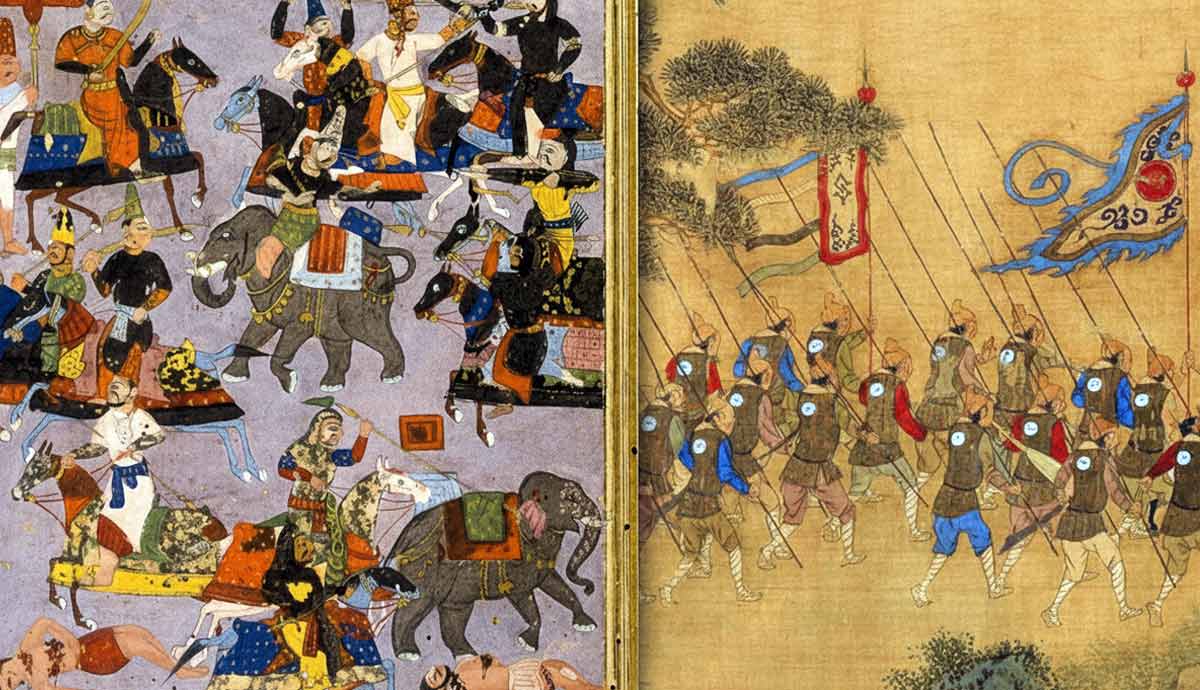
Although standing armies were rare in the medieval world, certain empires had the administrative capacity to maintain large military forces to defend against foreign threats, preserve law and order, and expand their realms through conquest. The largest armies in the medieval world came from empires in China, India, the Middle East, and Eurasia.1. Song Dynasty, ChinaMap of the Northern Song Dynasty. Source: Wikimedia CommonsSimilarly to the other Chinese dynasties, the Song dynasty (9601279) relied on quantity over quality. By the 1000s, Song emperors had over 1,000,000 men at their command, either garrisoning the kingdom or ready to march to battle. The cost of maintaining this force was enormous; some reports indicate that close to 80% of the state budget was used paying for equipment and salaries. The force was overwhelmingly composed of infantry, limiting its mobility. Additionally, Song emperors were afraid of generals rebelling against the dynasty and limited their authority.Internal chaos ate at the professionalism of the army and led to territorial losses at the expense of the Jin and Mongol empires to the north. The formidable size of Song armies as well as superiority in naval warfare enabled it to hold off the northern conquerors until 1279, when Kublai Khan completed the conquest of China, eight years after proclaiming the foundation of the Yuan Dynasty.2. Ming Dynasty, ChinaChinese scroll depicting Ming infantrymen. Source: Wikimedia CommonsIt is a common myth that Revolutionary France was the first army to rely mainly on conscript soldiers. Centuries earlier, Ming China used a system of conscription called weisuo. This meant that every Chinese household had to provide at least one military-aged male to the army, who would also bring his own supplies. This meant that the Ming emperors could field a force numbering over one million, enormous for its time.Over time, the erosion of order within Ming China weakened this system and mercenaries became more commonly used than conscripts. Nonetheless, some documents from the 1500s indicate that they still fielded 850,000 men for combat duties. These forces dwarfed any army that could be raised by European states at the time, owing to Chinas large population and efficient administration.3. Tang Dynasty, ChinaDepiction of soldiers of the guard of honor from the Tomb of Princess Changle in the Zhao Mausoleum, 644. Source: Wikimedia CommonsThe Tang Dynasty in China relied heavily on a conscription system known as the fubing system. In the 7th century, the system created an army of 600,000 men to be used by Tang leaders, an enormous contingent in that period. Repeated rebellions and external threats meant that the army grew to close to one million, rivalling the armies of the Ming Dynasty. The force was overwhelmingly composed of infantrymen recruited from the peasantry.The conscript system was gradually replaced by the use of professional soldiers, whom Tang leaders considered more capable. Even by using these men in a full-time capacity, the size of the army remained substantial. Other Chinese dynasties emulated the Tang in their recruitment of men for military service and the maintenance of a large standing army.4. Byzantine Empire, MediterraneanThe Invitation of the Varangians by Viktor Vasnetsov, before 1913. Source: Wikimedia CommonsAt its peak in the 6th century, the Byzantine Empire controlled most of the Mediterranean, stretching from what is today Armenia to modern-day Portugal. This was thanks to the efforts of Emperor Justinian I, who was determined to rebuild the Roman Empire. His senior general, Belisarius, conquered Rome, much of North Africa, and parts of Iberia. These conquests revealed the prowess of the Byzantine military.The size of the Byzantine army fluctuated over time, but it is estimated that during the 6th century, Constantinople had 350,000 men under its command. Much of this force came from the former Roman army and included men from all over the empire. Its most elite force was the Varangian Guard, founded in the late 10th century CE and composed of Norsemen or Englishmen. As the empire contracted, Byzantine armies dwindled in size.5. Sasanian Empire, Middle EastSilver Bowl Depicting a King Hunting, Sasanian c. 4th-5th century CE. Source: The Smithsonian National Museum of Asian ArtBetween 224 and 651 CE, the Sasanian Empire maintained a formidable military force that enabled them to dominate areas across the Middle East and Central Asia. The exact size of the Sasanid armies is not known, but some scholars estimate that it was over 300,000 men across the empire. The elite forces of the empire included elephant-borne troops and Aswaran cavalry units. Over the years of the empires existence, it battled the Byzantines for control over the Levant and parts of modern-day Anatolia.Despite its armys large size, during the 7th century CE the Sasanian Empire faced the twin threats of the resurgent Byzantines under Emperor Heraclius, and the Arab conquests initiated by the Prophet Muhammad. In 651, the Sasanian Empire was destroyed by the Rashidun Caliphate.6. Vijayanagara Empire, IndiaIllustration of the Battle of Talikota which led to the fall of the Vijayanagara Empire, 1565. Source: Wikimedia CommonsRuling over the southern part of the Indian subcontinent, the Vijayanagara Empire boasted a formidable army, similar to other Indian medieval kingdoms. However, the exact size of its forces is not known. Foreign travelers, mainly from Europe, visited the Vijayanagara realm and made estimates of its armys size in their writings. Based on their accounts, historians estimate that the Vijayanagara Empires military had between 500,000 to 750,000 men available to fight if they went to war.The most professional component of the force was called the Kaijeeta Sainya and wasessentially a household guard. This force numbered in the tens of thousands. The mainstrength of the empires army came from recruitment by regional leaders callednayakas, who conscripted peasants for military service. This allowed for the deploymentof a large infantry-heavy conscript force.7. Umayyad Caliphate, Middle EastBattle of Tours by Charles de Steuben. Source: World HistoryThe Umayyad Caliphates army was only a little larger than the Rashiduns but was still sizable for its time. Like the Rashiduns, it relied heavily on light cavalry to make quick advances against its enemies. Much of the elite of the force came from Syria, while converts from conquered territories (such as Berbers) and slaves helped increase the size of the armys infantry component. The Umayyads suffered a similar fate to the Rashidun Caliphate as a result of internal divisions.The exact size of the army is not known exactly but is estimated to be in the tens or hundreds of thousands. The scale of the Umayyad conquests meant that the caliphs had to recruit a lot of fighters to maintain control. For instance, a major Berber revolt led to territorial losses, meaning that the Umayyads had to recruit a force of hundreds of thousands to defend their territory.8. Delhi Sultanate, IndiaMap of the Delhi Sultanate during the 14th century Tughlaq dynasty. Source: World HistoryFor over 300 years, the Delhi Sultanate dominated the Indian subcontinent in the Middle Ages. Its army was a formidable force dominated by a well-trained and well-equipped cavalry component that enhanced the armys maneuverability and speed. It also had the ability to deploy mangonels and mines to assist with its siege operations, enabling it to conquer major population centers in the subcontinent. Its ranks were composed of Central Asians, Indians, and Mamluk mercenaries.At its peak in the 14th century, the sultanate had close to 500,000 men available, mainly cavalry. It was able to defend its territory from the Mongols and launch expeditions into other parts of India and Asia thanks to its size and maneuverability. However, it suffered from internal chaos that led to its armys destruction and the conquest by the Mughals in 1526.9. Mongol Empire, EurasiaMongol Siege of Kyiv ca. 1240 from the Facial Chronicle (Illustrated Chronicle of Ivan the Terrible) by an unknown artist, 1560-1570. Source: State Historical Museum, MoscowWhen Genghis Khan first started his conquests, he had a small force of mounted men with him to seize population centers in East Asia. By the time his empire expanded, he had a formidable force numbering in the hundreds of thousands. Both forced and voluntary recruitment boosted the Mongol army and enabled them to continue their march westwards. However, a large part of the army had to be used to garrison captured territories on the way, leading to Genghiss force being diluted over time.Even then, the Mongols were still able to advance into Europe with a force of 150,000 men. Even more impressive was the fact that most of this force was composed of cavalry, meaning that they had to bring more supplies for both men and horses. Being mounted also doubled the distance the army could travel in a day. Their mobility anticipated the use of massed cavalry in European armies.
0 Commenti
0 condivisioni
15 Views

 English
 Arabic
 French
 Spanish
 Portuguese
 Deutsch
 Turkish
 Dutch
Dutch
 Russian
 Romaian
 Portuguese (Brazil)
 Greek
Greek