


WWW.THECOLLECTOR.COM
Weapons in the Bible and the Archaeological Evidence For Their Use
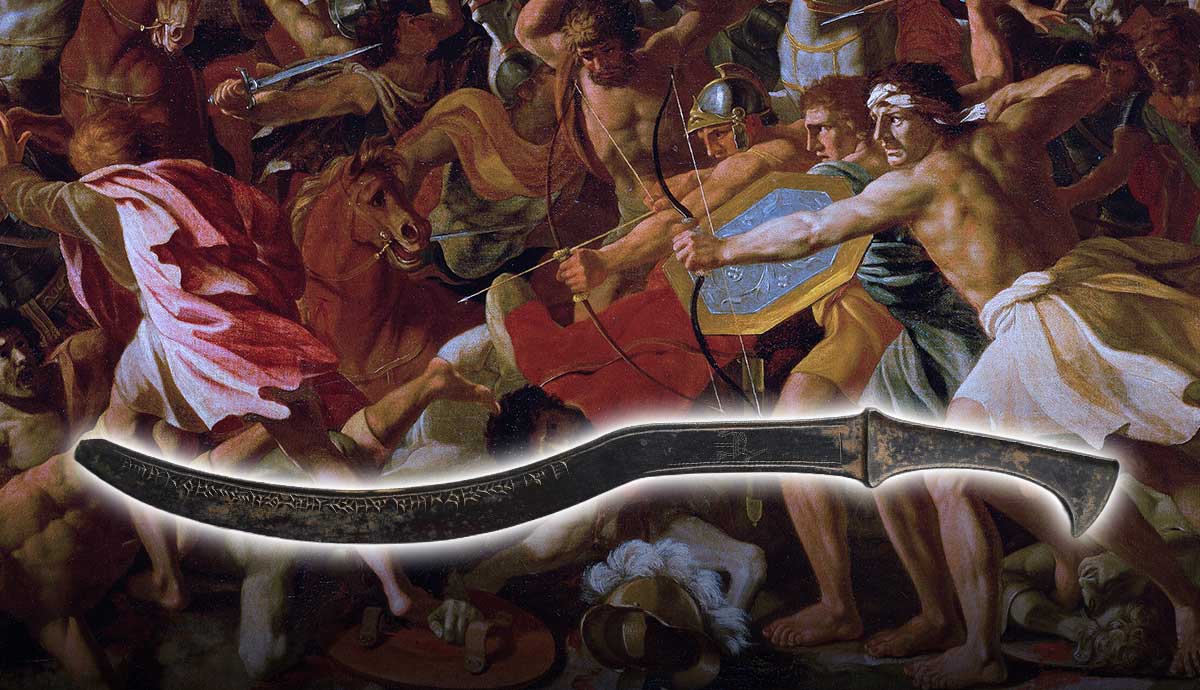
According to the Bible, the ancient Israelites frequently engaged in both offensive and defensive warfare. At times, God fights for Israel by manipulating the elements of nature, by confusing Israels enemies or, in some cases, by sending literal, embodied angelic beings to fight on Israels behalf. But most of the time, Israel used weapons like their enemies did.Between the Bronze and Iron AgesThe Victory of Joshua over the Amalekites, by Nicolas Poussin, ca. 162425. Source: Wikimedia CommonsHistorians of the ancient Near East often divide the approximately 3000 years BCE into two general eras: the Bronze Age (approximately 32001200 BCE) and the Iron Age (approximately 1200600 BCE). As their monikers suggest, a shift in metal refinement technology defines them. Biblical history includes both of these eras.Of course, the shift from a predominant use of bronze to iron did not occur at once across the ancient world, and the dates provided above only apply to the Mediterranean region, not the world as a whole. Even though iron was a far more common and easier metal to mine than the copper and tin of which bronze is made, iron requires a hotter temperature to reach its melting point. In addition, in order for it to become more durable than bronze, it must be carburized through a tedious forging process. Bronze Age furnace technologies could not reach the required temperature to melt iron, and even though iron tools were produced during the Bronze Age, these tools were not as easily shaped as bronze implements.Iron, thus, was not a discovery of the Iron Age; rather, the technology to effectively use iron was not widespread until around 1200 BCE. Importantly, the close of the Bronze Age is not defined merely by metallurgical technology; it was also a time of great convulsioneven collapseof civilizations throughout the Mediterranean world.Roundel with Joab Murdering Abner, ca. 151020. Source: The Metropolitan Museum of ArtAncient Israels monarchy did not begin until around 10501030 BCE, but stories of Israels invasion of Canaan are set in a time when the Bronze Age was still coming to a close. The battles in the Book of Judges would have occurred during the transition between these two eras. Thus, the Bibles battles take place at a time when civilizations that possessed effective methods of shaping iron were enjoying important military advantages.Did the Philistines Introduce Ironworking Technology to Israel?Triumph of King David, by Hendrick van Balen the Elder, ca. 15731632. Source: Wikimedia CommonsAccording to researchers studying the development of metallurgy by using samples from ancient artifacts, the revolution in metalworking technology that gave the Iron Age its name began around the Aegean Sea, where Greece and western Turkey are today. This is the area to which scholars believe the origin of the biblical Philistines may be traced. Samples of tools from Philistine cities in Israel suggest that they may have brought advanced iron weapons to the land of Israel.Iron weapons appear in the archaeological record in Israel-Palestine at least as early as the 12th century BCE. It should be noted that, unless Israel was able to exploit the lands of its immediate neighbors, it had little access to iron ore in their own soil. Israels nomadic history, along with its relatively limited access to essential metals, meant that, for much of Israels earliest activities in the land of Canaan, its most formidable opponents possessed weapons that were superior to their own.David Goes out to War, and Gains the Victory over Heathen Kings, in The Bible Panorama, by William A. Foster, 1891. Source: Wikimedia CommonsThe Bible hints at this disparity in weapons technology in several places. The text of Joshua, which relays Israels earliest years as a conquering nation, even mentions the fearful chariots of iron that some Canaanites possessed. Obviously, entire chariots could not be fashioned from iron. But iron is used in the Bible to evoke superior strength or indestructibility, and any use of the metal to reinforce war vehicles would be advantageous. Meanwhile, the earliest Israelites traditionally had no war vehicles at all.The Bible also suggests that the Philistines, Israels most protracted foe, were willing to sell iron farming tools to the Israelites but restricted access to iron weaponry. Iron weapons from this period tend to be concentrated in Philistine-controlled areas, which could be understood as corroborating the Philistine monopoly to which the Bible alludes. Indeed, it makes sense that the Philistines would not have wanted to arm their enemies!Chariots Dominated Battlefield Combat in Biblical TimesCylinder seal possibly from Syria, dating from the late Bronze Age. Source: The Metropolitan Museum of ArtWhile the sword often symbolizes force and violence in the Bible, many times it was chariots that gave an army a pivotal advantage in biblical battles. The strength of a standing army could be measured by the size of its cavalry and its number of chariots. However, chariots were unfit for guerrilla warfare, since they require flat ground to be effective, and numerous biblical examples suggest that guerrilla tactics were Israels strong suit.Trampling by hoof and the crush of chariot wheels, horrific as they sound, were likely a significant cause of casualties in ancient warfare. While handheld weapons and projectiles could certainly cause death, they more frequently maimed or merely started bleeding, which would only later be deadly. But an army of chariots and horses could decimate anyone in its path.Photograph of a statuette of a quadric with a warrior and charioteer from Cyprus, dating to the 6th century BCE. Source: The Getty MuseumThe Book of Deuteronomy, which is mostly legal material, prohibits Israelite kings from multiplying chariots due to their tendency to foster trust in military prowess rather than divine protection. Despite this law, King Solomon is said to have amassed a cavalry of 1,400 chariots and 12,000 horsemen. When God is imagined poetically as a warrior-savior in the Psalms, he is sometimes pictured as a charioteer.In several biblical stories, Gods favor on Israel is shown specifically in the thwarting of the enemys charioteering ability. Specifically, rainstorms and the mud they create could render even a large force of chariots useless, as in the story of the Egyptians who get stuck in the mud while trying to pursue the escaping Israelites across the Red Sea, or when Sisera and his Canaanite force is bogged to a standstill in the midst of a battle with Israel in the Book of Judges.Sword Styles in Biblical TimesThe Taking of the City of Jericho, by Antonio Tempesta, 1613. Source: National Gallery of ArtThe Bibles writers would have no reason to describe in detail an implement so familiar to their readers as a sword, so it is up to archaeologists to uncover what kinds of swords ancient Israelites may have used. The Bible mentions double-edged swords at times. This type of sword was common into the late Bronze and early Iron ages. They were around two feet, or 60 centimeters, long. These may have been introduced into the land of Israel by the conglomerate of migrant marauders often called Sea Peoples by historians, among whom are counted the Philistines.Later Roman swords, which were styled after Celtic design, were also sharp on both sides of the blade. These would later become all-too familiar in Israel during the Jews many violent interactions with Rome. The logic of weapon design is largely intuitive, so it is not always clear whether or not designs were borrowed, or simply appeared simultaneously in different cultural contexts. A short, double-edged blade that could be held in one hand would be a key asset in close-combat situations virtually anywhere.Photograph of a Sword from Egypt, dating ca. 15501458 BCE. Source: The Metropolitan Museum of ArtBut the swords used most by ancient Israelites may have been the so-called sickle sword, which were common in the Late Bronze Age. These had straight shafts coming from their handles, and then a crescent on the end.Photograph of an Assyrian sickle sword, dating from ca. 13071275 BCE. Source: The Metropolitan Museum of ArtThough similar to a sickle, they were sharpened along their convex edge. This style, called the khopesh, is associated especially with late Bronze Age Egypt, but specimens have also been found in the land of Israel. Charioteers used these to strike downward at infantrymen below them. The idea of smiting an enemy with the edge of the sword calls this type of weapon to mind.Spears, Javelins, and DaggersPhotograph of a bronze Minoan dagger, dating from ca. 16001450 BCE. Source: The Metropolitan Museum of ArtBecause a relatively large amount of metal is required to make a sword, daggers and spears may have been more common than swords in Israels arsenal. Archaeologists have uncovered many specimens of these, and they also appear frequently in the Bible. For example, the Israelite judge Ehud famously uses a short dagger to kill the Canaanite king Eglon. Abner, Sauls general, uses a spear to kill Asahel, one of Davids most renowned fighters.Photograph of Egyptian javelin shaft, dating from ca. 14791458 BCE. Source: The Metropolitan Museum of ArtThere are at least three words in the Hebrew Bible that refer to weapons composed of a stick with a sharp tip. Though sometimes used synonymously, these words often refer to separate items. The Philistine warrior Goliath, for example, carries both a javelin and a spear, or lance, into his fight with David. Basically, a javelin is intended to be thrown, while a spear or lance is not designed to leave the hand of the warrior. This was not, however, a strict rule for their use.The advantage of spears and javelins alike over swords and daggers was the distance they could put between a warrior and his enemy. The disadvantage, however, was that spears and javelins are designed primarily for thrusting or throwing; they were not as effective as swords for slashing or chopping, as is required in many close combat circumstances.Bows and Arrows Could Be Exceptionally AccuratePhotograph of Egyptian bow, dating from ca. 19421473 BCE. Source: The Metropolitan Museum of ArtBows and arrows appear in many places in the Bible as well, and archaeologists have uncovered vast numbers of arrowheads made from stone, iron, and bronze in the land of Israel. Jonathan, King Sauls son, famously used an arrow as a signal to David that David needed to flee Sauls wrath. King Ahab is killed in battle by a randomly shot arrow, and Jehu assassinates Ahabs son Joram with an arrow to the back. In a scene that evokes that of Robin Hoods final hour, the prophet Elisha instructs King Joash to shoot an arrow out of the window of the room where he lies dying as a symbol of Joashs coming victory over Syria.Photograph of Egyptian arrow points, dating from ca. 664525 BCE. Source: The Metropolitan Museum of ArtThe bow is a weapon ubiquitous across eras and throughout the world. Each culture modifies bow making technology to optimize available materials with the combat contexts in which the weapon would be used. For example, when range is most important, accuracy and agility may be compromised. A longer bow is difficult to wield atop a horse or from inside a chariot, but could be used effectively by infantrymen to launch arrows long distances or over walls.The goal of ancient warrior cultures was to develop the optimal design in consideration of the contexts and available materials. Most ancient Israelites probably made their own bows. There may have been far more variety in styles than the artwork available to archaeologists depicts.Photograph of an Egyptian arrow with a composite stone tip, dating from ca. 14791458. Source: The Metropolitan Museum of ArtThe Bible sometimes refers to bows made of bronze. This is a bit confusing, since bronze does not return to its original shape when bent. The bronze bow seems to be a metaphor for warrior-like strength. Bows with maximum resilience and strength throughout human history were usually made by combining a plant material like wood or bamboo with dried sinew, bone, or horn materials taken from animals.Slings and StonesPhotograph of Cypriot sling bullets. Source: The Metropolitan Museum of ArtBecause of the famous story of Davids standoff against Goliath, the sling and stone may be the weapon most readily associated with biblical combat. This primitive weapon, though sometimes understood as inferior and weak against bladed weapons of iron and bronze, was actually astonishingly deadly. In the hands of a skilled slinger, the flying stone can exceed 250 feet per second, which is as fast as arrows could travel.Unlike other, more sophisticated weaponry, the sling can be made easily and cheaply and the ammunition it requiresstonesare virtually everywhere. This meant that skill, not technology, mattered most in whether or not this weapon could be used effectively.David and Goliath, 1609. Source: Wikimedia CommonsLike the bow and arrow, sling and stone was a weapon used in cultures around the world in ancient times. There is evidence that slingers could be just as accurate as archers. A shower of golfball-sized stones launched even with moderate precision at excesses of 200 feet per second could be devastating for an attacking armyiron swords and spears notwithstanding. Sometimes these projectiles were fashioned from lead, which would have been even more destructive.Anything Can Be a Weapon in the Right (or Wrong) HandsThe Fall of Jericho, by Augustin Hirschvogel, 1540. Source: National Gallery of ArtSome biblical weapons were simply whatever was handy at the moment of attack. The Book of Judges tells of a time when Samson killed 1,000 Philistines with the jawbone of a donkey. In the same book, a warrior named Shamgar is said to have killed 600 Philistine soldiers with an ox goada mere staff. Jael, a woman in Judges, uses a tent peg to assassinate the Canaanite general Sisera as he sleeps, and an unnamed woman uses a millstone to assassinate Abimelech, the son of the Israelite leader Gideon, during Abimelechs attempted takeover of her city.Scenes of war in the Bible provide a window into combat methods and tools that were common in the ancient world. However, relative to those used by the vast and powerful empires that either enveloped Israel or hovered around its borders, Israels weapons throughout its history could never have been considered state-of-the-art. Israels, and later the Jews, astonishing ability to endure as a people group even as mighty empires rose and fell around them must be explained apart from martial skill or weapons technology.
0 Comments
0 Shares
24 Views

 Arabic
 French
 Spanish
 Portuguese
 Deutsch
 Turkish
 Dutch
Dutch
 Italiano
 Russian
 Romaian
 Portuguese (Brazil)
 Greek
Greek