


ALLTHATSINTERESTING.COM
The Tragic Story Of Korean Air Lines Flight 007, The Civilian Plane Shot Down In 1983
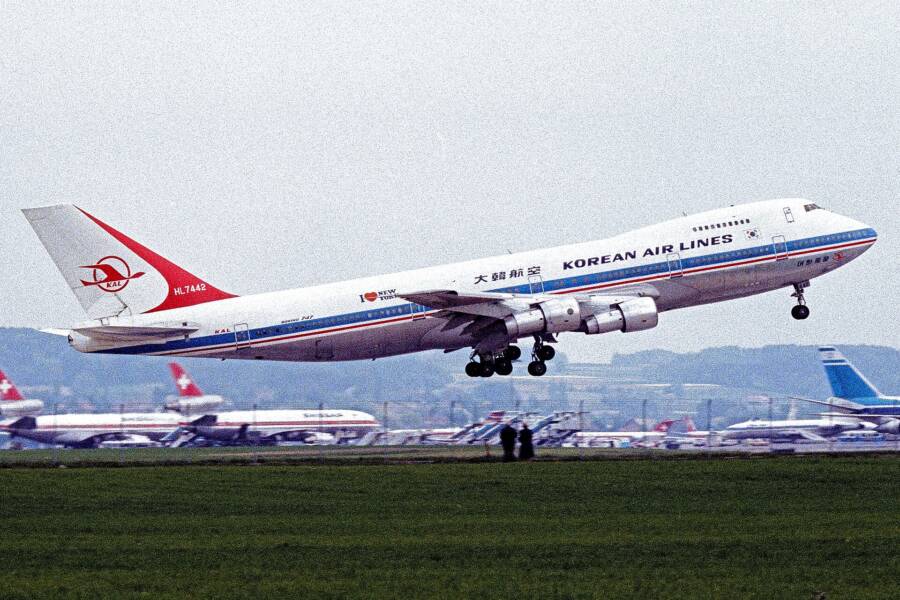
Mike Hoffmann/Wikimedia CommonsThe airplane involved in the Korean Air Lines Flight 007 disaster, pictured here in 1980.On Aug. 31, 1983, Korean Air Lines Flight 007 took off from New York City with 246 passengers and 23 crew members on board. It was bound for South Korea but it would never arrive.After a brief stop in Anchorage to refuel, the plane continued its journey across the Bering Sea. However, a navigational error sent it off its planned course and directly into Soviet airspace. As military forces in the U.S.S.R. watched the aircraft on radar, senior officials made the decision to shoot it down if it strayed into their territory again. So, when the plane crossed over Sakhalin Island, a Soviet pilot fired two air-to-air missiles. Korean Air Lines Flight 007 crashed into the Sea of Japan a few minutes later. There were no survivors.In the aftermath, the U.S.S.R. claimed that theyd thought the aircraft was a spy plane. However, U.S. President Ronald Reagan suggested that the incident was an intentional act of barbarism, adding fuel to the blazing flames of the Cold War.The Ill-Fated Journey Of Korean Air Lines Flight 007Korean Air Lines Flight 007 left John F. Kennedy International Airport shortly after midnight on Aug. 31, 1983. It landed as scheduled at Anchorage International Airport to refuel before continuing on to its final destination of Gimpo International Airport in Seoul.There were 246 passengers and 23 crew members on board, for a total of 269 people, including 22 children under age 12. U.S. Representative Larry McDonald was also on the plane, heading to Seoul to celebrate the 30th anniversary of the United States-South Korea Mutual Defense Treaty. The flight was supposed to follow a common path across the Bering Sea that took it south of Soviet territory and across northern Japan before landing in South Korea. Just 10 minutes after taking off from Alaska, however, it began deviating from its planned route, straying slightly to the north. Public DomainA flight map of Korean Air Lines Flight 007s intended route (dotted line) versus its actual path (solid line).Experts believe that the crew either failed to switch the autopilot into the proper mode or did so too late. Either way, nobody noticed that the aircraft was heading straight for Russias Kamchatka Peninsula. It was an error that proved to be fatal.The Soviet Union Shoots Down A Civilian PlaneKorean Air Lines Flight 007 entered Soviet airspace at a particularly precarious moment in history. Tensions were high between Moscow and Washington, D.C. A few months earlier, President Reagan had denounced the U.S.S.R. as an evil empire. Now, 269 passengers and crew members were caught in the middle of a geopolitical storm.Around 5:30 a.m. on Sept. 1, 1983 (the plane had crossed the International Date Line during its journey west), Flight 007 entered the restricted airspace surrounding the Kamchatka Peninsula. Soviet forces were carefully monitoring the radar because they were carrying out a missile test in the area. They were also aware that the U.S. Air Force had deployed an RC-135 military reconnaissance plane nearby.Public DomainU.S. Representative Larry McDonald was among the passengers on the doomed flight.As the passenger plane approached the peninsula, the Soviets sent four jets to intercept it, but the flight returned to international airspace before they could reach it. General Valeri Kamensky, Commander of the Soviet Far East District Air Defense Forces, then ordered the planes destruction if it was positively identified as a military aircraft. But General Anatoly Kornukov, who commanded the Sokol Air Base, was more aggressive with his assessment. He stated that since the plane had already entered Soviet airspace once, it should be destroyed if it did so again, even without proper identification.As reported by The New Yorker in 1993, Kornukov said, I am giving the order to attack if it crosses the state border.So, when Korean Air Lines Flight 007 flew over Sakhalin Island, Major Gennadiy Osipovich fired two air-to-air missiles from his Su-15 fighter jet. Whether one or both missiles made impact remains unclear, but the fate of everyone on board was sealed. The plane didnt explode immediately, though. Its descent into the Sea of Japan lasted several excruciating minutes, ending in a violent downward spiral that left no survivors.The Worlds Reaction To The Tragic AttackThe world awoke to shock and confusion on Sept. 1, 1983, as muddled details about the downed Korean Air Lines plane slowly emerged. Early reporting by The New York Times noted that the U.S.S.R. refused to acknowledge that theyd shot down the plane. Library of CongressMembers of the Korean Association of New York read a New York Post article about the downed aircraft. Sept. 1, 1983.However, President Reagan called the attack a horrifying act of violence and demanded an explanation. Moscow initially stayed silent on the matter, but Soviet officials soon responded with a narrative of their own: The U.S.S.R. claimed that the apparently unidentified aircraft had deliberately provoked Soviet defenses and appeared to be involved in U.S. espionage in enemy airspace, forcing the communist regime to shoot the airliner down.International outrage followed. Numerous governments suspended negotiations, canceled prior agreements, and imposed new restrictions on the U.S.S.R. Public demonstrations against the Soviet Union sprang up in New York City, Seoul, and Tokyo before a damning national address from President Reagan on Sept. 5.Commercial aircraft from the Soviet Union and Cuba on a number of occasions have overflown sensitive United States military facilities, Reagan said, as documented by the Ronald Reagan Presidential Library and Museum. They werent shot down. We and other civilized countries believe in the tradition of offering help to mariners and pilots who are lost or in distress on the sea or in the air.The president added, We believe in following procedures to prevent a tragedy, not to provoke one. But despite the savagery of their crime, the universal reaction against it, and the evidence of their complicity, the Soviets still refuse to tell the truth. They have persistently refused to admit that their pilot fired on the Korean aircraft.Los Angeles Times Photographic Collection/UCLA Library Digital CollectionsKorean Americans in Long Beach, California, protesting the attack on Korean Air Lines Flight 007. Sept. 7, 1983.And as more information came out about the incident, the political fallout continued to escalate. The Turbulent Aftermath Of The Korean Air Lines Flight 007 TragedyThe International Civil Aviation Organization launched its own investigation of the tragedy and came to two conclusions: According to their findings, The flight crew did not implement the proper navigation procedures to ensure the aircraft remained on its assigned track throughout the flight. In addition, The U.S.S.R. air defence command assumed that KE 007 was a United States RC-135 reconnaissance aircraft before they ordered its destruction.However, the Soviet Union wasnt innocent by any means. They had found the wreckage in the Sea of Japan and secretly retrieved the planes voice recorder, which confirmed that the flight wasnt part of a U.S. reconnaissance mission. Soviet leadership had been desperate to maintain this narrative as justification for shooting down the aircraft.Then, in 1996, Gennadiy Osipovich, the pilot who downed Korean Air Lines Flight 007, made a shocking revelation. He told The New York Times, I saw two rows of windows and knew that this was a Boeing. I knew this was a civilian plane. But for me this meant nothing. It is easy to turn a civilian type plane into one for military use I did not tell the ground that it was a Boeing-type plane. They did not ask me.It was also discovered that Soviet forces had seen that the passenger plane had navigational lights, which a military aircraft wouldnt have been using during a spy mission. Still, they decided to fire the missiles, killing hundreds of innocent people. Public DomainShips search for the wreckage of Korean Air Lines Flight 007 during recovery operations in the Sea of Japan. Sept. 17, 1983.The incident went on to have major consequences for air travel. President Reagan noted in his national address that Soviet military planes were not equipped with international radio wavelengths, communication through which could have prevented the fatal aerial escalation in 1983. As a result, the U.S. announced that Global Positioning System (GPS) would be standardized and freely available for civil aviation.The tragedy also fueled conspiracy theories that continue to this day. One claims that the U.S. downed the plane itself to kill Rep. Larry McDonald, who had spoken out against industrialists such as the Rockefellers and their alleged efforts to create a one-world government.Whats more, divers exploring the crash site purportedly found very little luggage and only a few bodies. They stated that it looked as if the debris had been dragged to the seafloor. The Soviets also claimed that former president Richard Nixon was expected to be on the plane until the CIA warned him not to board. In the end, however, no conspiracy theory can change the fact that 269 people lost their lives due to navigational error, political mistrust, and the heightened tensions of the Cold War.After reading about the tragedy of Korean Air Lines Flight 007, go inside the worst plane crashes in aviation history. Then, learn about Camp Century, the U.S. military base built in Greenland during the Cold War.The post The Tragic Story Of Korean Air Lines Flight 007, The Civilian Plane Shot Down In 1983 appeared first on All That's Interesting.
0 Комментарии
0 Поделились
28 Просмотры

 English
 Arabic
 French
 Spanish
 Portuguese
 Deutsch
 Turkish
 Dutch
Dutch
 Italiano
 Romaian
 Portuguese (Brazil)
 Greek
Greek