How Did the Famous Liberty Ship Class Beat German U-boats?
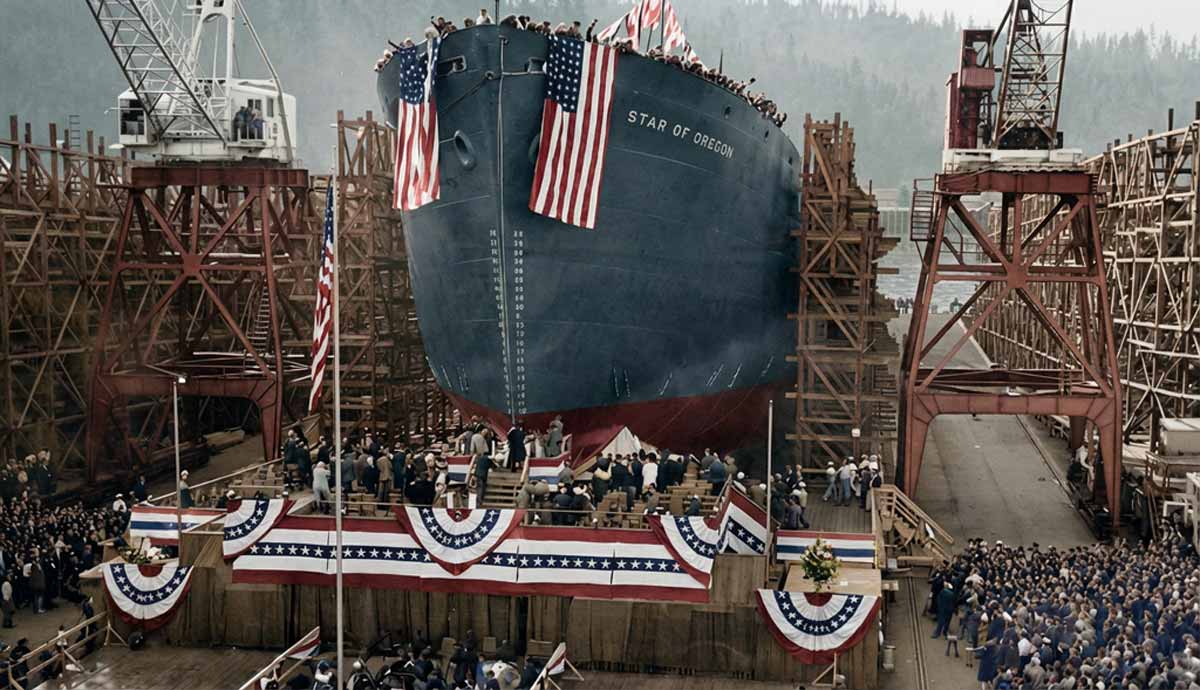
Launch of the first Liberty Ship, the Star of Oregon, 1941, colorized. Source: Old Oregon PhotosThe Battle of the Atlantic was a critical front. The Allies regarded the Atlantic supply lines as their lifeblood. Though dramatic-sounding, Britains survival, the shipping lanes between America and Europe, and the Soviet Unions possible survival depended on convoys. The first years of this front favored Nazi Germany.With no real surface fleet, Nazi Germany employed U-boats (submarines). First singly, but by June 1940, the Germans implemented wolfpacks, or submarine groups. These wolfpacks pounced on convoys protected by inadequate defenses, sinking over 1,200 ships by 1941. Even more went to the bottom just in 1942 alone. Both realized attrition as the key to victory. The Allies created the Liberty Ship, a British design mated with American production know-how.Exploited VulnerabilitiesMerchant ships (blue) and U-boats (red) losses in1941. Source: WikimediaThe Allies started the Battle of the Atlantic at a serious disadvantage. First, only a limited pool of escort ships existed. Second, traditional shipbuilding methods took time. Ship construction couldnt keep pace with losses.Lastly, the Atlantics vastness made protection extremely difficult. A glaring example was the Mid Air Gap, located dead-center in the Atlantic. No Allied aircraft could reach here, giving the U-boats immunity from air attack. This gap would exist until mid-1943. Across the Atlantic, the German Navy, or Kriegsmarine, skillfully exploited all these vulnerabilities. Coordinated wolfpacks continually struck, often at night, sending critical cargo to the ocean floor. The few escorts futilely raced between attacks with little to show.The Liberty Ship Program ImplementationA U-boat sank a British merchant ship. Source: Third Reich Collection Library of Congress1942 ship losses ranked worse than 1941. But changes loomed. With American industrial might now fully behind war efforts, Britain and America developed the Liberty Ship.Based on a British design and built using American automobile assembly-line production, the new Liberty ship stressed speed and simplicity. The cookie-cutter approach produced identical ships. Powered by older, dependable 19th-century triple-expansion steam engines, Liberty ships measured 441 feet with a 10,000-ton cargo capacity. And all for $2 million per ship built by 18 shipyardsAll this simplicity became the Liberty Ships secret sauce. Between 1941 and 1945, American shipyards completed 2,710 ships out of 2,751 planned. This made the Liberty Ship the most-produced seagoing ship and an Allied workhorse.Sheer Numbers = VictoryU.S. merchant fleet growth. Source: U.S. Maritime AdministrationAt first, 1943 looked to be a worse repeat of 1942. Ships continued to be lost, victims of still-effective tactics. German losses slowly ticked up, but still averaged an acceptable 5-8 U-boats per month. U-boats sank on average 50 ships monthly from January to May 1943. March losses reached 131, Germanys last great success.But Liberty Ships started rolling from shipyards, outpacing losses. Construction times fell using prefabricated sections and now skilled workers. For every ship sunk, one or more Liberty Ships left the harbors. Ratios of 1:1, 2:1, or even 3:1 occurred. New ship construction soon reached record levels.Even as maritime clashes occurred, the net amount of cargo shipped increased. Standardization meant that each Liberty Ship had a capacity of 10,000 tons. The ships being lost were pre-war freighters, tankers, or tramp steamers. These never matched the cargo capacity of a Liberty Ship.5 Liberty Ships-Simultaneous Launch 8/5/1942. Source: Library of CongressSheer numbers began to tell. In 1943, the U.S. launched 1,121 Liberty Ships. The total number of German U-boats built for World War II reached 1,150. Despite Germanys best efforts, total merchant tonnage actually increased. The Allies absorbed losses more easily- the supply chain never faltered beginning in mid-1943. Any losses really counted as a cost of doing business.A Qualified Unmatchable Leap HelpedSinking of U-185 8/13/1943. Source: Asisbiz.comLike in all wars, a crescendo is reached. May 1943, or Black May to Germany, would be that turning point. Numbers vary, but around 160 U-boats lurked, attacking five convoys. In these seesaw battles, the Allies broke the wolfpacks, destroying 43 U-boats by months end. The astonished Kriegsmarine commander, Admiral Karl Dnitz, recalled nearly all his boats. Such losses became unsustainable, especially with veteran crews killed.What helped defeat the U-boat fleet resulted from experience and technology. Examples of improved technology include radar, faster, more capable ships, forward-firing weapons, and others. New tactics, such as hunter-killer groups and very long-range aircraft, closed the Mid-Atlantic gap.The initiative now stood with the Allies. Despite multiple changes, Germany never regained the advantage. From September 1943 to May 1944, U-boats sank only 27 ships but lost 12. And Liberty Ship construction continued unabated.Their simple design and assembly-line manufacturing enabled hundreds to launch quickly. This became an Allied strategy victory.




 English
 Arabic
 French
 Spanish
 Portuguese
 Deutsch
 Turkish
 Dutch
Dutch
 Russian
 Romaian
 Portuguese (Brazil)
 Greek
Greek