


ALLTHATSINTERESTING.COM
John Haigh, The Acid Bath Killer Who Dissolved His Victims In Vats Of Sulfuric Acid
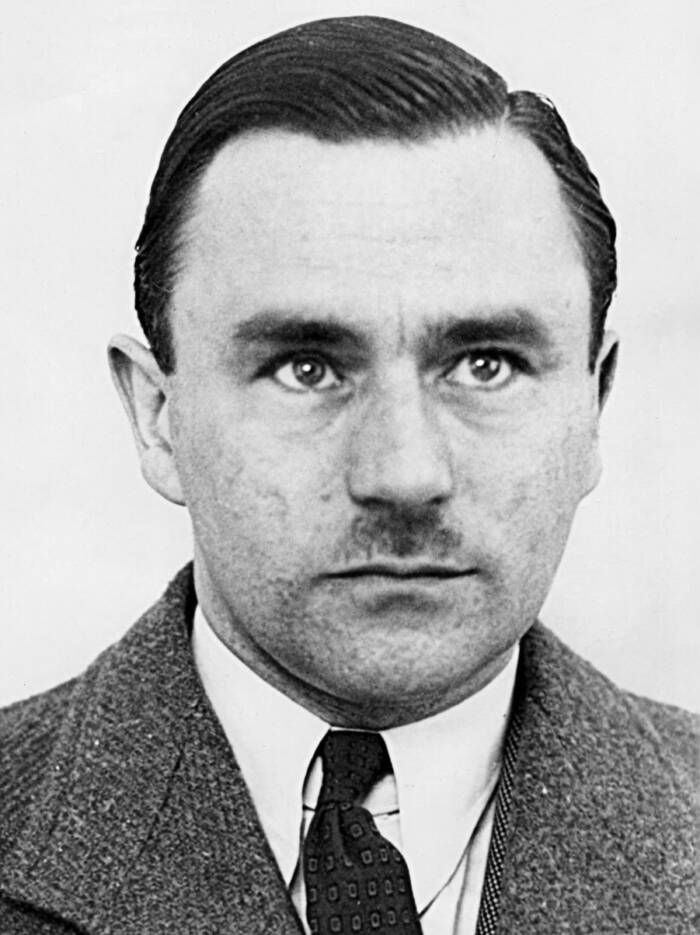
Sussex ConstabularyJohn George Haigh, the English serial killer known as the Acid Bath Murderer.In February 1949, police raided a warehouse in West Sussex, owned by John George Haigh, following the disappearance of a local woman. Inside, they found several 40-gallon drums and containers of concentrated sulfuric acid. Outside, they found 28 pounds of melted human body fat, part of a human foot, human gallstones, and part of a denture.The horror of the crime scene was instantly clear to investigators. Haigh had murdered someone, then dissolved their body in acid. But as they soon found out, Haigh had used this method to murder at least five other people.This is the chilling story of John George Haigh, the Acid Bath Murderer who dissolved his victims in acid.The Early Life Of John George HaighBorn on July 24, 1909, in Stamford, Lincolnshire, England John George Haigh grew up in a highly religious, conservative family. Haigh was discouraged against making friends, and forbidden from any entertainment aside from reading the Bible. That said, he was a talented piano player as a boy. But as a young man, he soon drifted into a life of crime.In his 20s, Haigh started committing financial fraud and was imprisoned in 1934, 1937, and 1941. He also began to learn about the law, including the idea of corpus delicti. This means body of the crime, and is the idea that a crime cannot be proven through a confession alone it also requires evidence. Haigh interpreted this to mean that a murder could not be proven without a body. He also began to experiment with dissolving mice in acid. Trinity Mirror / MirrorpixJohn George Haigh was charming to those who knew him, but he had a secret dark side. Indeed, Haigh believed he had come up with the perfect crime. The bodies of mice dissolved in acid in just 30 minutes, and Haigh suspected he could use the same method to get rid of human remains. After all, he believed that if investigators could not find a body, he would not be charged with murder. For his first victim, John George Haigh targeted a wealthy former friend and employer named William McSwann. Haigh had learned that McSwann had a lucrative job collecting rent from his parents tenants, and Haigh wanted it.The Victims Of The Acid Bath KillerIn 1944, John George Haigh lured McSwann to a basement and beat him to death. Then, he dissolved McSwanns body in a 40 gallon drum of acid.The plot turned out just like Haigh had hoped after two days, McSwanns body was gone and Haigh was able to pour the remains of the acid into the sewer. In the aftermath, he more or less took over McSwanns life. Crime and Investigation reports that Haigh quietly took over McSwanns landlord duties, and he began to plot the murders of his next victims: McSwanns parents.At first, McSwanns parents Don and Amy seemed to believe it when Haigh claimed that their son had fled to Scotland to avoid being drafted in WWII. But as the war came to an end, and he didnt return, they became more suspicious. And so Haigh killed them as well. As hed done before, Haigh destroyed their bodies in acid and poured the sludge into the sewer. He then stole their pension checks and took over their properties, which Haigh sold for a tidy sum. According to the University of Cambridge, Haigh was then able to move into a luxurious hotel in Kensington. To those who knew him at the time, Haigh seemed charming and wealthy, with a taste for fine suits and cars. But Haigh was also a gambler. And by 1947, hed run low on cash. To maintain his lifestyle, he needed more victims. Local Studies CollectionThe Onslow Court Hotel in Kensington, a luxurious hotel that John Haigh was able to afford by robbing and murdering his victims.After feigning interest in a house that was for sale, Haigh murdered the houses owners, Dr. Archibald Henderson and his wife, Rose Henderson. As hed done before, Haigh lured the couple to a secluded location, murdered them, and dissolved their bodies in acid. But though Haigh was able to then steal the Hendersons assets, he quickly killed again. But John George Haighs next victim, a widow named Olive Durand-Deacon, would be his last. The Arrest And Execution Of John George HaighJohn George Haigh crossed paths with Olive Durand-Deacon in 1949 at the hotel where they both lived. Deacon, an aspiring inventor, had an idea for artificial fingernails for women. Haigh told her he could help her develop her idea, and invited her to his workshop in Crawley, West Sussex.When Durand-Deacon arrived, Haigh murdered her like hed murdered his other victims, and dissolved her body in acid. But then he made a mistake. Though Haigh had poured his other victims into the sewer, he didnt have easy access to a manhole at his workshop. So he dumped Durand-Deacons remains in his backyard.Haigh then sold Durand-Deacons jewelry and had her fur coat cleaned. But her disappearance had not gone unnoticed, and investigators soon arrived at Haighs workshop door. Upon examining the backyard, they found piles of acid sludge and human remains. There, at Haighs workshop, was 28 pounds of human body fat, three gallstones, part of a left foot, 18 fragments of human bone, and the remains of Durand-Deacon dentures.John George Haigh was arrested. Though he gave conflicting statements about what had happened to the widow, he finally declared: I will tell you all about it. Mrs. Durand-Deacon no longer exists. She has disappeared completely and no trace of her can ever be found again. I have destroyed her with acid. You will find the sludge which remains at Leopold Road. Every trace has gone. How can you prove murder if there is no body?Sussex ConstabularyA police photograph of John George Haigh.But Haigh had misunderstood the concept of corpus delicti. Without this defense, he attempted to portray himself as insane, claiming that he had murdered his victims in order to drink their blood. This was somewhat difficult to prove, as Haigh had left no physical evidence of his victims behind. And Haigh had also suspiciously asked a detective if he had a better chance of being released from a psychiatric hospital than from a prison.In the end, a jury took just 30 minutes to find Haigh guilty. He was sentenced to death, and hanged on August 10, 1949. So what was really the motivation of the Acid Bath Killer? To this day, its unknown for certain. Possibly, Haigh was driven by financial gain. Possibly, he liked the thrill of getting away with murder, or the act of murder itself. Maybe he was even telling the truth when he told investigators that hed been driven by a desire to drink human blood. But it seems likely that John George Haigh was simply a psychopath, with little consideration for human life. Murder, for him, was a way to money and power, which he seemed to value above all else.The really interesting thing that emerges from the letters he wrote to his parents [from prison] is that he rarely addresses the question of his actual crimes, Friedrich Loesel, Director of the Institute of Criminology at Cambridge and an expert in forensic psychology, told Cambridge University. Losel continued: Nor does he write about his hanging. He also exhibits delusions of grandeur he is proud to read about himself in the papers, for instance. These are typical indicators of psychopathy. There is also very little evidence he understood the emotional impact of what he had done; it is as if he hears the tone but does not understand the music.Now that youve read about John George Haigh, the Acid Bath Murderer, read about the gruesome history of serial killer Edmund Kemper. Then, check out the story of Carl Panzram, the most cold-blooded killer in American history.The post John Haigh, The Acid Bath Killer Who Dissolved His Victims In Vats Of Sulfuric Acid appeared first on All That's Interesting.
0 Commentarios
0 Acciones
19 Views

 English
 Arabic
 French
 Portuguese
 Deutsch
 Turkish
 Dutch
Dutch
 Italiano
 Russian
 Romaian
 Portuguese (Brazil)
 Greek
Greek