


ALLTHATSINTERESTING.COM
Inside The Wild Story Of The Tsar Tank, Russias Absurd Experimental Vehicle From World War I
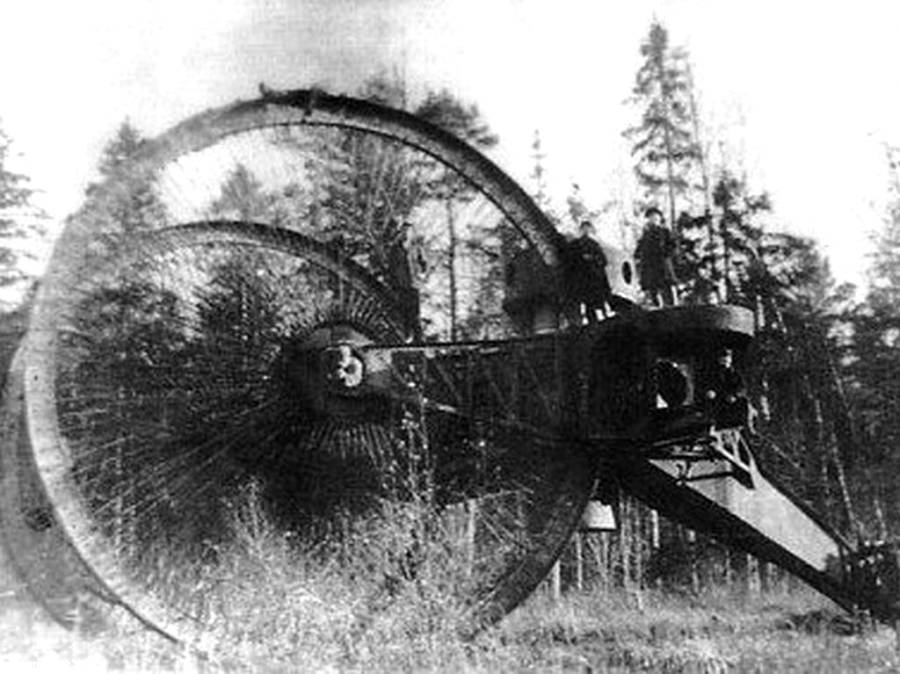
Wikimedia CommonsThe Tsar Tank, pictured during field tests, with soldiers standing on the carriage.From 1914 to 1918, the killing fields of Europe were a place of bloody stalemate. The Great War or World War I, as we know it today resulted in massive casualties on a frightening scale as belligerent empires became bogged down in trench warfare, with hundreds of thousands of lives sacrificed for mere yards of territory.To break the deadlock, numerous military innovators turned to the drawing board. Several countries simultaneously came up with the concept of the tank, as in water tank, coined by the British to disguise the real purpose of the armored vehicle that they were secretly developing.Most World War I tanks followed a similar design: a motorized protective barrier with treads to plow over obstacles and rough terrain, while also providing shielding for troops. Some early versions included machine guns and cannons to add offensive capabilities to strike at enemy positions.All kinds of tank designs and features were considered during the world conflict. But perhaps the most unusual prototype to emerge from the new era of military technology was the Russian Tsar Tank.What Was The Tsar Tank?Standing nearly 30 feet tall and weighing 60 tons, this monstrous machine looked more like Paul Bunyans tricycle. It included two enormous wheels that were intended to roll over any impediments.Also known as the Lebedenko Tank or the Netopyr (a Russian name for Pipistrellus, a genus of bats), this behemoth was the brainchild of Nikolay Lebedenko, a Russian military engineer who worked on the original design with Nikolai Zhukovsky, Boris Stechkin, and Alexander Mikulin.The Tsar Tank was gigantic even by todays standards, so it wouldve been considered especially massive during the advent of modern weaponry. It was nearly 60 feet long and almost 30 feet wide. The tank featured a large armored T-shaped carriage with a main top turret bristling with machine guns. Lower sponsons were also equipped with machine guns for covering fire. A crew of at least 10 men operated the vehicle.Each large wheel was powered by a 250-horsepower engine that was adapted from motors captured from a destroyed German Zeppelin. On firm ground, the Tsar Tank reached a top speed of 11 miles an hour. At the rear, a small metal rotor provided balance, giving the military vehicle the appearance of a tricycle on steroids. It also boasted some of the best weapons of the time, making its presence all the more intimidating.A design of the infamous Russian Tsar Tank, which was never used in a single battle.The Tsar Tank got its most famous name from Nicholas II, who was then the ruler of Russia. He took a keen interest in the project after Lebedenko showed the Tsar a small working version of the tank in 1915. They played with the small tank on the floor, setting up obstacles of books and other barriers, which the miniature model easily overcame. In theory, it seemed like a larger version of the tank could really give Russia the edge during World War I, and perhaps even break an agonizing deadlock on the battlefield.Nicholas was impressed with the idea and gave Lebedenko a reported 250,000 rubles (about $125,000, an enormous sum at the time) so that he could embark on the project for real-life battles. Construction then promptly began, under incredible secrecy. All of the parts for the Tsar Tank were produced as if they were intended for use in battleships or heavy industrial machines so that no one would know the truth about the projects nature.Inside The Infamous Failure Of The Tsar TankOn August 27, 1915, the Tsar Tank was put through its first field test, which initially seemed promising. The vehicle moved along a corduroy road a path lined with logs across a swamp. It crushed a tree and then moved off the roadway into the wetland. But thats where it stopped. The wheels spun and could not dislodge the rest of the Tsar Tank from the muck. The vehicles weight was too far to the back, causing the rear rotor to easily sink into the soft ground. Even with large engines, the two massive wheels did not have enough power to pull the rest of the tank out of the bog. It was clear that the tank had failed its tests miserably.Surprisingly, after this discouraging testing stage, many attempted to free the vehicle from the mud and even outlined plans to possibly redesign it for future tests. Some were so confident in the tanks potential for success that they ensured it would be guarded at its site in the wetland. But in the end, the vehicle was abandoned during the Russian Revolution.The tank then sat in the swamp until 1923, when it was salvaged for scrap.RedditThough the Tsar Tank failed its field tests, some hoped to improve the tanks design and give it another try in the future.Military historians have since debated whether or not the Tsar Tank would have been effective on the battlefield if it had been properly designed. Its sheer size certainly would have intimidated enemy soldiers, especially at a time when tanks were still relatively unknown (one might even imagine a War of the Worlds-style alien craft attacking average military units).However, the impressive bulk of the Tsar Tank would have also likely been a detriment, as heavy artillery would have easily damaged or destroyed its front wheels. Though it may have appeared powerful and indestructible from a distance, perhaps it wouldve been taken down once it got too close to enemy troops, stopping it right in its tracks.Chalk it up to another case of interesting idea, but maybe we should have thought it out a bit further.After this look at the Tsar Tank, go inside the story of Tsar Bomba, historys biggest nuclear weapon that created the largest man-made explosion the world has ever seen. Then, read about the Panjandrum, a disastrous experimental weapon that was supposed to help the Allies during World War II.The post Inside The Wild Story Of The Tsar Tank, Russias Absurd Experimental Vehicle From World War I appeared first on All That's Interesting.
0 Reacties
0 aandelen
222 Views

 English
 Arabic
 French
 Spanish
 Portuguese
 Deutsch
 Turkish
 Italiano
 Russian
 Romaian
 Portuguese (Brazil)
 Greek
Greek