Archaeologists In Germany Unearthed A 7,500-Year-Old Headdress Made From A Deers Skull And Antlers
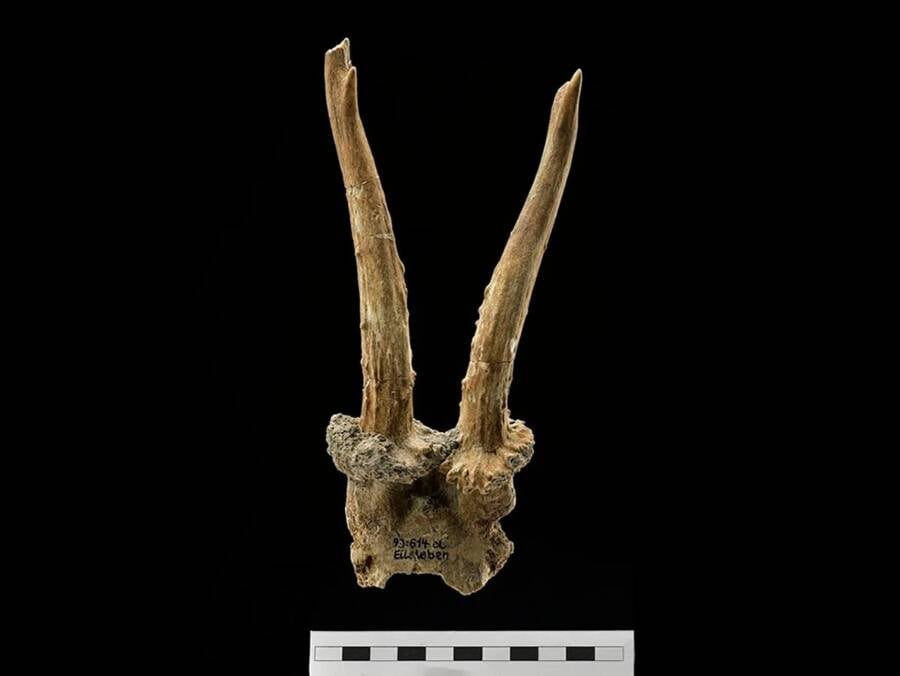
Landesamt fr Denkmalpflege und Archologie Sachsen-Anhalt, J. Liptk / L. Dietrich et al., Antiquity (2026)The underlying meaning and purpose of the deer skull headdress found in Eilsleben, Germany remain largely mysterious.At the remains of a small Neolithic settlement near Eilsleben in Saxony-Anhalt, Germany, archaeologists have found a wealth of prehistoric artifacts. Among the most fascinating objects to emerge from these excavations is a deer skull headdress that may have once served a ritualistic purpose.Whats more, this 7,500-year-old headdress also suggests a robust trade relationship that existed between Neolithic farmers and Mesolithic hunter-gatherers, both of whom were then navigating their own changing worlds.The Deer Skull Headdress Found At A Neolithic Settlement In GermanyAccording to a study published in Antiquity, the deer skull headdress was discovered at a Neolithic settlement in northern Germany. Today, the settlement is located near Eilsleben. But 7,500 years ago, it was perched at the edge of two converging worlds: that of hunter-gatherers of the Mesolithic age, and the farmers of the emerging Neolithic age.Martin-Luther University Halle, F. Becker / L. Dietrich et al., Antiquity (2026)Excavations at Eilsleben, a Neolithic settlement that was first uncovered in the 1970s.Excavations at the site have been ongoing since the 1970s, and have uncovered a large settlement from the Linear Pottery culture (circa 5500 to 4500 B.C.E) that stretches over 20 acres. The settlement includes longhouses, pits, and ditches, as well as traces of tool manufacturing centers.But in 1987, archaeologists uncovered something highly unusual: a modified deer skull. The skull had been worked into a rectangular shape, and notches had been added at the base of the antlers. These were seemingly for fasteners, suggesting that it had been used as a mask or headdress.Similar artifacts have been found at Mesolithic sites most famously at a burial in Bad Drrenberg from 7000 B.C.E. but they are far more rare in Neolithic contexts. Thus, the deer skull headdress appears to suggest that Neolithic people in Eilsleben had a healthy trading relationship with the Mesolithic hunter-gatherers who roamed nearby.Trade Between Neolithic And Mesolithic Groups At EilslebenThe Mesolithic period began around 10000 B.C.E., when the climate in Europe began to improve after the last Ice Age. Mesolithic people were hunter-gatherers, and in present-day Germany they hunted deer, bison, and boars using bows and arrows.Martin-Luther University Halle, L. Dietrich / L. Dietrich et al., Antiquity (2026)The fragments of an antler ax found at the Neolithic settlement. Antlers were rarely used as tools by the Linear Pottery culture, suggesting that they were a technology transfer from Mesolithic hunter-gatherers in the area.But around 6500 B.C.E., the Neolithic period slowly began in Europe. During these overlapping ages, Mesolithic hunter-gatherers still roamed the land, even as Neolithic people like the Linear Pottery culture established more permanent settlements, including the one at Eilsleben.The deer skull headdress is not the only sign of trade between these two peoples. At Eilsleben, archaeologists also found other antler tools, which are rare among Linear Pottery settlements, but more common in Mesolithic contexts, as well as flint arrowheads, which, similarly, were a technology primarily used by Mesolithic hunter-gatherers.Such items were seemingly part of a technology transfer between the two groups. But the headdress is an especially fascinating object.Martin-Luther University Halle, L. Dietrich / L. Dietrich et al., Antiquity (2026)Some of the stone and antler tools unearthed in Eilsleben.The most similar object in the archaeological record, from Bad Drrenberg, was thought to have been buried with a Mesolithic shaman. The presence of the mask at a Neolithic settlement suggests that Neolithic people were influenced by Mesolithic beliefs.Perhaps the Neolithic group faced new health problems due to their lifestyle which could include dental problems from eating grains or new diseases from working closely with domesticated animals and turned to the Mesolithic for help. Perhaps they needed a healer from the old world to help them survive in the new one.For now, many questions about the deer skull headdress remain, but it stands as an astounding artifact in more ways than one. Not only is it visually striking, but it also represents a crucial moment in human history, as the Mesolithic age ended and the Neolithic age began.After reading about the deer skull headdress that was found at a Neolithic settlement in Germany, learn about the worlds oldest structures and the fascinating history behind them. Next, go inside the stories of the most unbelievable prehistoric animals to ever walk the Earth.The post Archaeologists In Germany Unearthed A 7,500-Year-Old Headdress Made From A Deers Skull And Antlers appeared first on All That's Interesting.




 English
 Arabic
 French
 Spanish
 Portuguese
 Deutsch
 Turkish
 Dutch
Dutch
 Italiano
 Russian
 Romaian
 Greek
Greek