


WWW.THECOLLECTOR.COM
6 Famous Swordsmen of Medieval and Renaissance Europe Who Shaped the Art of Fencing
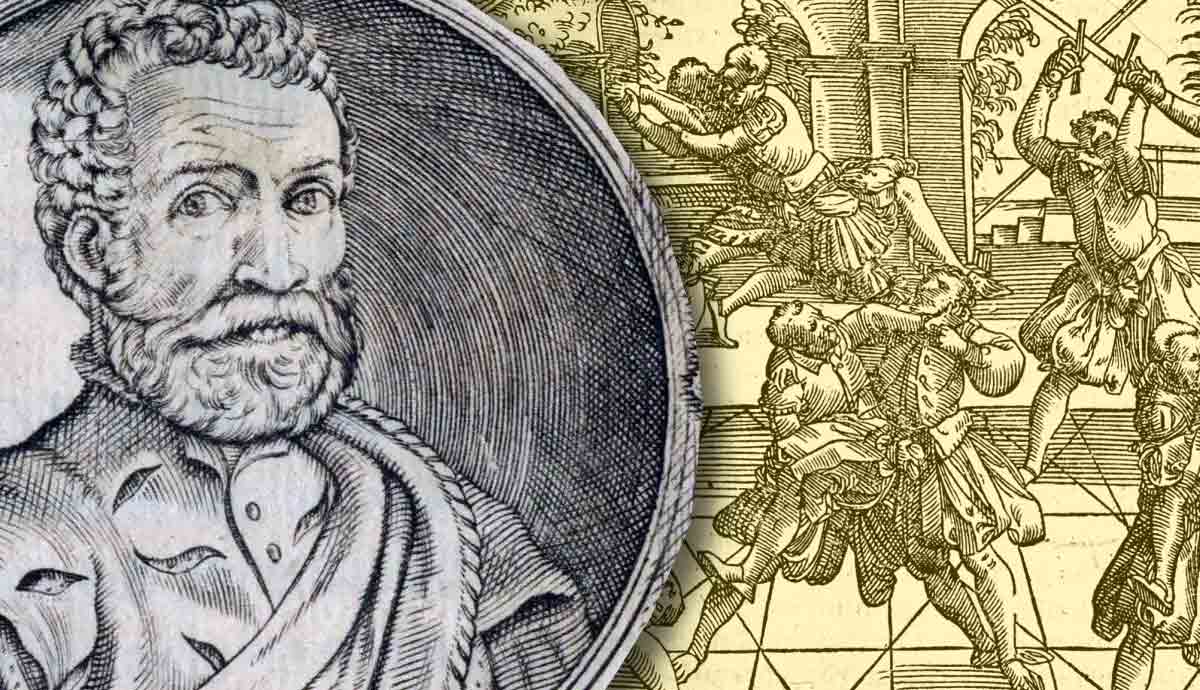
Swordsmanship in Europe developed over the course of hundreds of years in response to the shifting culture and the many innovations of weapons and armor. Famous swordsmen who trained others in the use of these weapons often came from wealthy backgrounds. It would have been unlikely for a commoner to own a sword, let alone train with it, at least during the Medieval Period. Leading into the Renaissance, the wearing of swords would have been more common, but extensive training took a lot of time. Those who were skilled in fencing could find work as masters-at-arms, private bodyguards, or mercenaries, or found their own school. Through this work, they gained experience that honed their knowledge further.1. Johannes LiechtenauerIllustration of Johannes Liechtenauer, from Cod. 44 A 8, Peter Von Danzig, 1452. Source: HROARR.comOne of the earliest widely known fencers was Johannes Liechtenauer, who lived sometime during the 14th century. His surname, Liechtenauer, indicates that he was likely from or associated with Liechtenau, Germany, in the region of Bavaria. Unlike many of the other swordsmen in our list, there is little that is known about Liechtenauers personal life, save that he traveled extensively and was possibly part of a mercenary group. He is instead known for his accomplishment and compilation of many of the fencing techniques that inspired many, particularly German nobles, to compile their own teachings or interpret Liechtenauers for easier consumption and understanding.Liechtenauer wrote his teachings down, or at least a distilled version, in a poem referred to as the Zettel, or Recital. The poem consists of a series of rhymed couplets, and upon initial reading, the Zettel is almost incomprehensible. This is intentional: Liechtenauer did not feel that his teachings of the longsword should be available freely, so it was written as a study guide or mnemonic device for use by swordsmen who already had some form of training in his system. The Zettel itself does not contain much nuts-and-bolts explanation of techniques. Later interpretations, on the other hand, go into more detail.2. Fiore Furlano dei LiberiPage from Fior di Battaglia depicting posta di donna, 14th century. Source: Aikido ItaliaFiore Furlano dei Liberi di Premariacco, born in the 14th century in the city of Friulano, was another noble: his familys title of Liberi possibly referred to their status of Imperial immediacy, as well as being free nobility rather than indentured. At the time, the Holy Roman Empire encompassed present-day Germany and the north of Italy, but Fiores family is thought to have answered directly to the throne rather than any intermediary.Being steeped in the lifestyle of nobility, Fiore had exposure to the martial arts from a young age and wrote that he was interested in learning and teaching. He spent many years learning fencing and battlefield techniques from both German and Italian masters, but only a few of them are named, such as Johane Suveno and Nicholai de Toblem. Many fighters wanting to make a name for themselves or doubting Fiores skill attempted to challenge him to duels when he would not train or fence with them.Fiore wrote his fighting manual, Fior di Battaglia (The Flower of Battle), over a six-month period in 1409, dedicating it to Niccolo III dEste, the Marquis of Ferrara, whom he had trained. Currently, only four known manuscripts of Fiores manual survive, and they are named after the libraries in which they reside. The most comprehensive version of the manual, commonly called the Getty Manuscript, covers unarmed, dagger, sword, and pole weapons extensively, and is structured from simple to complex concepts, with various plays, their counters, and the counters to those counters. Fiore wrote that trying to plan a fight beyond three layers of movement was unlikely to be successful, and even though his techniques were valid, he stated there was always a chance they would not work in a given situation.3. Camillo AgrippaCover of Agrippas manual, 1568. Source: Wikimedia CommonsNow we start moving beyond the transitional period and more into the Renaissance proper with an introduction to Camillo Agrippa, who, unlike many of the others we have listed here, was not a fencer by vocation. Rather, he was an architect and engineer who had a deep fascination with science and mathematics. As a whole, the Renaissance was defined by an increased interest in a more rationalist view of the world, though the Catholic Church still held sway.Sometime in the 1510s, Agrippa was born in Milan and moved to Rome during the 1530s, where he stayed for the rest of his life. He was affiliated with and worked in Rome, where he became acquainted with various famous figures, including Michelangelo. One of Agrippas most well-known architectural accomplishments was the 1570s creation of a hydraulic water system delivering water to the gardens of Villa Medici from the Roman aqueduct Acque Vergine.However, Agrippas most well-known accomplishment is his fencing treatise Trattato di Scientia dArme, written in 1553. During this time period, earlier cutting swords, such as the longsword or arming sword, had given way to the rapier, a thrust-centered weapon. He approached the study of swordplay as a geometric exercise. The illustrations of the figures in the book are used to demonstrate the idea of the point of the sword being in line with the opponent, as straight out as possible, and of moving based upon relative measurements of timing: mentions of half-time and double-time are made. A similar concept is expressed in Miyamoto Musashis work: Things seem slow or fast according to whether or not they are in rhythm.4. Salvator FabrisImage of Fabriss manual. Source: Camille Sourget LibrarySalvator Fabris, perhaps known best for being name-dropped in the novel The Princess Bride, was also a prolific author and fencer born and raised in Padua, Italy. He attended the University of Padua, which he would eventually return to, to teach his theory of fencing. At the time, swordplay was seen as a requirement for any young man of noble birth to learn. Having a good teacher was paramount to ones survival, let alone prosperity. Fabris traveled extensively through Germany, Denmark, and possibly Sweden.From 1601 to 1606, Fabris was the private fencing instructor to Christian IV, the king of Denmark. During this period, he wrote the fencing treatise Scienza e Prattica dArme and presented it to the king as a farewell gift upon leaving his service to return to Italy, where he took his teaching position at the University of Padua. Fabris simplified the Italian rapier system, bringing the number of guards down to four. They are still used in modern fencing.Fabris was so well-known that, according to rumor, Shakespeare requested his aid in choreographing the stage fighting in Hamlet.5. Joachim MeyerImage from the Meyer manual section on rapier. Source: HROARRWe return to Germany in the late 16th century to look at Joachim Meyer, one of the most notable authors who wrote about the longsword and other weapons. Meyer was born in 1537 in Basel, Switzerland, where he studied to become an apprentice cutler, or knifemaker. However, he developed an early interest in fencing before moving to Strasbourg in Germany in 1560. He became a Freifechter, or free fencer. In other words, he was allowed to study and teach swordplay without being tied to a guild. The predominant one was the Marxbruder Guild, but Meyer disliked what he felt was an excessive adherence to tradition. The idea of writing a comprehensive fencing manual for the masses ran contrary to their teaching methods. Eventually, Meyer became affiliated with the rival Federfechter Guild.Joachim Meyers 1570 fencing manual, commonly called The Art of Combat, was dedicated to Johann Casimir, Count Palatine of Simmern. Its basis is the longsword, but Meyer suggests that fencers extrapolate the concepts for use in other weapons and in unarmed combat. It draws much of its inspiration from the earlier manuals written by members of the so-called Society of Liechtenauer, but illustrated in a more sportive context. At the time, the longsword in particular had fallen out of fashion as an everyday carry weapon and in war, partially because of advances in armor and the advent of primitive firearms.One critical difference shows in Meyers instructions: most of the thrusts are deemphasized in his longsword curriculum. This is because, at the time under German law, inflicting a thrust wound was illegal in a duel because it was harder to treat and more likely to be lethal. Therefore, cutting or striking with the flat was required first, before a thrust could be legally used in self-defense.6. George SilverOpening page of Paradoxes of Defence, 1599. Source: WiktenauerThe final figure were discussing here is George Silver, an English gentleman and fencing master, though he did not call himself such. During the time period in which he was active (late 1500s to early 1600s), fencing was seen as uncouth and the province of criminals and general malcontents. Dueling was illegal, though it was still known to happen. Silver wrote two volumes dealing with his concepts of fencing: Paradoxes of Defence, a dedication to the Earl of Essex, Robert Devereaux, and a follow-up, Brief Instructions on My Paradoxes of Defence. The first volume mostly denounces the use of the rapier and the thrust-oriented style of civilian swordplay that was prevalent at the time. Silver wrote extensively about the ideas of moving in tempo with the enemy, and what he called twofold mind; that is to say, thinking of how to attack and retreat.Silver critiques the notions of fighting frivolously or for any slight quarrel, instead exhorting people to try to talk their disputes out before settling them at swordpoint, and advises avoiding fighting if at all possible.
0 Kommentare
0 Geteilt
229 Ansichten

 English
 Arabic
 French
 Spanish
 Portuguese
 Turkish
 Dutch
Dutch
 Italiano
 Russian
 Romaian
 Portuguese (Brazil)
 Greek
Greek