


ALLTHATSINTERESTING.COM
The Astonishing Story Of The North Dakota Blizzard Of 1966 That Ravaged The State
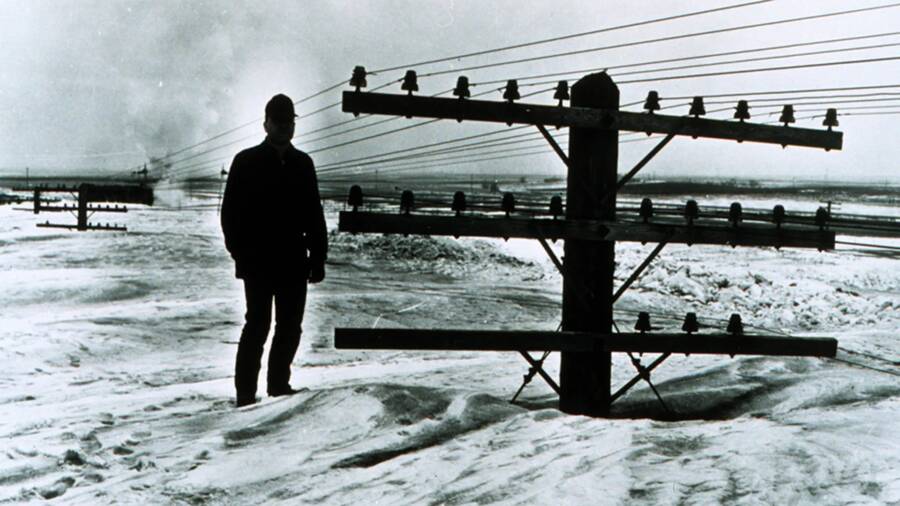
NOAA Photo LibraryNorth Dakota Department of Transportation employee Bill Koch standing next to power lines that were buried by a snow drift after the North Dakota blizzard of 1966.People living in North Dakota are used to extreme weather. In the summer, thunderstorms are common and temperatures can spike to over 100 degrees Fahrenheit. In the winter, residents habitually face bitterly cold winds and temperatures that plunge far below freezing. But the North Dakota blizzard of 1966 stands out as one of the worst in U.S. history. It began in March, a time when much of the country is starting to think about spring. On March 2nd, it began to snow heavily in North Dakota, and wind gusts of up to 70 miles an hour created mountainous snow drifts across the state. Visibility was close to zero in some areas, and certain places even suffered through 30 straight hours of near-zero visibility. The North Dakota blizzard of 1966 lasted through March 4th, and killed at least 18 people in North Dakota and the surrounding states, as well as thousands of livestock. It stands as a harrowing reminder of the power of nature even in places used to extreme weather and the deadliness of winter storms. How A Colorado Low Brought An Intense Winter Storm To The Great PlainsBy 1966, North Dakota had endured several intense blizzards. In January 1888, a violent blizzard killed 112 people and decimated the states open range cattle industry. Then, in March 1941, another blizzard whipped up with little warning, killing 39 people, many of whom were trapped in their cars. But the North Dakota blizzard of 1966, while less deadly, brought some of the worst conditions to the state in March 1966.National Weather ServiceThe North Dakota blizzard of 1966 was part of a Colorado Low weather system.Then, the National Weather Service reports that a weather system known as a Colorado Low started moving north up through South Dakota. This kind of weather system, a low-pressure system that usually occurs in the winter, forms around the southwest portion of the U.S. and then makes its way east. It can bring very intense precipitation, which is exactly what it did in North Dakota. On March 2nd, heavy snow began to fall. But even though temperatures were relatively mild at first in the 20s and though people had plenty of warning about the coming storm, the blizzard would be one of the worst in the states history.Wind, Snow, And Low Visibility: Inside The North Dakota Blizzard Of 1966As the State Historical Society of North Dakota recounts, the North Dakota blizzard of 1966 came with plenty of warning, but most people had never experienced a snowstorm so powerful before. Though travelers were instructed to stay off the highway, and city residents were advised to stay indoors, some still became trapped in the storm, and others were killed as the blizzard unfurled across the state. North Dakota Department of Transportation/FacebookA train buried in the snow during the North Dakota blizzard of 1966. Between March 2nd and March 4th, the state was pummeled by heavy snowfall, with some locations receiving 20 to 30 inches of snow. Meanwhile, icy winds with gusts as high as 70 miles per hour howled through the air, creating massive snow drifts. Some of these snow drifts grew to be 30 or even 40 feet tall, practically burying power lines and road signs. But one of the worst parts of the North Dakota blizzard of 1966 was the near-zero level of visibility. Places like Fargo had little or no visibility for 30 straight hours. The outside world was practically blind white, and this was extremely dangerous. The Peril Of The North Dakota Blizzard Of 1966In the end, at least 18 people died due to the North Dakota blizzard of 1966 (five in North Dakota itself, and others in nearby states like Minnesota and South Dakota). The conditions proved to be deadly in different ways.State Historical Society of North DakotaHere, a North Dakota resident escapes from his house. Because of high snow drifts, he escaped via the attic window.In Strasburg, a six-year-old girl got separated from her brothers while trying to make it to a barn 60 feet from their house. Tragically, she was found frozen to death two days later. In Woodworth, a 12-year-old girl stepped outside to close up a chicken coop, and apparently got lost trying to make her way back to the house, 100 feet away. She too was found frozen to death. Lost children were not the only victims several men had heart attacks during the North Dakota blizzard of 1966, either while trying to shovel snow or make their way through the storm. And tens of thousands of livestock perished, including at least 18,500 cattle, 7,500 sheep, 7,000 turkeys, and 600 hogs. Some died in the storm itself, some were killed by collapsing barns, and others suffocated after becoming trapped in barns because of the high snow drifts.State Historical Society of North DakotaA cow that froze to death during the North Dakota blizzard of 1966. Thousands of livestock died during the storm, costing the state millions of dollars. But some people managed to escape extremely dangerous situations. Near New Salem, three trains, including one carrying 500 passengers, became stuck in the snow. The trains had to be dug up with shovels, because the snow drifts were too deep for local snowplows. Meanwhile, at least two couples became trapped while trying to make their way to a hospital for their childrens births. One woman ended up giving birth in a farmhouse; the other in a car. And scores of people became stuck in their vehicles when the conditions grew too dangerous, and couldnt be rescued until the storm started to let up. Indeed, the storm all but shut the state down for several days. Schools closed, newspapers werent able to publish the news, phone service was knocked out, and traffic was largely halted. Even once conditions began to clear, the effects of the blizzard were still acutely felt. The Damage Caused By The Winter StormWhen the storm cleared, North Dakotans and other residents of the Great Plains took account of the aftermath, and found that theyd lived through one of the worst winter storms in U.S. history. Snowfall records were set at Devils Lake (which got 30.5 inches of snow), as well as Grand Forks (which got 27.8 inches of snow). This, the wind, and the duration of the storm made it an all-time record blizzard for the state of North Dakota.North Dakota Department of Transportation/FacebookA man next to a towering snow drift in the aftermath of the North Dakota blizzard of 1966.It was also an expensive storm. The loss of livestock alone cost the state millions of dollars. But the storm had also shut down businesses and schools, stopped the movement of goods, and damaged infrastructure.Thus, while people living in the Great Plains are used to intense weather, the North Dakota blizzard of 1966 certainly stands out in the regions history. Immensely powerful and destructive, it hung over the northern states for days. Its mammoth snow drifts, high winds, and low visibility made it an especially treacherous storm, and led to the tragic loss of many lives.But the people of the Great Plains are hardy. As the State Historical Society of North Dakota stated: Snow is part of winter routine on the northern Great Plains. Rather than drive people away or prevent the development of towns and cities, people learn to adapt to the usual cold and snow of winter and to accept unusual storms such as that of March 1966 as part of life in the semi-arid north.After reading about the North Dakota blizzard of 1966, discover the wild story of the Blizzard of 1888, the Great White Hurricane that tore through the Eastern Seaboard. Or, learn the stories of some of the worst blizzards in history.The post The Astonishing Story Of The North Dakota Blizzard Of 1966 That Ravaged The State appeared first on All That's Interesting.
0 التعليقات
0 المشاركات
254 مشاهدة

 English
 French
 Spanish
 Portuguese
 Deutsch
 Turkish
 Dutch
Dutch
 Italiano
 Russian
 Romaian
 Portuguese (Brazil)
 Greek
Greek