


WWW.THECOLLECTOR.COM
What Did Students Learn at a Medieval University?
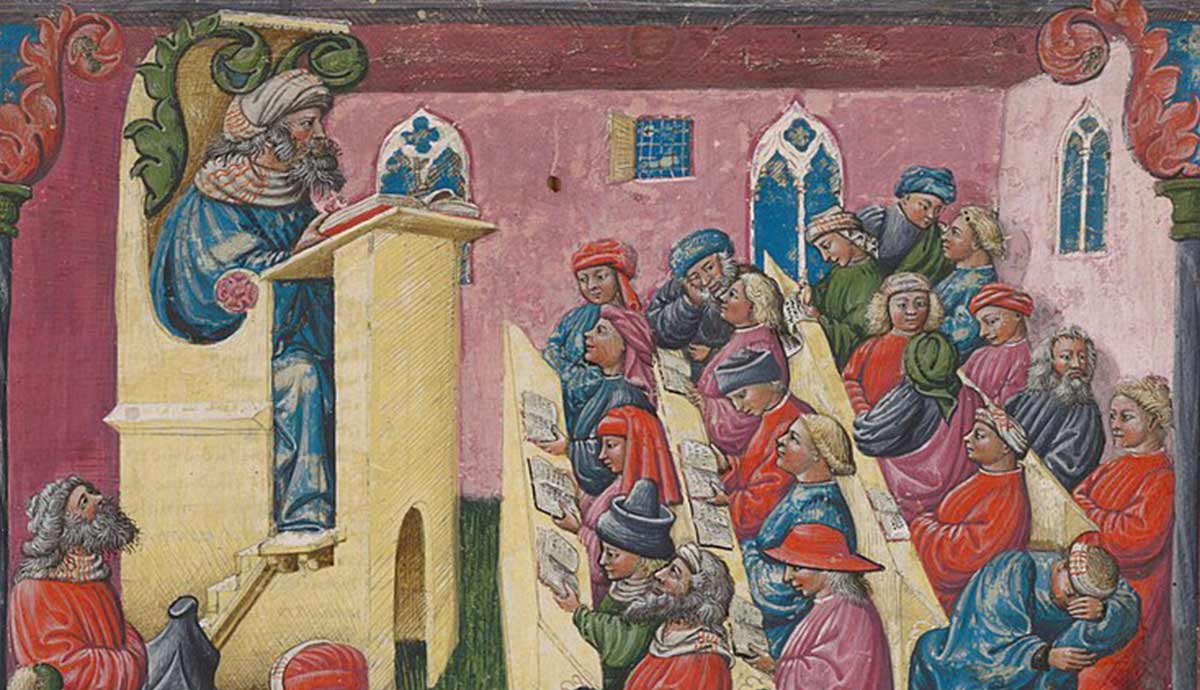
The university as we know it now differs greatly from its medieval counterpart. During the Middle Ages, some of the most prominent universities in the world began to form, including Oxford University, Cambridge University, the University of Paris, Charles University (Prague), and many more. But why was the Medieval university a necessity? Who attended them? What went on behind closed doors?Early Medieval Education Systems Before UniversitiesA Bologna University class, by Laurentius de Voltolina, c. 1350s. Source: Wikimedia CommonsDuring the Early Medieval Period, specifically in Christian Europe, education looked much different from what we think of it now. There was no expectation for anybody to receive a formal education, unless you were a member of the nobility or the Church. Children did not attend school during the day; they worked on farms or helped out at the family home. In addition, when it came to leaving home, there was no real expectation for anyone to further their educationwith a largely agrarian economy and lifestyle, what was the purpose of furthering your education when your time could be spent working for the family business, such as farming or blacksmithing?Monastic schools were an example of early medieval education that worked alongside the universities for many centuries. Wealthier members of society could afford to send their sons to become monks, and as such, they would receive a monastic education. As well as learning the contents of the Bible inside out, they would also learn valuable educational skills, such as reading and writing.In the Middle Ages, monks were the primary writers of the age, so being able to read and write was an essential part of a young monks education. Furthermore, they would also learn practical skills, such as how to mend things and how to grow and tend to their own crops.Education for the Nobility in the Middle AgesMob Quad at Merton College, Oxford University, constructed between 1288 and 1378. Source: Wikimedia CommonsThe nobility were the most educated group in medieval Europe, partly because they had to be, and partly because they were the only ones who could afford an education.However, their form of education did not take place at university; instead, children would have private tutors, who would teach them a range of subjects, ranging from reading, writing, Latin, French, geography, arithmetic, history, scripture, astrology, and more, depending on each individual monarchs preference.This meant that there was often a huge discrepancy in the education levels between members of the nobility and the common people, although even by todays standards, members of the British royal family receive a much better education than the majority of the British population, because they can afford it. So, has much changed in the last thousand years or so?It would be easy to say that nothing has changed, but this is where the rise of the medieval university comes in.The Origins of the Medieval UniversityQuadrangle at Kings College, Cambridge, photo by Kirsten Drew. Source: UnsplashAround the late 11th century, the medieval university began to crop up as an institution, evolving from the already-existing cathedral and monastery schools.The reason for the evolution can be attributed to a number of factors. Firstly, the population increase in Europe meant that there was a higher demand for all sorts of professions, including lawyers and physicians, and with no formal institutions to train them, potential lawyers and physicians needed an institution from which to learn.As with population growth, the urban centers of many of Europes largest cities began to expand, resulting in a greater demand for housing and employment opportunities. Many of these professions required a form of formal training, so that was another reason why the rise of the medieval university began.Furthermore, the rediscovery of classical texts in this period spurred demand to learn about them and understand them, showing that universities were not simply places where lawyers and physicians could ply their trade, but institutions dedicated to the study of classical texts, and a new branch of educators: academics.Separation of Church and State in Medieval UniversitiesA meeting of doctors at the University of Paris, by tienne Colaud, c. 16th century. Source: Wikimedia CommonsDespite the fact that many of Europes medieval universities were founded on former cathedral schools or monastic schools, they maintained a certain degree of autonomy, resulting in a distinct separation of Church and State within the university walls.Universities were self-governing bodies of education, neither backed by the Church nor the State, and as such, students and teachers formed guilds to protect their interests.It was these original guilds that meant that funding for university study was possible, with a corporation of students and masters dedicated to studying particular areas of academia, ranging from arithmetic to history.Some of the earliest universities which sprang from guilds included the University of Bologna, Italy (founded in 1088, it is the oldest university in the world in continuous operation), University of Paris (France, 1150), University of Oxford (England, 1167), University of Salamanca (Spain, 1218), University of Coimbra (Portugal, 1288), Charles University (Czech Republic, 1348), Jagiellonian University (Poland, 1364), University of Vienna (Austria, 1365), Heidelberg University (Germany, 1386), and the University of St Andrews (Scotland, 1413).The Curriculum at a Medieval UniversityThe University of Bologna. Source: Wikimedia CommonsNaturally, the curriculum differed depending on the university and what the students would be studying, but there were some general rules about what was taught, especially in the early years of the medieval university as an institution.The subjects known as the Seven Liberal Arts were almost exclusively taught to every student in medieval universities. These subjects were rhetoric, grammar, logic, geometry, arithmetic, music, and astronomy.Today at university, we tend to focus on just one subject, especially in Europe. In the US, it is common to major in one subject (such as history) and minor in another (like English). However, joint honors degrees are not hugely popular in Europe, and most undergraduates tend to specialize in one subject, such as history, geography, or civil engineering, and so on, perhaps then going on to study a masters in medieval history or human geography, for example.However, the seven Liberal Arts helped to shape early education in the centuries that followed, as these formed the basis of the modern European education system as we know it: English (rhetoric, grammar), Maths (arithmetic, geometry, logic), Science (astronomy), and the Arts (music).The impact that this had on the wider European education system cannot be ignored.How Were Students Taught at Medieval Universities?A map of medieval universities in Europe, by William Robert Shepherd, 1923. Source: Wikimedia CommonsRemarkably, the method of teaching at universities has not changed too much in almost 1,000 years of them being a European institution.While preconceptions of education in the Middle Ages often involve a strict teacher walking around with a baton ready to beat any student who dares to disagree with him, the reality was much different.Universities in the Medieval Period were (and still largely are) places of debate, learning, and interactive opinion-sharing.Teachers at universities (academics, lecturers, and so on) would generally form a lecture on a certain text or reading (for those in the arts) and then invite the class to debate it, or to form their own opinions on the text. Much like in todays universities, where lectures are the primary method of teaching, and then seminars are where the debate goes on, this has generally remained the same.Students would engage in intellectual discussions with one another and with their lecturers, creating an institution where debate was actively encouraged so that they could get a better understanding of the texts they were studying and form their own opinions on them.This idea of healthy debate is not typically associated with the Middle Ages, but behind the closed doors of universities, it was actively encouraged.The Social Impact of Medieval UniversitiesDiagrams on natural sciences in a medieval university book, c. 1300. Source: British LibraryAside from fostering healthy debate, medieval universities became well-known institutions throughout Europe, attracting huge numbers of people to study at them.While initially, universities were solely reserved for members of the wealthier classes, and just men at that, the idea that the medieval university did not impact society because of this is, frankly, ridiculous.One of the biggest impacts that medieval universities had was that they helped to train a range of people in different fields and industries, from doctors to lawyers to the next generation of teachers, which in turn, led to the slow move away from a solely agrarian economy and a more academically-focused one in the centuries to come.Literacy rates in the middle and upper European classes also shot through the roof with the advent of the medieval university, creating a higher demand for books, texts, and arts. While it would be almost another 1,000 years before literacy rates were high throughout the continent, the impact that this had at the time was incredible.Final ThoughtsThe University of St Andrews. Source: Wikimedia CommonsThe medieval university as an academic institution was one of the greatest educational developments in world history.The fact that in Europe these aforementioned universities are not just still active almost 1,000 years after their founding, but are still world-leading universities, goes to show the impact that they have had over the centuries of their existence.Countless well-known people have passed through the doors of these institutions. Take Oxford University, for example: John Wycliff, Thomas More, Thomas Wolsey, and Roger Bacon all passed through Oxford University in the Middle Ages/Renaissance, while people such as J.R.R. Tolkien, Bill Clinton, Theresa May, and Hugh Grant have all graduated as Oxonians in more recent years.
0 Yorumlar
0 hisse senetleri
250 Views

 English
 Arabic
 French
 Spanish
 Portuguese
 Deutsch
 Dutch
Dutch
 Italiano
 Russian
 Romaian
 Portuguese (Brazil)
 Greek
Greek