


ALLTHATSINTERESTING.COM
The Shocking Story Of George Metesky And How He Became New Yorks Mad Bomber
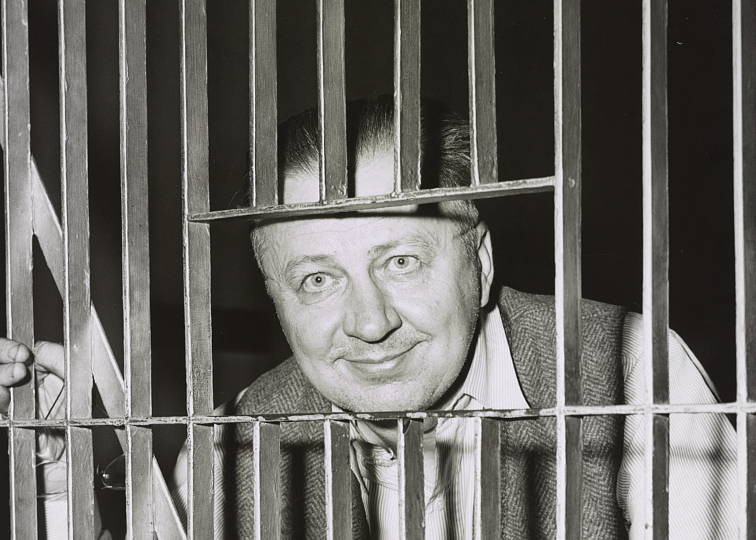
Al Ravenna/Library of CongressGeorge Metesky, the Mad Bomber, stands behind bars in Waterbury, Connecticut after his arrest. January 1957.In the spring of 1973, a man was released from New Yorks Matteawan Hospital for the Criminally Insane, ready to slip back into society after a nearly two-decade exile. That man was George Metesky, better known as the Mad Bomber, who had once terrorized the city of New York for about 16 years in his bizarre and violent quest for justice.Starting in November 1940, George Metesky planted dozens of bombs, injuring at least 15 people in the process. All the while, the Mad Bomber kept the police, particularly Inspector Howard Finney of the bomb squad, scurrying throughout the city to investigate his explosives, from random phone booths to the New York Public Library, Grand Central Station, and Radio City Music Hall. Shockingly, Metesky wasnt caught until 1957.Through it all, the Mad Bomber seemed to have a special fixation on the New York City-based energy company Consolidated Edison, also known as Con Edison or simply Con Ed. Indeed, his first bomb was accompanied by this ominous note: Con Edison crooks, this is for you!George Meteskys Chilling Transformation Into The Mad BomberPhil Stanziola/World Telegram & Sun/Library of CongressDetectives escort George Metesky, the Mad Bomber, through police headquarters in Waterbury, Connecticut to be booked following his arrest. January 1957.The son of Lithuanian immigrants, George Metesky was born on Nov. 2, 1903 in Connecticut. After dropping out of high school, Metesky joined the Marines and worked as a specialist electrician, developing mechanical expertise.Eventually, he found employment at the United Industrial Light and Power Company, a subsidiary of Con Edison. His anger toward the company began after he was injured during an industrial accident in 1931. Not only was he left disabled for 26 weeks, but he had also inhaled scalding boiler fumes, which he said led to pneumonia and tuberculosis. Worse yet, he was denied workers compensation following his injuries and illnesses, purportedly because he had waited too long to file.While many New Yorkers would admit to wanting mild revenge on Con Ed (especially those whove waited hours for repairmen to show up at their apartment), George Meteskys fury toward the company took a darker turn. It started on Nov. 16, 1940, when Meteskys first pipe bomb was found on a window ledge of a Con Ed building in New York City. The device thankfully didnt explode, but a note nearby clearly indicated that Con Ed was being targeted intentionally with the bomb this was no random placement.Similar bombs were recovered in 1941, but after the U.S. entered World War II, Metesky wrote a letter to the police, promising not to make any more bombs during the war. However, he also vowed, I will bring the Con Edison to justice. They will pay for their dastardly deeds. He signed the letter F.P. (He later revealed that this stood for fair play.)Metesky continued to send threatening letters to the police, press, and Con Ed, and then, in 1950, he resumed planting pipe bombs in places like Grand Central Station and the New York Public Library.As the years went on, he picked more and more public places to hide his bombs, such as Penn Station, the Port Authority Bus Terminal, and Radio City Music Hall. He also placed bombs in numerous phone booths.Of the 33 bombs he was known to have planted, about half of them exploded, injuring at least 15 people and startling countless passersby.How The Mad Bomber Was Finally CaughtEverett Collection Inc/AlamyGeorge Metesky, pictured while on his way from Bellevue Hospitals psychiatric division to court in New York City.George Meteskys warped sense of justice fueled his crusade against Con Ed. He soon held New York City itself hostage few could visit a phone booth, go to the theatre, or see a movie without wondering if the time was ticking against them and another bomb was about to explode before their eyes. True, the Mad Bomber hadnt killed anyone, but hadnt doesnt mean wouldnt. The risk to innocent lives didnt seem to matter much to Metesky, who seemed more determined than ever to publicly punish Con Ed.Meanwhile, the police became increasingly frustrated with their failure to identify the Mad Bomber. They eventually sought out partnerships with the press in an attempt to locate him, and their combined forces did establish a dialogue with the terrorist. However, the New York papers that cooperated were often accused of crass collaboration in order to raise circulation.It didnt help that the police investigation was still proceeding glacially, and by the late 1950s, Inspector Howard Finney and his bomb squad turned to psychiatrist James Brussel for insight. Brussel used the Bombers diction (the old-fashioned phrasing of dastardly deeds suggested a non-native Anglophone), methods of implanting the explosives (the penetration of a movie theaters seats with a knife spelled an Oedipal misalignment), and handwriting (the sag of his ws mimicked the curve of breasts) to create a mockup of what the suspect may look like an early version of the criminal profile.Brussel concluded that the Bomber must be an Eastern European man, living with female relatives, with a compulsive and paranoiac nature. In his memoir, Brussel remembers that he predicted: When you catch him, and I have no doubt you will, hell be wearing a double-breasted suit.While authorities did find this profile enormously helpful, sources also attribute the finding of the Mad Bomber to Con Ed clerk Alice Kelly. In 1957, Kelly found a company personnel file on a disgruntled former employee named George Metesky, whose background and syntax matched that of the suspect.The police then came to arrest Metesky, the son of Lithuanian immigrants, and he answered the door to the house he shared with his sisters. The police asked him to change out of his pajamas, at which point he put on a double-breasted suit before surrendering to the authorities.Next, revisit another New York bombing of long ago with this look at the 1920 Wall Street bombing. Then, see where authorities took criminal profiling after the days of George Metesky, with this look at the real FBI profilers and criminals that inspired Netflixs Mindhunter.The post The Shocking Story Of George Metesky And How He Became New Yorks Mad Bomber appeared first on All That's Interesting.
0 Комментарии
0 Поделились
251 Просмотры

 English
 Arabic
 French
 Spanish
 Portuguese
 Deutsch
 Turkish
 Dutch
Dutch
 Italiano
 Romaian
 Portuguese (Brazil)
 Greek
Greek