


WWW.THECOLLECTOR.COM
How the Ruthless Conquests of Tamerlane Ignited Timurid Renaissance
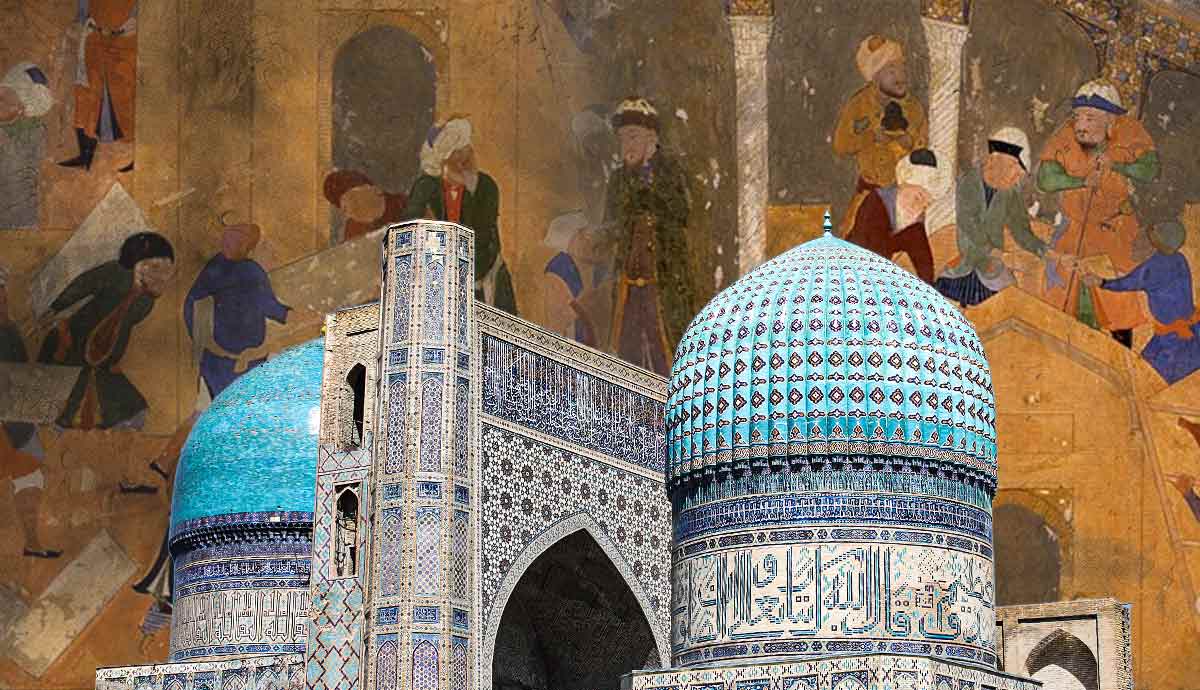
The notorious Turco-Mongol warlord Tamerlane is most famous for his brutal and bloody military campaigns. However, he was also a cultured ruler and patron of the arts and sciences. In fact, under Tamerlane and his descendants, the Timurid Empire saw the blossoming of cultural exchange and development while the imperial capitals of Samarkand and Herat became epicenters of extraordinary artistic and intellectual achievements. Discover how one of historys most violent empire builders created a flourishing of Central Asian art, science, literature, and many other disciplines.Whats in a Renaissance?The Mausoleum of Sufi mystic Khoja Ahmed Yasawi, one of the earliest examples of Timurid architecture. Source: Wikimedia CommonsTo begin, we must acknowledge that the term Timurid Renaissance has come under scrutiny. Historians continue to debate whether the period can be classed as a rebirth of intellectual progress or even be considered unique as a period of intellectual achievement at all. The Timurids did not rediscover ancient wisdom, nor did they enlighten the previously unenlightened. Other great kingdoms and learned rulers blessed the region well before Tamerlane. Indeed, many have argued that the Timurids only stand out because they specialized in patronizing chroniclers and writers who embellished the narrative of Timurid achievement.However, the Timurids are far from the only royal dynasty that had scribes heap superlatives on their accomplishments; dismissing their achievements because of it would be a mistake. The Timurids were not the first learned dynasty, but their empire was still a major center of learning and accomplishment up until its final days. While dynastic enhancement may have colored the Timurid achievements, these accomplishments are still noteworthy in their own right.For the time being, the Timurid Renaissance is still generally accepted, even if only because the term Renaissance has also become a popular shorthand for a period of intellectual development. However, as we shall see, it can be argued that the Timurid Renaissance was a rejuvenation of learning and culture in at least some aspects. So, to the instigator of this not-quite-a-renaissance, Tamerlane himself.Tamerlane Renaissance ManTamerlane overseeing the construction of a mosque in Samarkand, 15th century. Source: Wikimedia CommonsThe son of a petty steppe noble, Tamerlane received a functional but rudimentary education. Certainly, he was not raised a Philosopher King nor an enlightened despotin fact, he was almost certainly illiterate. Yet from these modest origins, and an early career as a part-time bandit, he became one of the most powerful men in the world. Such a meteoric rise requires great intelligence, not just mere brutality. Certainly, Tamerlane was a military and political genius, and he was, for example, extremely skilled at chess, his favorite variant of which is still known as Tamerlane chess. Yet it would be a great mistake to assume Tamerlanes genius was limited to warfare, conquest, and strategy.Illiterate or not, Tamerlane possessed a fierce curiosity and desire for knowledge. The scholar Ibn Khaldun declared Tamerlane after meeting him: highly intelligent and very perspicacious, addicted to debate and argumentation about what he knows and also what he does not know. Tamerlane was also a pre-eminent patron of scholars and artisans. Such was his respect for learned men that he famously spared the lives of scholars and artisans in the cities he conquered. Even his fiercest contemporary critic, Ibn Arabshah, acknowledged that Tamerlane:Loved learned menhe gave the highest honor to the learned and doctors and preferred them to all others and received each of them according to his rank and granted honor and respect.Tamerlane turned his empire into an intellectual and cultural haven, but there was one city in particular that he lavished with intellectual patronage. Samarkand is one of the oldest and most storied cities in the world, but by Tamerlanes day, it had declined drastically after being sacked by the Mongols in the 1220s. Even so, the city still held great prestige, and in 1370 Tamerlane made it the capital of his new empire.Samarkand and the Development of Timurid ArchitectureThe great Bibi-Khanym Mosque built by Tamerlane in Samarkand. Source: Wikimedia CommonsThe great conqueror would do more than just restore the city to its former glory. Much of the treasure Tamerlane plundered in his conquests, and the learned men he spared, were transported back to Samarkand: the treasure to fund the citys renovation, and the learned men to transform Samarkand into a center of scholarship, whether they liked it or not.Coerced as they were, these scholars and learned men transformed Samarkand into the cultural and intellectual jewel of Tamerlanes empire. Indeed, many great minds willingly came to Samarkand to partake in the bounty of learning. Tamerlane also commissioned grand building projects throughout the city, often contributing to the plans himself, adorning his capital with new walls, palaces, and centers of learning and spirituality.The many magnificent monuments of Tamerlanes Samarkand include the Bibi-Khanym Mosque, the largest Mosque in the world at the time, and named after Tamerlanes wife. Just as magnificent is the Gur-e-Amir Mausoleum, built for Tamerlanes grandson but eventually becoming the resting place of Tamerlane himself and much of the Timurid royal family.These great projects were built in the newly emerging Timurid architectural style, a gorgeous blend of new building designs with traditional decorating and artistic techniques. Other ancient cities like Bukhara and Tamerlanes own birthplace of Kesh also received Timurid makeovers from the conqueror. However, one city would become almost the equal of Samarkand: Herat, in modern-day Afghanistan, the first city of Tamerlanes son and successor, Shahrukh.Shahrukh (1377-1447) was Herats governor before eventually succeeding his father to the imperial throne in 1411, after a six-year succession war with his nephew Kalil Sultan. As governor, he bestowed his patronage upon Herat just as his father did on Samarkand. After taking control of the empire, he made Herat the new imperial capital, leading to an explosion of Timurid cultural development.Shahrukh, Herat, and New Cultural DirectionsThe Musalla Complex in Herat, where Shahrukh and his wife Gawharshd had many of their great monuments built. Now, only Gawharshds mausoleum and five minarets still remain. Source: Wikimedia CommonsThough Tamerlane had not had much of an education, he was determined that his descendants would receive one befitting their new status. The education of the Timurid royalty became a particularly noteworthy part of their legacy, but among the educated Timurid princes, Shahrukh stands out. Cultured and with a passion for poetry and writing, Shahrukh patronized scholars and writers and made Herat a haven for learning as well as monument building.Shahrukhs wife, Gawharshd, who commissioned some of the citys most spectacular buildings, became the most renowned of the Timurid builders after Tamerlane himself. Her most noteworthy building projects were a Madrasah and a Friday Mosque, both built at the center of Herat. Nor was Herat the only city to benefit from her architectural ambition, as she famously designed and commissioned a mosque in Mashhad, still renowned today for its architectural beauty.While noble women at the time often commissioned religious buildings, they almost never commissioned mosques, demonstrating Gawharshds true status and power. However, Shahrukh was just as prominent a patron of great works as his wife, nor were their accomplishments solely limited to architecture.Shahrukh and Gawharshd slowly shifted the traditionally Turco-Mongolic Timurid court culture towards embracing more Persian and Islamic elements. In particular, they patronized works of Persian literature and calligraphy, creating specialized writing workshops in Herat dedicated to calligraphy and manuscript production.The most acclaimed of these belonged to their son, Baysunghur (1397-1433), a particular patron of calligraphy. His workshops helped popularize the brand-new Nastaliq writing script under masters such as Jafar Tabrizi. Timurid calligraphy also combined with architecture to create magnificent inscriptions on the walls of Madrasahs and mosques. Famously, Baysunghur himself wrote the inscriptions for his mothers mosque in Mashhad.Herat and Timurid LiteratureIllustration from a Timurid Collection of Persian Poetry, 1405-29. Source: The Met, New YorkUnder royal patronage, Persian poetry boomed. Timurid nobles, such as Shahrukhs nephew, Iskandar Mirza, often composed many works of poetry. Shahrukh also patronized the Persian poet and Sufi scholar Mawlan Jami, who swiftly became a favorite at the Timurid court in Herat. This celebration of poetry was not just restricted to Persian writers, as schools of Chagatai and Arabic poets also flourished in Herat and across the empire.The literary surge also extended to works of history. Many of these were, in fairness, works that promoted Tamerlanes life and Timurid genealogy as a way of boosting Timurid legitimacy. Despite this, many are still interesting and useful sources from the time written by important historians such as Hafiz-i Abru.The blossoming of Timurid literature also helped spur the evolution of Timurid artwork. Persian manuscripts and folios were traditionally decorated with imagery known as Arts of the Book, and with the increase in manuscript production, this art also flourished. The Herat school of manuscript production and decoration became the most prominent of the period. Additionally, cultural contact with Ming Dynasty China led to Timurid artists combining Persian and Chinese wall painting techniques, creating beautiful landscapes throughout the palaces and pavilions of the royal family.Yet, of all the disciplines that blossomed during this period, mathematics and science arguably had their most profound heyday. However, much of this progress came not in Herat but back in Samarkand, under the patronage of Shahrukhs eldest son, Mrz Muhammad Targhy, more commonly known as Ulugh Beg.Ulugh Beg, the Astronomer PrinceA statue of Ulugh Beg in Samarkand. Source: Wikimedia CommonsBorn in 1394, Ulugh Beg was appointed governor of Samarkand by his father at the tender age of 16. From the very beginning of his tenure, he transformed his grandfathers capital into an even greater paradise of science and learning. He complemented Tamerlanes great monuments with his own scholastic institutions: the famous Registan complex of Madrasahs and schools, which became arguably the finest centers of learning in the Islamic world.Yet, his greatest achievement by far was his magnificent observatory, completed in the 1420s, the largest in the world at the time. The building was split into two, with a massive sextant in the middle, through which Ulugh and his associates tracked the stars and greatly advanced the science of astronomy.While the Timurids were all well-educated, Ulugh Beg was by far the most academically accomplished, being an acclaimed scientist in his own right and publishing many notable academic works. Perhaps his best-known work is the Zij-i Sultani, the most accurate astronomical catalog at the time. He also worked with and supported many of the great minds that were by now flocking to Samarkand.Samarkands ornate architecture in Registan Square, photo by Ozodbek Erkinov. Source: UnsplashThe great mathematician Jamshid al-Kashi studied in Ulugh Begs Samarkand, making groundbreaking advances in the calculation of Pi. In fact, Ulugh Beg made the city such a pre-eminent center of learning that even his fathers trusted confidant and poet laureate, Mawlan Jami, moved to study with the prince.The 1420s-1440s were arguably the apogee of the Timurid Renaissance. Samarkand under Ulugh Beg and Herat under his parents became centers of learning, scholarship, and culture to rival even the great Italian cities in their heyday. The rest of the empire also intellectually flourished. Fars province, for example, saw its own literary bloom under Shahrukhs other son, Ibrahim Sultan, and grandson, Abdulah Mirza. The most famous of these works was the Zafarnama, a biography of Tamerlane by Sharaf al-Din Ali Yazdi.DeclineA depiction of a battle between Timurid forces and the Qara Qoyunlu confederation, one of several neighbors who encroached on Timurid territory during the succession crises, 1430. Source: Wikimedia CommonsTragically, however, these good times would not last long. When Shahrukh died in 1447, a succession crisis flared up across the empire. Ulugh Beg was theoretically his fathers successor, but other family members were eager to challenge his authority. Though Ulugh Beg surpassed his father and grandfather in learning and intellect, he had not inherited their aptitude for politics and warfare. Just two years later, he was ousted from the throne and assassinated by his own son. However, this patricidal ruler was swiftly deposed himself, and as the crisis continued, the empire began to wither away.For most of the 1450s, Timurid rule was split between Shahrukhs great-nephew, Abu Said Mirza, in Samarkand, and his grandson, Abul-Qasim Babur Mirza, in Herat. Abul-Qasims death in 1457 saw another two-year-long succession crisis before his cousin seized control of the whole empire, or rather what was left of it. The chaos of repeated succession crises and civil wars had seen much of the empire either break away or fall to opportunistic conquering neighbors. Meanwhile, the empires intellectual institutions were also suffering badly. Ulugh Begs magnificent observatory was destroyed shortly after his death, and Herat had been weakened by repeated sieges.Despite these waning fortunes, Abu Said Mirza was a decent enough ruler. He was not the military or intellectual powerhouse of his forebears, but he kept things steady for a decade. However, when he died in 1469, the Timurid Empire functionally collapsed. Most of it had been conquered by neighboring nations, and what was left was divided among several competing Timurid princes. Yet it was at this moment that the last truly great Timurid prince emerged, Husayn Bayqara Mirza, a descendant of another son of Tamerlane.Swan SongA portrait of Husayn Bayqara as Iskander (Alexander the Great) with the Seven Sages of Wisdom. Equating Husayn with Alexander, considered the ideal monarch by Timurid scholars, shows how Husayn was held in high regard, 1494-5. Source: British LibraryIn the chaos following Abu Said Mirzas death, Husayn seized control of Herat and most of the province of Khorasan. He swiftly stabilized his kingdom, repelled further invasions, and resurrected the cultural and intellectual majesty of his new capital. Contemporaries and later chroniclers consider his reign the last great Timurid triumph. Indeed, some scholars attribute the term Timurid Renaissance solely to his reign as he effectively rebirthed Timurid cultural progress after decades of instability and imperial collapse. His grandson, Babur, said of his reign:His was a wonderful age! In it, Khorasan and above all Herat were full of learned and matchless men. Whatever task a man took up, he aimed and aspired at bringing that work to perfection.In his 35 years of rule, Husayn and his trusted vizier Ali-Shir Navai reinvigorated the artistic and literary heart of Herat. Under their guidance, Persian poetry reached even greater heights. The venerable Mawlan Jami even returned to Herat and composed some of his greatest works under Husayns patronage before his death in 1493.Chagatai poetry also saw a boom as Ali-Shir, himself an accomplished poet, kickstarted a new linguistic evolution as impactful as the one Persian poetry had enjoyed under Shahrukh and Jami many years past. Once again, Art of the Book artistry took off in Herat, with new techniques and styles growing under Husayns patronage.Husayn was also a prolific architect, restoring many great monuments in Herat and adding major buildings of his own to a degree that rivalled even Gawharshd. Most notably, he renovated the Great Mosque of Herat, a grand monument that predated the Timurids but was restored by Husayn to a previously unreached level of magnificence. He also added to the Musalla complex begun by Gawharshd, adding his own Madrasah and minarets to the imposing network of great buildings.The Timurid Renaissance: In ConclusionThe Gr-i Amr Mausoleum in Samarkand, the final resting place of Tamerlane and many of his descendants. Source: Wikimedia CommonsDespite his many great accomplishments and the flourishing of Herat, Husayn spent many of his last years battling Uzbek nomads, internal revolts, and his own ailing health. When he died in 1506, the last remnants of Tamerlanes great empire fell shortly after. The many great monuments in Herat and Samarkand began to decline as the geopolitical centers of Central Asia shifted once again. Yet, for over a century, the Timurids dominated the heart of the Eurasian continent and fundamentally advanced science and culture.The offspring of an illiterate steppe warrior had become poets, authors, architects, and scientists, all while controlling a vast empire. Nor would the end of the empire be the end of the Timurid legacy, for Babur, grandson of the last Timurid ruler, would go on to found his own mighty empire, the Mughal Empire of India. The Mughals drew heavy inspiration from their Timurid forebears in the fields of art and science, as did the Timurids successors in Iran, the Safavid Empire.There is a strong case to be made that the Timurid era can be considered a true renaissance. They were not the first great dynasty to bless the region, but they greatly restored much of its glory after the devastation of Mongol invasions and infighting. The Mongol Khanates were not ignorant savages, but even so, they had taken power and prestige away from Central Asia, power and prestige that was restored and surpassed by Tamerlane and his descendants.The Timurids rejuvenated ancient cities that had gone into declineSamarkand and Herat, but many others also. Moreover, the intellectual pursuits of the Timurids and the melting pots of learning and culture they created saw huge advancements in many fields. The light of the Timurid Renaissance burned briefly in the grand scheme of things, but it burned no less brightly for it.
0 Commentarii
0 Distribuiri
263 Views

 English
 Arabic
 French
 Spanish
 Portuguese
 Deutsch
 Turkish
 Dutch
Dutch
 Italiano
 Russian
 Portuguese (Brazil)
 Greek
Greek