


ALLTHATSINTERESTING.COM
The True Story Of Triboulet, The 16th-Century Court Jester Whose Wit Saved His Life
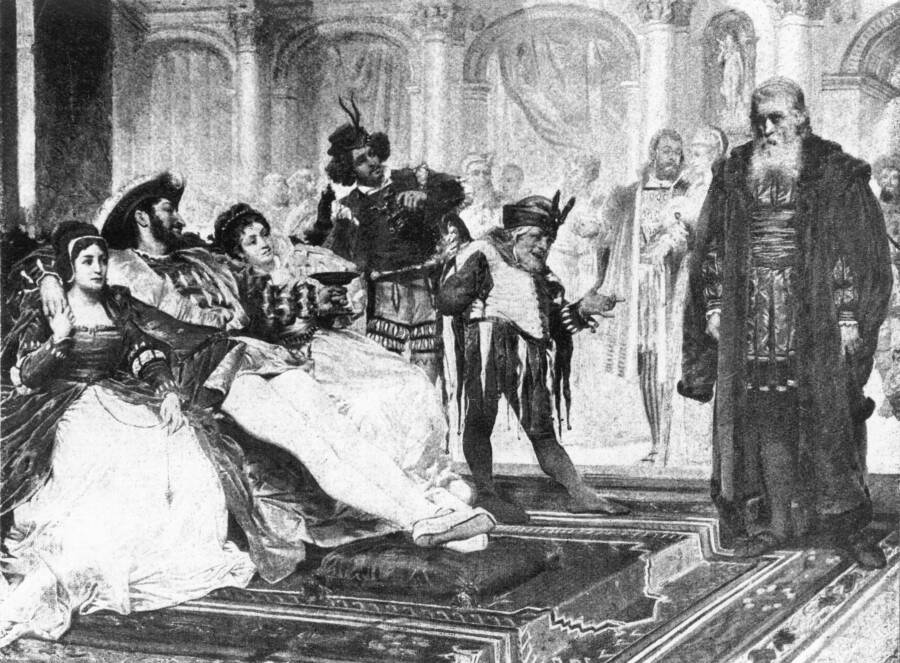
DEA Picture Library/Getty ImagesTriboulet in court, as illustrated by Jules-Arsene Garnier for Victor Hugos play Le Roi sAmuse in 1832.The history and literature of European royal courts littered with comedically gifted jesters. But no court entertainer was as quick-witted as Triboulet. He served in French courts, inspired the works of Victor Hugo, and even saved his own life with a particularly cunning display of his talents.Triboulet took his work seriously. But, tasked to find the joke in any situation that presented itself, he often took things too far. He made his most harrowing mistake during the reign of Francis I and brilliantly resolved it.In an attempt to lighten the mood, Triboulet slapped the king on his rear. The monarch wanted him executed but offered him the chance to apologize. Instead, the jester dug himself even deeper, and the king ordered him killed.After reflecting on the jesters dutiful service, however, Francis I offered him the choice of how he wished to die. Triboulet gave a retort so amusing it inspired famous works of literature and opera that made him a legend.Triboulet Was Born With Congenital DisordersWikimedia CommonsTriboulet purportedly suffered from microcephaly.According to Dr. John Dorans 1858 The History of Court Fools, Triboulet was born Nicolas Ferrial in 1479 in Blois, France. He suffered from microcephaly a neurodevelopmental disorder resulting in congenital disabilities.According to 19th-century French journalist Paul Lacroix, His bowed back, his short and twisted legs, his long and hanging arms, amused the ladies, who contemplated him as if he had been a monkey or a paroquet.Triboulet was a low-level jester around town who was made a court fool by patent around age 24 by the future King Francis I. Once in the service of Francis, Lacroix wrote, Triboulet suddenly ceased to be idiotic and imbecile, and became a witty, diverting, and crafty buffoon, and, above all, a perfect courtier.Lacroix also described his dress in vivid detail: a serge costume of vibrant red and yellow, his cap adorned with the royal arms, and the figure of a fools head at the tip of his wand. It was a jesters job to expose hypocrisy in authority, from religion and law to personal vanity and royal excess. They were granted admirable freedom to do so, despite a kings purported godliness.And Triboulet used this unspoken liberty across his tenures for kings Louis XII and Francis I of France. Until one day he took it too far. How Triboulet Saved Himself With His WitWikimedia CommonsPierre dAillys Court Jester Triboulet Encounters Death (ca. 1500).According to Dornan, it is unclear whether Triboulet ever served directly under Louis XII. Both men were born in Blois, and the town served as a summer resort for the court. And owing to his early reputation and patronage by Francis, it is likely Louis XII would have been aware of him.But it is Triboulets work for Francis I after the death of Louis XII that has become the stuff of comedic legend. And two stories remain particularly cherished today.The first concerns Triboulet frantically notifying the king that a nobleman was threatening to beat him to death. Francis I told him not to worry, and that he would hang the man within fifteen minutes if he dared. Ah, Sir! Triboulet said. Couldnt you contrive to hang him a quarter of an hour previously?Triboulets boldest work, however, nearly killed him.Expecting the applause of courtiers, Triboulet once struck the king on his backside. Francis I was about to have the jester executed but offered mercy if Triboulet could come up with an apology more offensive than the act itself.RijksmuseumAn illustration of Triboulet at work (ca. 1716 1761).Im so sorry, your majesty, that I didnt recognize you! Triboulet said. I mistook you for the Queen! Unfortunately, the kings wife was the one person at court who was entirely off-limits. The king was so furious that he reneged and ordered Triboulets death. However, as a reward for the jesters years-long servitude, he permitted his jester to choose a manner of death. Triboulets response marked the most memorable act of his life:Good sire, for Saint Nitouches and Saint Pansards sake, patrons of insanity, I choose to die from old age.Remarkably, the king found this so humorous that he granted Triboulet banishment instead of death.Inspiring The Works Of Verdi and Victor HugoPennsylvania Academy of the Fine ArtsThe image of a court jester dressed in red is thought to be based on Triboulet.Triboulet did indeed die of old age in the French countryside in 1536. But it was Victor Hugo who solidified his legacy with the 1832 play Le Roi sAmuse. It imagined the jester as a cruel, wrathful figure regularly abused and embittered by the world.Composer Giuseppe Verdi based his Rigoletto opera on this play, casting aside work an adaptation of William Shakespeares King Lear and deeming Triboulet a more interesting character. His resulting figure was a composite of the real jester, Hugos character, the Hunchback of Notre Dame, and Lear.And though the historical record accounts for many court fools, it is Triboulet alone whose eponym triboulet has come to signify the image of a Renaissance jester dressed entirely in red.After learning about Triboulet, read about Mary Queen of Scots and her grisly execution. Then, learn about ten awful jobs youll be glad no longer exist.The post The True Story Of Triboulet, The 16th-Century Court Jester Whose Wit Saved His Life appeared first on All That's Interesting.
0 Комментарии
0 Поделились
257 Просмотры

 English
 Arabic
 French
 Spanish
 Portuguese
 Deutsch
 Turkish
 Dutch
Dutch
 Italiano
 Romaian
 Portuguese (Brazil)
 Greek
Greek