A Metal Detectorist In Germany Just Happened Upon A 1,000-Year-Old Cross Featuring Jesus Surrounded By A Wheel
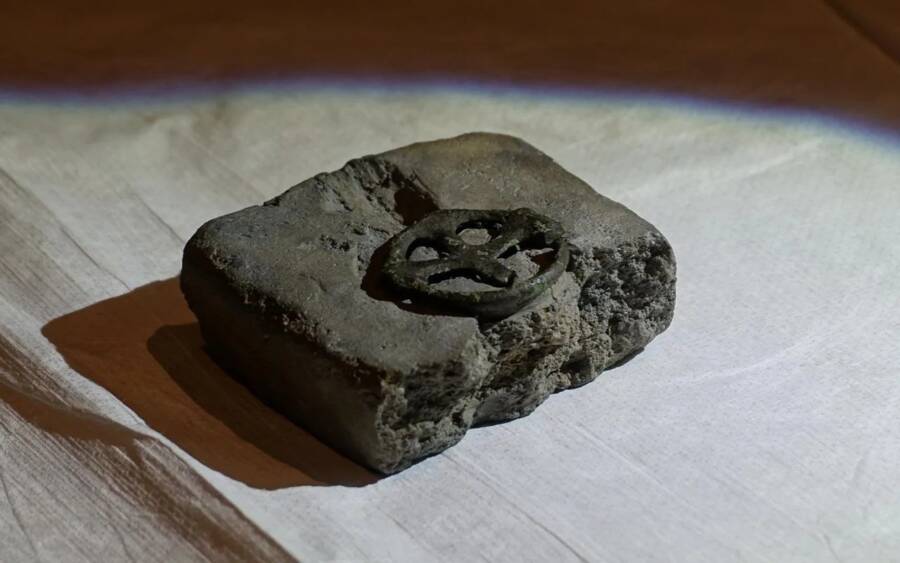
Brandenburg State Office for Monument Preservation and Archaeological State Museum (BLDAM), Lukas GoldmannThis bronze wheel cross is a remnant of early Christianity in the region.During excavations in northern Germany, a volunteer archaeologist was scouring the ground with a metal detector when she got a signal. Upon excavation, archaeologists discovered a rare medieval wheel cross made of bronze a find that quickly proved extraordinary in more ways than one.For starters, the cross perfectly matches a blacksmiths mold that was found in the region in the 1980s, suggesting that the blacksmith produced such objects in large quantities. For another, the cross is evidence of the spread of Christianity in the region before the Slavic Revolt of 983 broke out in opposition to it.The Discovery Of A Medieval Wheel Cross In Brandenburg, GermanyAccording to a statement from the Brandenburg State Office for Monument Preservation and Archaeological State Museum (BLDAM), the bronze cross was found during excavations at a site in the Havelland area of Brandenburg. A volunteer archaeologist named Juliane Rangnow was examining the site with a metal detector when she found this remarkable object, which archaeologists have dated to the 10th or 11th century.Brandenburg State Office for Monument Preservation and Archaeological State Museum (BLDAM), Gabriel GrafThe bronze wheel cross dates to the 10th or 11th century, a time when Christianity was far from accepted in this majority-Slavic region.Holding such a find in your hand is like a bridge to the past, Rangnow remarked, adding: Thats what makes the work as a volunteer archaeological monument conservator so exciting.The wheel cross was unearthed alongside a number of other artifacts from the 10th or 11th centuries, including iron weapons, coins, and pieces of gilded jewelry. But the cross stands out for a number of reasons, including its connection to another artifact found in the region more 40 years earlier.In 1983, archaeologists found a mold for a wheel cross in nearby Spandau, which became known as the Spandau Cross. Thrillingly, researchers have now discovered that the newly-unearthed cross found in Brandenburg exactly matched the mold of the Spandau Cross, meaning that the latter was surely used to make the former.The discovery of a small bronze cross is not just another find among many, Minister of Culture Dr. Manja Schle said. This find is spectacular in several respects: It fits exactly a casting mold that was discovered more than 40 years ago that is unique for an archaeological find from this period.Researchers now suspect that the blacksmith who made it served a large market and a highly mobile population. Its also a sign of early Christian presence in the region, something which would be violently rejected by many locals in the late 10th century.The History Of Early Christianity In The Region And The Slavic Revolt Of 983National Museums in Berlin, Museum of Prehistory and Early History, Claudia PlampThe Spandau cross mold that was found in 1983, and which matches the bronze wheel cross found in Havelland.The wheel cross found in Havelland is not only a remarkable object because of its rarity or its connection to the Spandau Cross mold. Its also extraordinary because of the time in which it was made.In the early 10th century, the region, then populated by non-Christian Slavic tribes, was conquered by the East Frankish Kingdom. And those conquerors brought with them a new religion: Christianity. But the Slavic people resisted their conquerors, and overthrew them during the Lutician Revolt, or the Slavic Revolt of 983. The region was politically and religiously independent for the next 150 years, until Christianity successfully began to spread in the 12th and 13th centuries, when the region was absorbed into the Holy Roman Empire.The newly-discovered wheel cross is thus a rare relic of early Christianity in the region. Before the Slavic Revolt of 983, such totems were common, though many have been lost today.This new find is one of the rare early pieces of evidence of the unique Christianization history of the northwestern Slavs, said Lukas Goldmann, a research associate for the Slavic Middle Ages at BLDAM, which continues to shape northeastern Germany to this day.After reading about the bronze wheel cross that was found in Germany, discover the mysterious story of Kryi Kalnas, Lithuanias hill of crosses. Then, learn the full story behind the crucifixion of Jesus Christ.The post A Metal Detectorist In Germany Just Happened Upon A 1,000-Year-Old Cross Featuring Jesus Surrounded By A Wheel appeared first on All That's Interesting.




 English
 Arabic
 French
 Spanish
 Portuguese
 Deutsch
 Turkish
 Dutch
Dutch
 Russian
 Romaian
 Portuguese (Brazil)
 Greek
Greek