


ALLTHATSINTERESTING.COM
David Hahn, The Radioactive Boy Scout Who Tried To Build A Nuclear Reactor In His Backyard
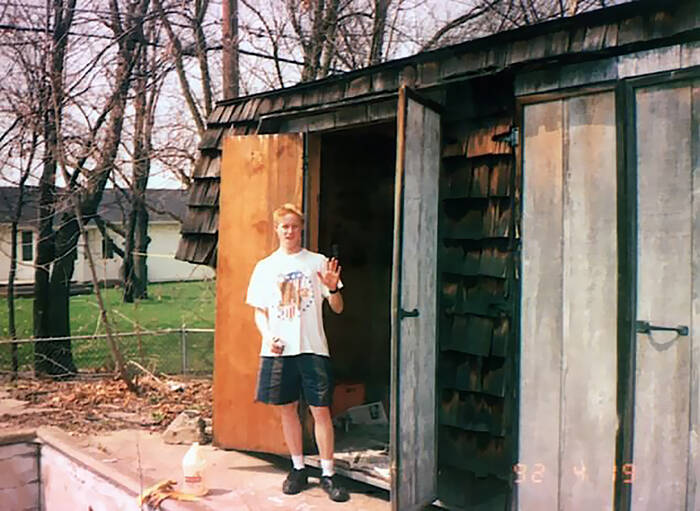
David Hahn, the so-called Radioactive Boy Scout, pictured in front of the shed in which he tried to build a nuclear reactor.In 1995, a teenage boy scout in Michigan named David Hahn attracted the attention of local authorities in his Detroit suburb. Hahn caught the laws eye when suspicious materials were found in his car. But further investigation revealed a series of backyard science experiments, including the teens attempt to build a working nuclear reactor.Achieved with materials he had at hand, Hahn managed to successfully create a homemade neutron source in an everyday backyard shed and nearly irradiated his whole neighborhood.Hahn had been fascinated with science since childhood. Intending to create a breeder reactor in 1995, the result was less than intended, but enough to capture national attention. This is the unbelievable true story of David Hahn, the teenager popularly known as the Radioactive Boy Scout or the Nuclear Boy Scout.David Hahn, The Nuclear Boy ScoutYouTubeA young David Hahn sporting a merit badge sash.David Hahn tried to build his homemade nuclear reactor when he was only 17, according to FBI records. Conducted in his step-mothers backyard in Commerce Township, Michigan, the experiments were run in near total secrecy.Practically a wunderkind, Hahn began studying chemistry at age 10 and had fabricated nitroglycerin by 14. Before attempting to build his reactor, Hahn tarnished his bedroom with his experiments, so his parents moved his work to their basement, before settling on the shed.Hahn gathered information by contacting the Nuclear Regulatory Commission, hoping to gain insight into the steps of building a breeder reactor. In most cases, Hahn was able to gather the info he needed with the help of aliases and cover stories.Hahns interest in creating a breeder reactor was fueled by many things. The teen read about chemical experiments fervently, teaching himself how to manipulate reactions, and was awarded a merit badge for atomic energy in 1991. He supplemented his practical research with long study sessions at his local libraryThe flames of Hahns fascination were fanned by two obsessive goals, one being the task of creating a breeder reactor; the other, of collecting each element on the periodic table regardless of radioactivity.For Hahn, the creation of a homemade nuclear reactor would have been a more complex task than creating a homemade breeder reactor. Both requiring dangerous materials, breeder reactors utilize the more available chemical isotope Uranium-238 the chemical element thorium while nuclear reactors may only use the scarcer Uranium-235.While the uranium used in nuclear reactors are readily fissionable, Uranium-238 and thorium are more available.And so, utilizing household items and a lead block as a stand-in reactor, Hahn got to work. He collected thorium from lanterns, radium from clocks, tritium from gunsights, and lithium from $1,000 worth of batteries he bought himself.Hahn also employed coffee filters and pickle jars to handle dangerous and potentially deadly chemicals. The lack of protection, save for his gas mask, later likely affected Hahns life expectancy.During his shed-bound experiments, Hahn persevered through accidental burns on his skin, turning his hair green, and mistakenly causing himself to pass out.When the experiment met its threshold, Hahn had created a crude neutron source. While unable to produce fissionable fuel at the rate of other reactors, the the Boy Scouts experiment was already spreading detectable radiation several houses away. David Hahns Experiments Attract The Wrong Kind Of AttentionJim WestDavid Hahn posing with The Golden Book of Chemistry Experiments, a book that shaped his interests.As detected by David Hahns own Geiger counter, his experiment proved radioactive by the time it was disassembled and left 40,000 town residents potentially at risk.Police located Hahns shed after stopping the young teen for unrelated reasons. Finding suspicious materials in his trunk, the scout informed the officers the content was radioactive. From there, it did not take long to uncover the shed and its impact on Hahns neighborhood.The local police contacted the federal authorities, leading the Environmental Protection Agency to Hahns doorstep. Those who entered Hahns shed lab were warned by a misspelled Caushon sign on the wall.Inside, authorities found evidence of Hahns dangerous hobbies. The remnants of the experiment and materials collected posed numerous health risks, and the EPA declared the property a Superfund hazardous materials cleanup site.Despite insistence from officials, Hahn refused to be medically evaluated following the long periods he spent around radioactive materials. Since his experiment took place with minimal protection, Hahns life expectancy was likely shortened after the incident.Following the labs dismantling, Hahn achieved his Eagle Scout rank despite his dangerous experiment. However, regardless of what progress he made, Hahn had trouble finding direction following the experiments fallout.I was very emotional as a kid, and those experiments gave me a way to get away from that. They gave me some respect, Hahn told Harpers Magazine in 1998.The Sad Final Years Of The Radioactive Boy ScoutKenneth HahnDavid Hahn and his half-brother, Kevin.The collapse of his experiment, turmoil from a failed relationship, and his mothers suicide each contributed to Nuclear Boy Scout David Hahns depression, according to Ars Technica. Attempting to find his place in the world after the disastrous events in his backyard, he tried his hand at college and the military, mostly at the request of his father and step-mother.Hahn served in both the United States Navy and the United States Marine Corps, but only found new complications with mental health as he grew older.Following his original experiments disassembly, Hahn once again attracted the polices attention a decade later. Suspected of creating another reactor and storing it in his freezer, Hahn was arrested in 2007 for stealing some detectors.The devices were taken from the apartment complex Hahn was staying in. The theft was significant for the small amounts of radioactive americium found in the smoke detectors. Since americium was found in greater amounts in Hahns shed in 1995, authorities evacuated residents for five hours fearing the infamous former Boy Scout was at it again.At the time of the incident, police had already been tracking Hahn and monitoring the region for radioactivity. Coinciding with his return to the area, authorities took note that Hahn had begun advertising a book written about his experiment.With their eyes already fixed on Hahn, the police were quick to arrest him on account of his theft. Sixteen smoke detectors across Hahns building and another in his complex had gone missing. Police found additional empty smoke detectors near Hahns trash.Following his arrest, David Hahn pleaded guilty to attempted larceny of a building and was sentenced to 90 days in jail. And about a decade later, Hahn died from a combination of alcohol, diphenhydramine, and fentanyl. The Nuclear Boy Scout was just 39 years old.After reading about David Hahn and his attempts to build a nuclear reactor, see Chernobyl today after nuclear disaster. Then, read about Hisashi Ouchi, who sustained the worst radiation burns in history.The post David Hahn, The Radioactive Boy Scout Who Tried To Build A Nuclear Reactor In His Backyard appeared first on All That's Interesting.
0 Commenti
0 condivisioni
309 Views

 English
 Arabic
 French
 Spanish
 Portuguese
 Deutsch
 Turkish
 Dutch
Dutch
 Russian
 Romaian
 Portuguese (Brazil)
 Greek
Greek