


ALLTHATSINTERESTING.COM
Inside The Little-Known Story Of Who Actually Invented Television
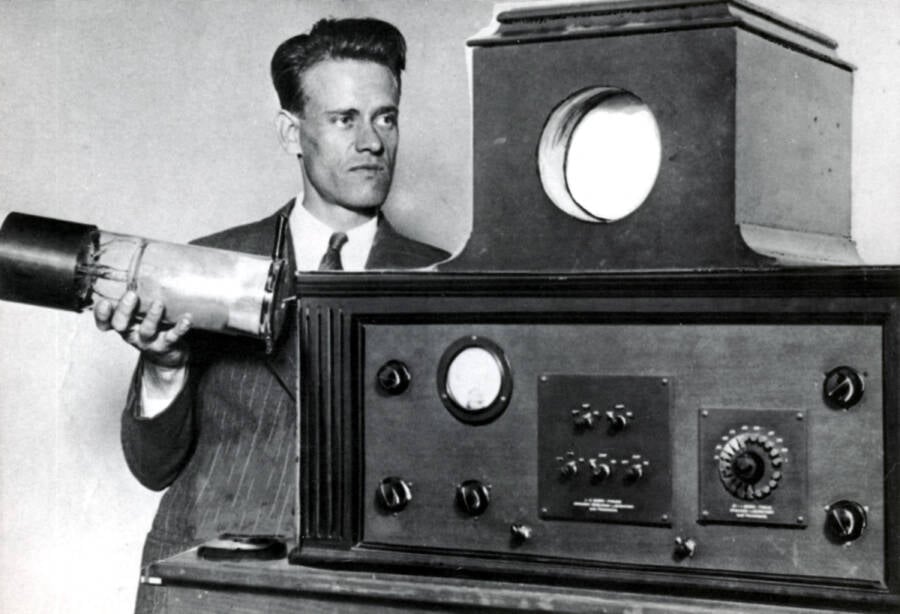
Science History Images/Alamy Stock PhotoPhilo Farnsworth, the American inventor whos most often credited as the man who invented television. Today, its easy to take the television for granted as one of many options for entertainment available to us, especially during the age of the internet and the ongoing popularity of social media. But it cannot be understated just how radically television transformed culture.The word television was first coined by Russian scientist Constantin Perskyi at the International Congress of Electricity during the Worlds Fair in Paris in 1900. But it took the work of numerous inventors, scientists, and engineers to create what would eventually become the small screen, including Scottish engineer John Logie Baird, Russian-born engineer Vladimir Zworykin, and German scientist Paul Gottlieb Nipkow.That said, the title of the father of television is most often given to an American inventor named Philo Farnsworth. A former farm boy, Farnsworth was just 14 years old when he first dreamed up the idea of what would become the television standard, which later led to him being credited as the man who invented television as we know it. He went on to hold more than 300 patents related to television and other technologies. Unfortunately, Farnsworth didnt get to enjoy his success, as he soon found himself at the center of a long legal battle with the Radio Corporation of America (RCA). Though Farnsworth emerged victorious, his problems were far from over, and as RCA became forever associated with the introduction of television, Farnsworths name remained in relative obscurity.Inside The Origins Of TelevisionLong before families were gathered around their televisions to watch their favorite shows each night, a Russian scientist named Constantin Perskyi conducted research into electricity and image transmission.He was not alone in his research. Around the turn of the 20th century, the whole scientific world was abuzz with the possibilities of electricity. The 19th century had already seen the invention of the pioneering electric telegraph, created by Samuel Morse in 1844, followed by the telephone, developed by Alexander Graham Bell in 1876. Then, by 1896, Guglielmo Marconi had introduced a successful wireless telegraph, or radio.Unsurprisingly, the Worlds Fair in Paris in 1900 offered an exciting showcase of various emerging technologies, and proved to be the perfect place for Constantin Perskyi to present his paper, Tlvision au moyen de llectricit, or Television by means of electricity.Public DomainThe Palace of Electricity at the Worlds Fair in Paris in 1900.Perskyis paper, delivered during the International Congress of Electricity, became a landmark moment in the early history of television. After all, it was the first time that word had ever been used. It was a combination of the Greek root tele, meaning far off, and the Latin word visio, meaning sight. Though some were put off by that combination, Perskyis term finally gave the concept of distant electric vision a concise and enduring name. On top of that, his paper raised more awareness of existing electromechanical technologies and other related ideas, including the work of German scientist Paul Gottlieb Nipkow, the creator of the Nipkow disk.Invented in 1884, the Nipkow disk was a simple spinning disk that could help send images through wires. The disks spirals of apertures passed successively across a picture, making the idea of a mechanical television possible (though Nipkow described his system as an electric telescope).Perskyi clearly recognized the brilliance of the model and the limitations of older technology from earlier years and made it a goal to expand upon this concept, which he had now dubbed television.Years later, other brilliant innovators took the idea even further.Philo Farnsworths Humble Life Before He Became The Father Of TelevisionPhilo Farnsworth was born in a log cabin in Beaver, Utah, on August 19, 1906, but his family later moved to a remote farm in Rigby, Idaho, when he was still a boy. It was hardly the sort of place where technological geniuses usually thrived but Farnsworth was thrilled by his new home. From an early age, Farnsworth had displayed an insatiable appetite for science, and one of his favorite things about living in Idaho was that his new home had electricity. Farnsworth was fascinated by the technology and made it his mission to learn as much as he could about the farms generator, and electricity in general. From there, he eventually converted almost all of his familys appliances to electrical power.Public DomainPhilo Farnsworth, the man who invented the prototype of the first working, fully electronic television system.Though Farnsworths formal education was relatively limited, he often learned much more from his own experiments and independent reading. And according to the Smithsonian Magazine, it was while he was plowing a potato field in straight, parallel lines that the foundational idea for electronic television struck him. He was suddenly inspired to create a system that could break an image into horizontal lines and reassemble those lines into a picture at the other end. He also realized that electrons would be crucial to capturing and transmitting a clear moving image.He was only about 14 or 15 years old at that point, but when he later presented a sketch of his then-hypothetical invention to his high school teacher, it was clear that his idea was likely workable. That teacher, Justin Tolman, held onto Farnsworths sketch, too which would later provide crucial evidence in the patent battles that lay ahead. The Complicated History Of And Battles Over Who Invented TelevisionAs Philo Farnsworth began to further test his idea, he continued to break new ground. His idea had eliminated the need for any mechanical image-transmitting systems (like those associated with the Nipkow disk), which made the process of transmitting image data seem more manageable. Throughout his teenage years, he clearly envisioned a vacuum tube that could reproduce different images electronically by shooting a beam of electrons, line by line, against a light-sensitive screen.Meanwhile, other great minds were putting their own ideas into motion. Scottish engineer John Logie Baird publicly demonstrated the first-ever successful transmission of moving images in 1926. His system depended on mechanical rotating disks to scan moving images into electronic impulses, and he was clearly inspired by Nipkow while putting together his creation.Notably, Baird also later went on to create a system of color television and even demonstrated a form of stereoscopic (3D) television.Wikimedia CommonsJohn Logie Baird, a Scottish engineer whos often considered one of the men who invented early television.Then, in 1927, Farnsworth was able to complete the prototype of the first working, fully electronic television system. He was just 21 years old at the time, and even though his first successful image was nothing more than a simple line, it proved his system worked, and that was all he needed. By 1929, he had successfully transmitted images of people, including his wife.Not everyone was thrilled with Farnsworth, though. David Sarnoff, the head of the Radio Corporation of America (RCA), saw Farnsworths achievements as a threat to his company, which had also heavily invested in its own research, led by the Russian-born engineer Vladimir Zworykin. Sarnoff wanted to influence the future of television just as he influenced radio by controlling the essential patents and eliminating his competitors. As Thomas Lento, the director of communications for the Sarnoff Corp., told the MIT Technology Review in 2000, Sarnoff was the Bill Gates of his age. RCA had a stranglehold over an entire sector of the economy.Public DomainVladimir Zworykin, pictured with a collection of video camera tubes.So, upon learning about Farnsworths patent and his promising plans for the future, Zworykin decided to pay him a visit in 1930. While Zworykin was impressed, he and Sarnoff proceeded to claim that Zworykins patent for a camera tube should take priority over everything Farnsworth created. They also claimed their own research was superior, even though Sarnoff offered Farnsworth $100,000 to buy his growing company, own his patents, and take Farnsworth on as an RCA employee.After Farnsworth turned him down, RCA launched a lengthy legal battle to invalidate Farnsworths patents and elevate Zworykins patent instead.Fortunately for Farnsworth, he had a trump card.Philo Farnsworth Proved His Title As The Man Who Invented Television At A PricePublic DomainPhilo Farnsworth, pictured before the Temporary National Economic Committee in 1939.RCA had a lot more money than Philo Farnsworth, and they were prepared to take him down in patent court, no matter how long it took. Farnsworth didnt have the same luxuries of resources and time, so he started out at a disadvantage. Furthermore, RCAs lawyers tried to argue that Farnsworths journey to creating his television system was impossible no teenage boy could have devised the technology he was claiming to have invented. If that crucial aspect of Farnsworths story was proven false, then RCA had a better shot at claiming he had no real claim to the patent they so greatly valued. There was, however, one other person who could validate Farnsworths claims: his old teacher, Justin Tolman. As it turned out, Tolman had held onto that sketch Farnsworth gave him when he was still in school, proving that Farnsworth was worthy of being called the father of television and the man who invented the device.Public DomainA family watching television in 1958.Finally, the U.S. Patent Office sided with Farnsworth in 1934, and Sarnoff eventually had to pay Farnsworth about $1 million in licensing fees.Despite the victory, though, the battle had taken its toll on Farnsworth. He soon endured patent appeal lawsuits from the RCA, turned to liquor to cope with the stress, struggled to manage the money he was awarded, and ultimately died in debt when he was just 64 years old.RCA, thanks to its massive marketing power, became synonymous with television in the public mind, and its true creator a genius farm boy turned inventor never truly received the proper recognition he deserved.After learning about who invented television, go inside the history of the first lightbulb. Then, read about seven brilliant Black inventors you never learned about in history class.The post Inside The Little-Known Story Of Who Actually Invented Television appeared first on All That's Interesting.
0 Commentarii
0 Distribuiri
352 Views

 English
 Arabic
 French
 Spanish
 Portuguese
 Deutsch
 Turkish
 Dutch
Dutch
 Italiano
 Russian
 Portuguese (Brazil)
 Greek
Greek