A Metal Detectorist In England Unearthed A Roman Figurine Depicting A Big Cat Pawing A Mans Severed Head
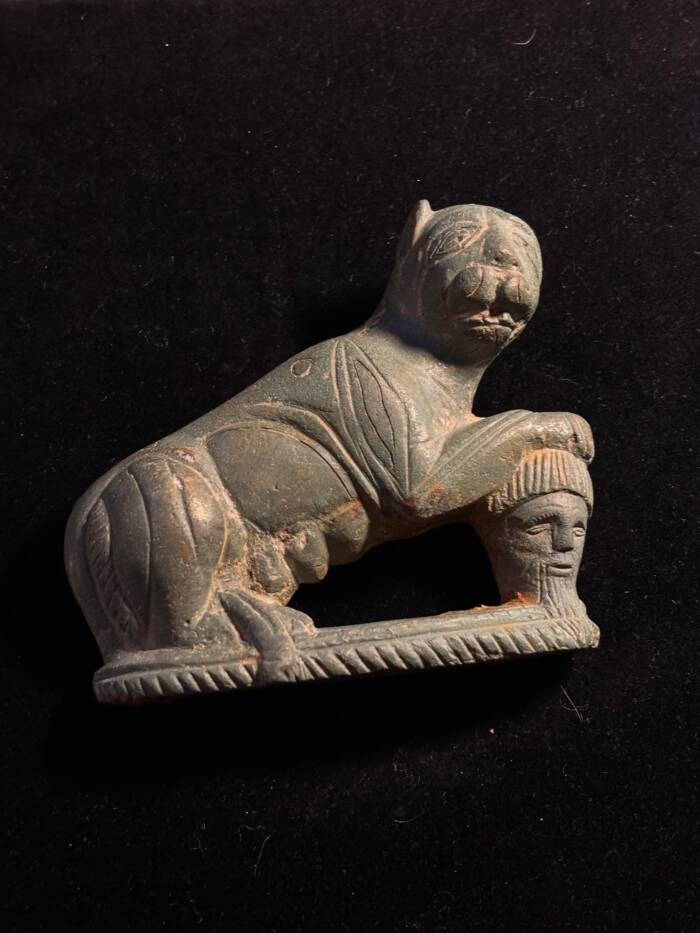
Essex Portable Antiquities Scheme/FacebookThe unique Roman relic depicting a big cat pawing a severed head, which was found in Harlow, Essex in 2024.A rare Roman artifact discovered by a metal detectorist in Harlow, Essex in 2024 has been officially declared Treasure by the British government.The artifact is a small, copper-alloy sculpture depicting a large cat resting its paw on a detached human head. It was dated to approximately 43 C.E. to 200 C.E., a few hundred years before the fall of Rome, and experts believe it was likely affixed to the straps used to yoke an animal to a carriage or wagon.It is the only known Roman vehicle fitting found in Britain that uses this particular feline motif, giving it special historical significance.A Unique Depiction Of A Big Cat From The Days Of Roman BritainIn its listing of the find, the British Museum describes its fearsome appearance: Substantial anatomical detail is rendered through modeling in the round and incision, the latter giving a stylized accentuation to the animals musculature. Meanwhile, two faint circles on the feline figure suggest it depicts a leopard, but experts arent sure.Though it is three-dimensional on one side, the back of the sculpture is hollow and filled with lead, indicating it was likely attached to a vehicle at that end.The eyes on the disembodied human head are closed, indicating that the man is dead. The inclusion of this detail the detached head makes the discovery unique for Britain, as does the stylized rendering.His beard, as well as the felines tail, hangs over the edge of the base. That beard, along with the mans hair, are in keeping with Greco-Roman iconography used to represent barbarians, those who lived outside of those empires spheres of influence.The British MuseumA detailed look at all sides of Roman relic found by a metal detectorist in Essex.This combination is otherwise unknown among objects of this kind, though the pairing of feline and head is documented on other objects, the museum notes.One such similar object is currently housed at the Colchester Museum, though it is slightly different. The Colchester Museum artifact also depicts a female big cat resting her paw on a disembodied head, but in this instance it is not the head of a barbarian. Rather, the panther is resting her paw on a medallion bearing the face of Jupiter Ammon, a syncretic deity combining the Greco-Roman king of gods, Jupiter/Zeus, with the Egyptian supreme god Amun.Furthermore, other ancient artifacts have likewise depicted big cats resting their paws on a wide range of objects.Symbolic Links Between This Feline Relic, Bacchus, And BarbariansIn many of these cases from the time of ancient Rome, motifs of large cats including panthers, leopards, and on occasion, tigers are linked to the god Bacchus and his retinue, meant to symbolize the gods wild, ecstatic, and untamed nature. Artists have often depicted Bacchus riding large cats in chariots or wearing their skins to emphasize his power and connection to the exotic.Artifacts such as the one found in Essex were once thought to decorate vehicles used in religious processions, but that interpretation has changed in more recent years. It is now believed that these vehicle fittings gained popularity at the same time as other Bacchic images as symbols of good fortune and protection for travelers.The Colchester MuseumThe Colchester panther, with the head of Jupiter Ammon.Still, the pairing of a feline and a barbarian head is not so a common one.The pairing of feline and disembodied head does however echo two images found widely in other Roman media of felines with an animal head, usually that of a sheep, held underneath their feet or in their mouth and sitting or lying over a human figure, the latters head close to the animals mouth or paws, the museum notes.The head is distinctly that of a barbarian, as evidenced by its full cap of hair and long beard, representing Greco-Roman stereotypes of barbarism. The British Museum calls this an intriguing pairing, linking an exotic animal to what would have been considered an exotic human, creating an evocative image of the barbaric periphery of the empire, where beings epitomizing the uncivilized other might be imagined as confronting one another.It is these unique traits that have led British officials to declare the artifact official Treasure, as it has been deemed of considerable historical interest and could greatly contribute to the study of Roman Britain.After learning about this rare Roman artifact, learn about the brutal Roman animal battles known as venationes. Then, read about the Roman Empires most brutal leaders.The post A Metal Detectorist In England Unearthed A Roman Figurine Depicting A Big Cat Pawing A Mans Severed Head appeared first on All That's Interesting.




 Arabic
 French
 Spanish
 Portuguese
 Deutsch
 Turkish
 Dutch
Dutch
 Italiano
 Russian
 Romaian
 Portuguese (Brazil)
 Greek
Greek