


WWW.THECOLLECTOR.COM
The War of 1812: Causes, Key Events, and Lasting Effects
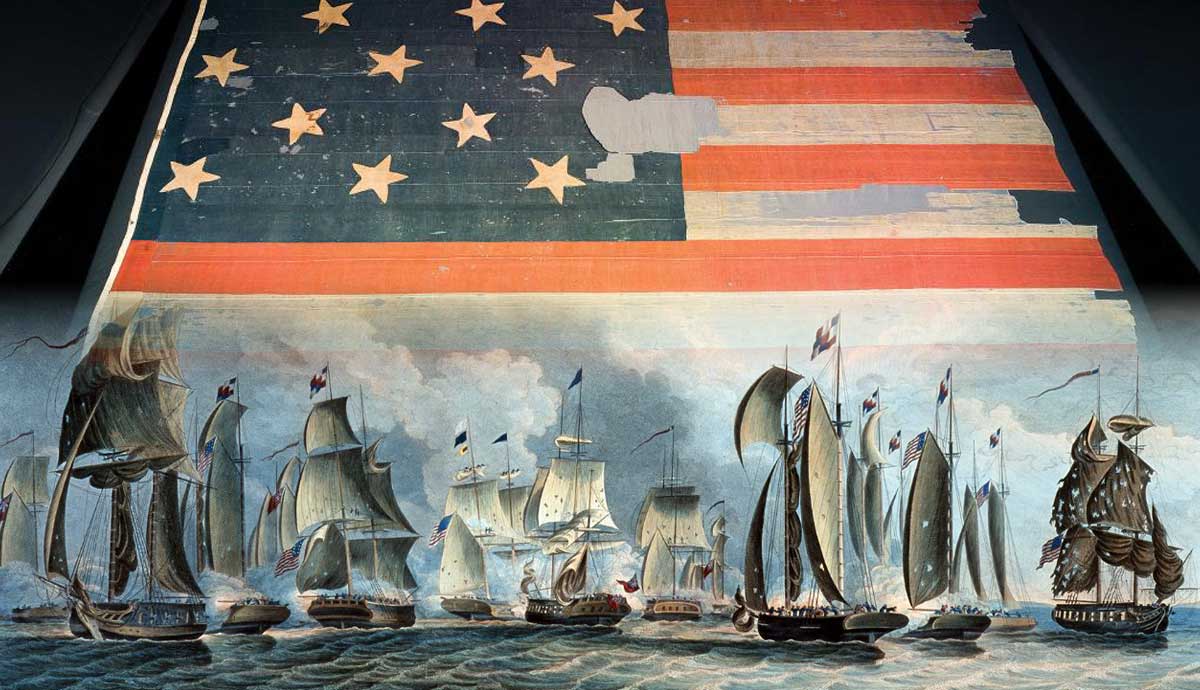
The American Revolutionary War officially provided early American citizens with independence from British colonial rule, but after eight years of fighting, victors were left with the responsibility of shaping the United States politically, economically, and militarily. Founded on the ideals of life, liberty, and the pursuit of happiness, the nascent country continued to be the target of provocative actions by Britain into the 1800s. Less than thirty years after American independence, the United States was once again at war with Britain.Primary CausesPrint of President James Madison by Gilbert Stuart, 1828. Source: Smithsonian InstitutionDuring the early 19th century, British actions at sea and in American ports escalated tensions with the United States. Namely, the Royal Navy forced American sailors into service for the British navy without their consent, a method known as impressment. With Europe embroiled in the Napoleonic Wars, Britain restricted American trade with France, infringing on Americas rights as a neutral power. In 1807, President Thomas Jefferson had attempted to enforce American neutrality by placing an embargo on all trade with the United States, but this policy was abandoned in 1809 as it only served to damage American economic interests. When President James Madison came to office in 1809, the drumbeat for war grew ever louder.Countering both real and perceived grievances with British actions in the early 1800s was a strong motivator for further hostilities. War hawks cheered on the idea of expanding the American territory north into Canada, and on the western frontier, settlers faced immense clashes with Native American groups intent on protecting their land. The Americans believed this resistance was fueled by the British, strengthening calls for war.On June 18, 1812, the United States formally declared war on Britain and American forces soon invaded British Canada. However, fighting an adversary with the worlds most powerful navy would prove especially challenging for the United States.Major BattlesPainting of General William Henry Harrison by Rembrandt Peale, date unknown. Source: Smithsonian InstitutionOne of the most significant battles of the War of 1812 occurred shortly after the American invasion of Canada. Near modern-day Ontario, British and Canadian troops successfully defended the invasion despite the death of British commander Major General Isaac Brock. This early success at the October 1812 Battle of Queenston Heights marked a sustained period of British control over the Niagara region.In October 1813, the War of 1812 observed more intense fighting in northern Canada. At the Battle of Thames, future president and General William Henry Harrison led American forces against the British and their Native American allies. Already suffering from an immense naval defeat at the Battle of Lake Erie one month prior, retreating British forces launched a counteroffensive near the Thames River. The unrelenting American forces pursued the British, refusing to let their enemies regroup. During the resulting engagement, Shawnee leader Tecumseh was killed in battle. This led to the effective collapse of Tecumsehs Confederacy and weakened the British western flank.The following year, the Battle of Lake Champlain, also known as the Battle of Plattsburgh, proved crucial for securing the northern boundary of the United States. In the deadly naval engagement, American Master Commandant Thomas Macdonough outmaneuvered the superior British fleet, leading to a decisive victory. Just two days later, American forces successfully defended Fort McHenry at the Battle of Baltimore. The action prevented the British from exploiting their successful attack on Washington DC on August 24, 1814 and would have a significant impact on American national identity.Turning PointThe Battle of Lake Erie, Second View. Engraving by Murray Draper and Co. after Sully and Kearny, c. 1813. Source: Naval History and Heritage CommandWhile there were many important battles during the War of 1812, the Battle of Lake Erie in 1813 proved to be a primary turning point in the struggle for control of the Great Lakes. Controlled by the British, Lake Erie facilitated the transportation of supplies and troops in the theater. On September 10, 1813, American naval forces made an attempt to reclaim the lake by engaging the British near Put-in-Bay in northern Ohio.During the battle, American Master Commandant Oliver Hazard Perry led his naval forces through heavy casualties. Damage inflicted by the British was so intense that Perrys flagship vessel, the USS Lawrence, was exposed and rendered indefensible. Instead of surrendering, the brave naval officer boarded a smaller craft and assumed command from the USS Niagara. Refusing to give in to British momentum, Perry organized naval bombardments in a decisive counterattack, forcing the British to surrender. Following the confrontation, Perry sent a memorable status report to fellow American commanders, We have met the enemy, and they are ours.Not only did the Battle of Lake Erie allow the United States to dominate the crucial waterway for the remainder of the War of 1812, but the exchange also permitted American forces on land to exploit retreating British and Native American forces by recapturing Detroit, which was lost to the British early in the war. This series of events turned the tide of the war and strengthened the United States negotiating position. The signing of the Treaty of Ghent in December 1814 ended hostilities, and the war ended in February 1815 after its ratification.Immediate ImpactDrawing of President James Monroe by Jacques Reich, 1899-1920. Source: Smithsonian InstitutionThe War of 1812 had several immediate outcomes that shaped US foreign policy in the early 1800s. The Treaty of Ghent maintained the status quo ante between the United States and Britain in terms of territory. Both sides now sought a diplomatic solution to issues such as impressment. Although the British made no formal commitment to end impressment, the end of the Napoleonic Wars in Europe reduced the British Navys manpower requirement and rendered the controversial recruiting method unnecessary.In the aftermath of the War of 1812, the United States found it easier to expand westwards and incorporate new states into the Union, while American shipping could trade freely with economic partners overseas. Renewed American confidence and friendly relations with Britain enabled President James Monroe to formulate the Monroe Doctrine of 1823, which warned European colonial powers from interfering in the Americas.Politically, the War of 1812 began the sustained decline of the Federalist Party. A leading political force during the early years of American independence, Federalist leaders including Alexander Hamilton and John Adams advocated for a strong central government, closer diplomatic ties with Britain, a national bank, and protectionist tariffs. While the partys influence diminished following Thomas Jeffersons defeat of John Adams in the 1800 presidential election, the War of 1812 made Federalists politically suspect, and contributed to the partys ultimate demise by the 1820s. Paradoxically, the centralization of government powers to effectively prosecute the war meant the Jeffersonians were compelled to adopt Federalist ideas.Long-Term EffectsCoat worn by Andrew Jackson at the Battle of New Orleans, 1815. Source: Smithsonian InstitutionIn addition to the short-term consequences, the War of 1812 had a longer-term impact that altered the United States over the following decades. Following the conflict, the United States experienced a decade of national consensus known as the Era of Good Feelings, which saw major advancements in interstate commerce and economic development. The technological and infrastructure improvements strengthened the country over the following decades.The Era of Good Feelings gave American leaders the opportunity to expand south by acquiring Florida from Spain in the 1819 Adams-Onis Treaty. Over the following decades, ambitious settlers were encouraged to journey across the Mississippi River as western portions of the territories acquired under Louisiana Purchase were incorporated into the Union. Disputes about the status of slavery in the West contributed to the tensions that would result in the American Civil War during the 1860s.The War of 1812 strengthened the US army and navy and enhanced the profile of military commanders who would become president. Andrew Jackson gained national attention for leading the United States to a decisive victory in the 1815 Battle of New Orleans. While the battle had been fought one month after the signing of the Treaty of Ghent, it did not influence peace negotiations, and ended the war on a high note for the United States. The popular general would go on to found the Democratic Party and become one of the most transformational presidents in American history during his eight years in office between 1829 and 1837. A few years later, William Henry Harrison campaigned on his war record to defeat Jacksons successor Martin Van Buren in the 1840 presidential election.Shaping American National IdentityThe Star-Spangled Banner on display at the National Museum of American History. Source: American Battlefield TrustOne of the most important outcomes of the War of 1812 was its impact on American national identity. The conflict came to be seen as a second war of independence, and the sack of Washington in August 1814 underlined the existential nature of the war. During the ensuing Battle of Baltimore, American defenders successfully defended Fort McHenry from the British Navys overwhelming bombardment. A key strategic post that protected the approach to Baltimore, its successful defense turned around Americas military fortunes in the Chesapeake Bay, but its longest-lasting impact was to inspire the national anthem of the United States.During the engagement, American lawyer Francis Scott Key was aboard a British vessel negotiating the release of an American doctor captured by the Redcoats near Washington DC The morning after the bombardment, Key emerged to witness how an American flag still flew over Fort McHenry, signifying how American troops successfully resisted the assault. This observation, along with the red glare of the rockets fired at the fort, was included in Keys famous poem, the Defence of Fort MHenry.Now known as the Star-Spangled Banner, Keys poem was soon set to the tune of the Anacreontic Song, a popular English drinking song that had already been used for political campaign songs in the late 18th century. Over the course of the 19th century, American soldiers often sang the Star-Spangled Banner to boost morale. In 1931, the song was formally recognized as the national anthem of the United States. Today, the original Star-Spangled Banner resides at the National Museum of American History in Washington DC, forever memorializing the sacrifices and legacy of the War of 1812.
0 Commentaires
0 Parts
19 Vue

 English
 Arabic
 Spanish
 Portuguese
 Deutsch
 Turkish
 Dutch
Dutch
 Italiano
 Russian
 Romaian
 Portuguese (Brazil)
 Greek
Greek