A Rare 3,300-Year-Old Ceramic Mask Depicting A Human Face Was Just Uncovered From A Grave In Bahrain
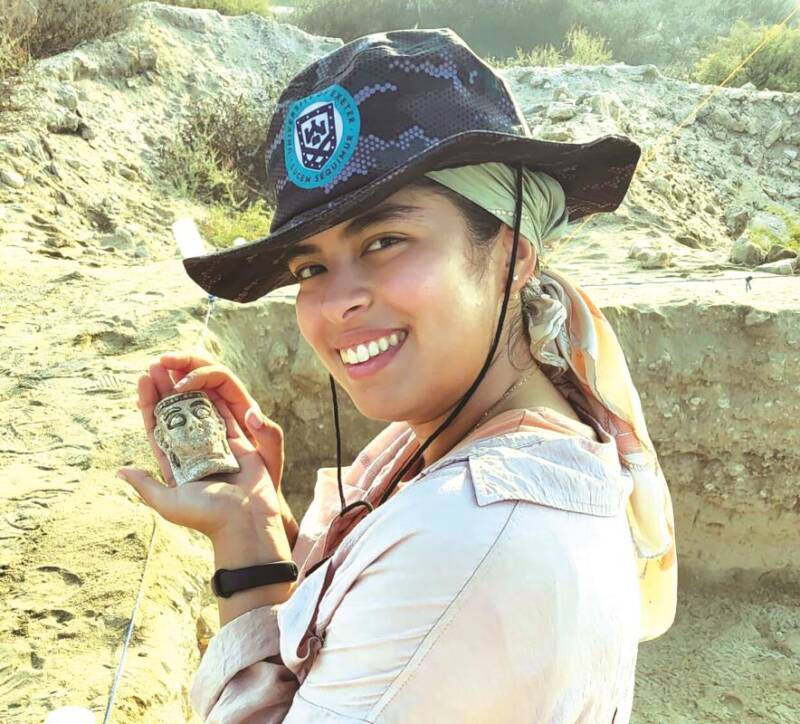
Bahrain Authority for Culture and AntiquitiesThe ceramic mask dates back to the Middle Dilmun period, around 1200 B.C.E.During excavations at the Hilla archaeological site in southern Bahrain, archaeologists uncovered a roughly 3,300-year-old grave containing two adult women and an infant. Nestled in between the remains, they also found a tiny ceramic mask, intricately carved to depict a human face. The find, only the second of its kind in Bahrain, offers a tantalizing look at the Dilmun people, an elusive civilization in the Persian Gulf during the Bronze Age. The Ceramic Carving Found At The Hilla Archaeological Site In BahrainThe find, announced by the Bahrain Authority for Culture and Antiquities, took place during excavations at the Hilla archaeological site. While excavating the 3,300-year-old grave of two women and a baby from the Middle Dilmun period, archaeologists uncovered the tiny ceramic mask. It had been deliberately placed alongside the three bodies, suggesting that it was ritualistic in nature. Bahrain Authority for Culture and AntiquitiesThe faience mask found in the 3,300-year-old grave.The ceramic, which depicts a human face, was made from faience, a type of glazed pottery. Only one other carving like this has ever been found in Bahrain, which makes the artifact extremely rare. However, the mask has not yet been thoroughly studied by researchers, so many questions about its composition, age, and ritualistic purpose still remain. That said, the ceramic carving is not the only thing that archaeologists found at the Hilla archaeological site. While excavating burials in the area, they also unearthed rings made of seashells, tools that were used to apply kohl an ancient makeup similar to modern eyeliner a large ceramic vessel, and a pointed object that researchers believe is a needle or an awl. These items, which appear to be personal belongings, seemingly played an important role in burial rituals among the ancient Dilmun people. Indeed, although more research is needed to better understand the purpose of the mask, it does offer new insights into the Dilmun civilization, which existed from roughly 3000 B.C.E. until 600 C.E. A Brief History Of The Dilmun CivilizationThough the Dilmun civilization remains somewhat enigmatic, archaeologists believe that it was once an important independent kingdom in the Persian Gulf. Ancient Sumerian texts (from which we know its name) suggest that it was a prominent nexus of commerce, and that the Dilmun people traded copper, beads, precious stones, pearls, dates, and vegetables with the Sumerians and other civilizations in exchange for agricultural products.Rapid Travel Chai/Wikimedia CommonsRuins of a temple in Bahrain believed to have belonged to the Dilmun civilization.Located along an important trade route between Mesopotamia and the Indus Valley Civilization (in present-day Bahrain, Kuwait, and parts of Saudi Arabia), Dilmun was even significant enough to the Sumerians to make its way into their religious texts: The Sumerian god Enki had a connection to Dilmuns underwater springs. Indeed, these underwater springs which still exist today and made Bahrain into an oasis surrounded by desert are thought by some to be the basis for the Garden of Eden in the Bible. But most of what we know about the Dilmun people comes from ruins crumbling remains of settlements or, like at the Hilla archaeological site, expansive burial grounds. These offer a tantalizing look at the lost civilization, which left no written records of its own. As such, the ceramic mask discovered in the 3,300-year-old grave at the Hilla archaeological site is a profoundly important artifact. Though small enough to fit in the palm of your hand, it was seemingly a ritualistic object that was significant enough to be buried with two women and an infant. Though its exact purpose remains a mystery, further research will hopefully offer clues about its origins, carvings, and meaning, which in turn will perhaps give insight into the women and child it was buried alongside and the lost civilization to which they belonged. After reading about the ceramic mask from the lost Dilmun civilization that was found in a mass grave in Bahrain, discover the forgotten story of Zenobia, the ancient warrior queen of the Middle East. Or, learn about Queen Dido, the royal who established the ancient city of Carthage. The post A Rare 3,300-Year-Old Ceramic Mask Depicting A Human Face Was Just Uncovered From A Grave In Bahrain appeared first on All That's Interesting.




 English
 Arabic
 French
 Spanish
 Portuguese
 Deutsch
 Turkish
 Dutch
Dutch
 Italiano
 Russian
 Romaian
 Greek
Greek