


WWW.THECOLLECTOR.COM
The Meanings Behind Famous Witchcraft Symbols Explained
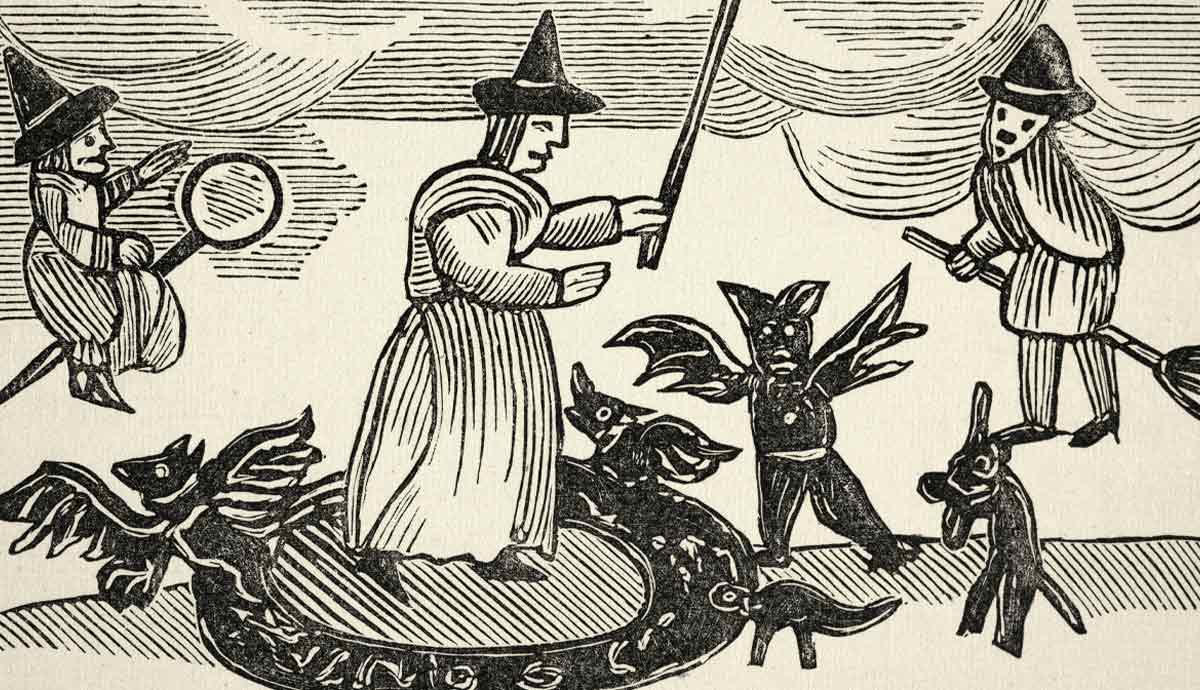
Witchcraft is a complex subject with a long history, stretching back to the ancient world. Because of its extensive and varied history, there is no true witchcraft, but rather a series of folk beliefs that held meaning at the time and place they were practiced. That said, when people in the Western world think about witches and witchcraft today, it conjures up images associated with European folk beliefs from the Middle Ages and Modern Era. These beliefs, in addition to the modern practice of Wicca, are associated with a series of symbols. Discover some of these quintessential witchcraft symbols.A Brief History of WitchcraftCirce Offering the Cup to Odysseus, by John William Waterhouse, 1891. Source: Gallery OldhamThe history of witchcraft is complex. Mentions of witches in one form or another survive from ancient Mesopotamia and in the Bible. WItches in Greece and Rome had their own goddess, Hecate, and in the Odyssey, the hero meets the divine witch Circe, who helps him on his journey. During the Christian Middle Ages, the idea of witches developed an element of evil and was described as including a pact with the devil; a belief that only accelerated in the early Modern Era. Although men were occasionally accused of witchcraft, the majority of those persecuted were women from the lower classes. By the 18th century, widespread belief in groups of women making pacts with the devil faded in favor of a more enlightened mindset.In the late 19th century there was a revival of interest in folk practices and the occult. This culminated in the mid-20th century with the creation of Wicca and the rise of ritual magic societies like the Hermetic Order of the Golden Dawn. Though these neopagan belief systems are modern creations, practitioners use symbolism from the past as part of their rituals and beliefs. Though Wicca is the most common form of modern witchcraft practiced today, there are countless individual belief systems that use symbolism borrowed from across history.Witches Preparing for Sabbath, by Andries Stock, Netherlands, c. 1610. Source: Metropolitan Museum of ArtThe word witchcraft is derived from the Old English word wicce, meaning witch, and craft, which has the same meaning in modern English. Old English was a gendered language, with wicce being the feminine form of the word, and wicca, the masculine. It is possibly derived from the North Sea Germanic word wikkon and the Gothic word weihs, meaning sacred. The word haegtes is another Old English word for witch, and was later shortened to hag, and shares the same root as the word hex, or to curse something. It is probably based on the Proto-Germanic word hagatusjon, whose meaning is unknown, but is possibly related to the word for hedge or boundary.Black Cats, Cauldrons & Pointy HatsCauldron, Dagestan, Russia, mid-15th century. Source: Metropolitan Museum of ArtIn the Western world, say the word witch and a certain image comes to mind: an old, wart-covered woman bent over a bubbling cauldron, wearing a black robe and a pointy hat, a broom for flying propped in the corner, and a black cat familiar looking on. Where did these images come from?For the most part, witchcraft was associated with women. Because of this, items used in the domestic sphere were then applied to witches through association. The cauldron was simply a cooking pot that was common in most households. Many women accused of evil and occult practices were known as local healers, using potions, salves, and other concoctions to solve a wide array of problems; substances that could be cooked up in her cauldron. This idea became cemented in the imagination with William Shakespeares play Macbeth, which features a trio of witches who give the protagonist a prophecy while chanting double double, toil and trouble! over a boiling cauldron. Many modern witches use cauldrons for their symbolic purposes, representing a womb.Portrait of Mrs Salesbury with her Grandchildren Edward and Elizabeth Bagot, oil painting, c. 1676. Source: Wikimedia CommonsThe pointy hat and black robe are more difficult to pin down. Most likely, the look was invented by artists after the famous witch hysteria of the 16th and 17th centuries. The most famous of these was the Salem Witch Trials, and black was a common color worn during the era. A pointed, broad-brimmed hat was also a common fashion of the era, worn by quakers, ale-wives, and Jews in some parts of Medieval Europe. Whatever the source, by the 19th century, they were inescapably connected with witches.The black cat as a witchs companion or familiar can trace its roots to ancient Greece, where black cats were linked with the goddess Hecate. During the Middle Ages, they were associated with Satan and evil. Over time, this belief evolved into the idea that the cats were directly in the witchs service, spying for them or performing specific tasks. It was also believed by some that a witch could transform into a cat at will. In many cases, owning a black cat was evidence of witchcraft.Broomstick & Midnight FlightsDeparture for Sabbath, by Baron Dominique Vivant Denon, French, c. 18th century. Source: Metropolitan Museum of ArtPerhaps the most well-known witchs symbol was the broomstick. Like other symbols of witchcraft, the broom was a domestic tool used mostly by women, making it easily associated with witches. How they came to fly on them is complex. Even after converting to Christianity, much of Europe, especially rural areas, continued to practice their pagan folk beliefs. Some of these included jumping over a pitchfork or broom as a fertility ritual. These rituals were conducted at night, either because of tradition or to avoid attention. Either way, being airborne under the moonlight entered popular imagination.Another major theory links flying broomsticks with the use of hallucinogens. According to some medieval sources, individuals would make ointments, brewed in their cauldrons, of course, containing belladonna, mandrake, henbane, and ergot. These plants and fungi have hallucinogenic properties, especially the sensation of flying. If ingested, however, these can cause vomiting and digestive issues. It was later discovered that the mixture can be absorbed through the skin, especially through mucus membranes, such as the female genitalia. According to those sources, those looking to experience the highs would smear the ointment on a broomstick and then sit on it, absorbing its properties.Vasilisa the Beautiful and the Baba Yaga, by Ivan Bilibin, 1900. Source: Wikimedia CommonsOn top of this, brooms were used as a sort of calling card. When leaving their house, women would prop their broom on the door as a way to signal that they were away from home. This led to brooms being connected to women traveling. In some cases, the broom would be left in the chimney, which gave rise to the belief that witches used brooms as a way to fly to their secret meetings, exiting their homes through their chimneys. Though brooms were the most common flying vehicles, other household items could also be used to fly. In Eastern Europe, the witch Baba Yaga would ride through the night on a mortar and pestle, a variation of the common image.The PentagramGreek Coin of Zeus Amon with rams horn and Pentagram, c. 4th century BCE. Source: British MuseumProbably the most widely used and misunderstood symbol in modern witchcraft is the pentagram. Made with five lines to construct a five-pointed star, it has a long history in religious and occult beliefs dating back to ancient Egypt and Mesopotamia, and has been found on artifacts from Greece and Judea. In the Middle Ages, it was a potent Christian symbol, representing the five wounds of Christ. In Arthurian legend, it was painted on Sir Gawains shield, representing the five knightly virtues. In the Abrahamic religions, the pentagram is sometimes called Solomons seal and, according to tradition, was used by the Israelite king to bind demons and speak to animals. More often, the Seal of Solomon is a six-pointed star, but the five-pointed star is referenced on occasion.In modern witchcraft, it has become a symbol for witchcraft itself, much like the Cross for Christianity or the Crescent for Islam. The five points represent the five elements of earth, air, fire, water, and spirit. It is used as a symbol of protection, and may also be a visual representation of the Triple Goddess and the Horned God, as well as the combination of masculine and feminine. In most uses, the star is contained within a circle. Modern witchcraft also uses other star symbols, the Hexagram with six points and the Septagram, which has seven points, though these are much less common.An amulet containing a Pentagram and other esoteric symbols, Italian, c. 16th-17th century. Source: British MuseumIn most witchcraft practices, the pentagram is depicted with the single point facing upwards, a sign of protection, ascension, and the heavens. However, the symbol can be inverted with the one point facing down and the two points facing upward. This has been used by practitioners of black magic as a symbol of spiritual descent and may be a symbol of the demon Baphomet. It has also been used by the Church of Satan, an atheistic organization that uses occult imagery.The Triple Goddess & the Horned GodHecate as a triple goddess. Source: British MuseumWicca and other modern witchcraft revere two beings in particular. The foremost is the Triple Goddess, who represents the divine feminine. Often connected to the Greek deity Hecate, there are many other deities that have been associated with the triple goddess concept, such as the Celtic goddesses Brigid and the Morrigan. In general, there are three aspects to the goddess: the Maiden, the Mother, and the Crone. The Maiden represents youth, innocence, and vitality; the Mother represents fertility and nurturing; and the Crone represents wisdom, experience, and the ending of life. In total, the Triple Goddess represents the stages of life, the changes in the seasons, and the natural cycle of life, death, and rebirth. The visual symbol of the Triple Goddess is a waxing moon, a full moon, and a waning moon.Cernunnos depicted on the Pillar of the Boatmen, 1st century CE. Source: Musee de ClunyWhile the Triple Goddess represents femininity, the masculine is found in the Horned God. There are many forms this being can take, depending on the beliefs of the individual or specific tradition, but he is universally a male deity with horns or antlers on his head. He is often connected to the Celtic god Cernunnos and has a close affiliation with nature, the hunt, and the untamed wilderness. The Horned God is also said to lead a Wild Hunt, a folk belief from northern and western Europe that involves spectral hunters who pursue their supernatural quarry across the heavens. The symbol for the Horned God is a circle with an upturned crescent on top, resembling a pair of horns.Other Common SymbolsTable of Alchemical symbols, by Basil Valentine, 1671. Source: Wikimedia CommonsWitchcraft makes use of many symbols that have their origins in belief systems of the past. This includes the four classic elements, earth, fire, water, and air, each one represented by a different triangle, the same symbols that were used in classical alchemy. Fire is an upright-pointed triangle, with its opposite, Water, a downward-facing one. Air is an upward-facing triangle bisected by a horizontal line, and Earth is the reverse of this. These symbols have been used for centuries by both occultists and alchemists as representations of the foundational materials of the universe.Symbols related to the seasons and the weather are used as well. One of these is the solar cross. It is a circle divided into four equal-sized sections by two intersecting lines. This represents the four seasons or the four elements. There is also the sun wheel, which is further subdivided into eight separate sections. Occasionally, the outer circle can be broken at the point of each of the lines or spokes of the wheel, creating a wheel swastika or a black sun emblem. These symbols were common in ancient times, but are rarely used today due to their association with fascist political ideologies.Illustrations of a triquetra and a triskelion: Source: Wikimedia CommonsOther symbols include those found in pre-Christian belief systems. These can include stylized representations of the Norse symbol Mjolnir, Thors hammer, the Egyptian symbols the Eye of Ra, or the Eye of Horus, as well as the ankh and the All-Seeing Eye, used by occult practitioners for centuries. There are other symbols as well, such as the triskelion, three outward spiraling lines emitting from a central point, the triquetra, three interlocking ovals creating a three-cornered shape, which has its origins in Celtic folklore.While these symbols all have specific meanings in their original contexts, when they are imported into modern witchcraft, we project new meanings onto them. They certainly conjure magical ideas of hidden worlds.
0 Commentarios
0 Acciones
26 Views

 English
 Arabic
 French
 Portuguese
 Deutsch
 Turkish
 Dutch
Dutch
 Italiano
 Russian
 Romaian
 Portuguese (Brazil)
 Greek
Greek