


WWW.THECOLLECTOR.COM
10 Ancient Nautical Superstitions and Their Origins
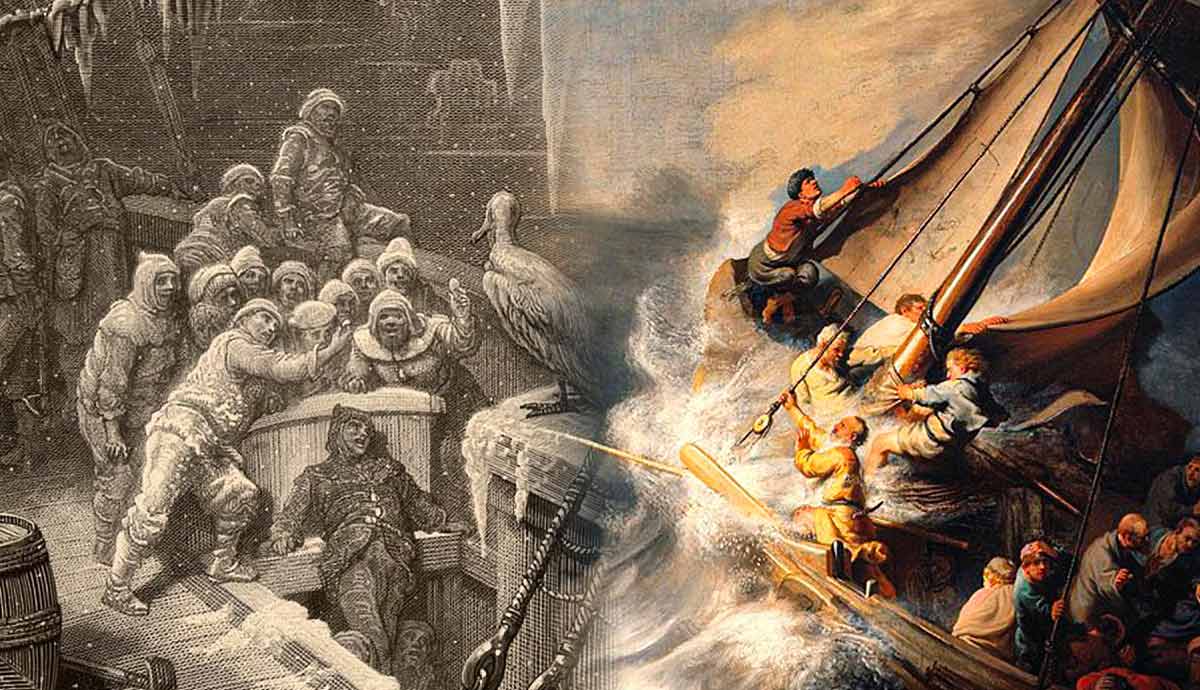
Considering the dangerous and unpredictable nature of sailing and sea-travel in general, it is little wonder that so many superstitions have become associated with the job.In this article, we will name ten ancient nautical superstitions and then explore their origins. What brings good luck, and what brings bad luck whilst aboard a ship? Which rituals should be performed while at sea, and which seemingly innocent actions should be avoided at all costs? Where do the roots of these superstitions lie, and should they really be honored to achieve a safe voyage?1. No Sailing On FridaysCrucifixion, by Andrea Mantegna, 1457-60. Source: The LouvreSuperstition number one: It is bad luck to begin a voyage on a Friday.Friday is different from all the other days of the week. Due to its association with the death of Jesus Christ, it has been viewed in a negative light for over 2,000 years.As Fridays in general are considered bad luck, it is no surprise that the day has become associated with bad luck for sailors. To this day, it is reported that setting sail on a Friday encourages ill fortune for the ship.The origins of this superstition can be traced to the mid-16th century. Stephen Bathory (1533-1586), the King of Poland and Grand Duke of Lithuania, refused to sail on a Friday as it was the day on which Jesus Christ was crucified. His influence spread across Europe, and those who trusted the wisdom of the King followed his advice. Over the last five centuries, a sailors fear of Friday has only intensified.There is a well-known story in England that the British Admiralty attempted to dispel this superstition by proving it wrong. They commissioned a ship named HMS Friday, and her maiden voyage purposely began on Friday the 13th. Legend has it that after departing, the ship was never seen again.This is probably an urban myth, but to this day, many sailors would tell you otherwise.Apparently, it is also bad luck to begin a voyage on the first Monday in April, the second Monday in August, and the last day of the year (December 31st).2. A Pinch Of SaltDetail of The Last Supper, by Leonardo Da Vinci, 1495-8. Source: FaithhubSuperstition number two: It is bad luck to pass the salt to another member of the crew.Salt in general is considered unlucky in many parts of the world. There are lots of superstitions regarding salt, many of which revolve around an accidental spill.Have you ever experienced a feeling of dread after sprinkling some salt across the table? Have you ever thought to dispel your inevitable bad luck with some meaningless ritual? Have you ever thrown a pinch of salt over your shoulder for luck, as your grandmother might have taught you?In The Last Supper by Leonardo Da Vinci (painted c. 1495-1498), it appears that a small vessel has been knocked over. Salt spills from a silver pot onto the tablecloth. The hand that has knocked the salt belongs to none other than Judas Iscariot, who was in the midst of betraying Jesus Christ. Da Vinci uses the salt as an omen of what is about to occur: the arrest in the Garden of Gethsemane and later the Crucifixion of Jesus Christ. What could be more unlucky than that? It is telling that Da Vinci chose to signify this bad luck with the spilling of salt.Spilling salt was thought to be particularly dangerous to sailors. It was believed that accidentally spilling salt into the ocean would upset the natural balance of the seawater. In effect, the sea would be angered by the extra salt it received.To avoid the spilling of salt, sailors would not pass it directly to each other over dinner. Instead, if someone required the salt, it would be picked up and placed down onto the table again. This was thought to be safer than the risky moment at which it was passed between two hands, and had the potential to be dropped.3. Time Spent With Cats is Never WastedCaptain AJ Hailey with Ships Cat, 1920s. Source: UBC LibrarySuperstition number three: Cats bring good luck to a ship.It was Sigmund Freud who declared that time spent with cats is never wasted. Countless sailors from centuries past would have agreed heartily with this sentiment.Most nautical superstitions revolve around omens and warnings. There arent many things that are said to bring good luck on a sea vessel, but a feline shipmate is perhaps the most significant and memorable. Once aboard, the chosen creature is affectionately referred to as the Ships Cat.The keeping of a ships cat is by no means a modern tradition. Cats have been accompanying seafarers on their voyages for many centuries. Pirates, explorers, traders, fishermen, private travellers, pilgrims, and naval officers have all enjoyed the companionship of a cat whilst sailing the seas.Considering their fear of water, it seems strange that cats were ever selected as appropriate candidates for sea travel. It is thought that they were originally welcomed aboard for one reasontheir ability to kill mice and rats. Rodents not only chewed the ropes but also spread disease among crew members. Consequently, an infested ship was something to be avoided at all costs.Cats played a potentially life-saving role on board a ship. They were also friendly and adorable enough to cheer their shipmates in times of misery.This is one of the few nautical superstitions that stems from real historical facts.Unfortunately for many superstitious sailors, the Royal Navy banned cats and other pets on board ships in 1975.4. No BananasIllustration of a banana from the Acta Eruditorum, 1734. Source: Wikimedia CommonsSuperstition number four: Bananas bring bad luck to a ship.How could something so innocent as a banana bring misfortune upon a boat or ship? The notion seems so unlikely that it is almost laughable. However, sailors of centuries gone by would have cursed any member of the crew who dared to bring such a fruit on board. Specifically, bananas were said to have the power to sink a ship.The origins of this superstition can be found in the 18th century, when trade ships began bringing bananas from the Caribbean back to Britain. Due to the growing popularity of bananas in Europe, demand was high, and was being met by those who had the ships to bring them back. Naturally, as was normal for the era, plenty of these trade ships sank midway through their voyages. As far as these sailors were concerned, these ships all had one thing in common. Yes, they were all carrying hordes of bananas.In all likelihood, no more boats sank than usual. Nonetheless, it was the bananas that were blamed for these failed endeavors, and they have since become renowned for the ill-fate they bring upon a ship and its crew.5. Red Sky in the Morning, Sailors Take WarningRed Sky and Crescent Moon, by JMW Turner, 1818. Source: ResearchGateSuperstition number five: A red sky at either dawn or dusk can foretell the weather for the following day.Have you ever heard the famous rhyme?Red sky at night, shepherds delightRed sky in morning, shepherds warning.In nautical terms, this rhyme becomesRed sky at night, sailors delightRed sky in morning, sailors take warning.Thanks to this short poem and its variations, the superstition regarding the color of the sky is well known across the United Kingdom. A red sky at night means that the weather will be sunny and clear the following day. A red sky in the morning means that the upcoming day will bring with it bad weather, possibly even a storm.Storm on the Sea of Galilee, by Rembrandt, 1633. Source: RKD ImagesWhen it comes to ancient nautical superstitions, this one may be the oldest of all. An early mention of the phenomenon, recorded 2,000 years ago, can be found in the New Testament of the Bible.Jesus says, When evening comes, you say, it will be fair weather, for the sky is red, and in the morning, today it will be stormy, for the sky is red and overcast. You know how to interpret the appearance of the sky, but you cannot interpret the signs of the times (Matthew 16).But is it really true that we can predict the oncoming weather by the color of the sky at dawn or dusk? For clarity, we may turn to a trustworthy source: The British Meteorological Office. They reveal thatRed sky at sunset means high pressure is moving from the west, so the next day will usually be dry and pleasant. Red sky in the morning means a red sky appears due to the high-pressure weather system having already moved east, meaning the good weather has passed, most likely making way for a wet and windy low-pressure system.It seems that the predictions associated with a red sky are based more on science and observation than they are on stories and superstition.6. I Shot the AlbatrossThe Albatross, by Gustave Dor, 1832-1883. Source: University of AdelaideSuperstition number six: It is bad luck to harm or kill an albatross.Like one, that on a lonesome roadDoth walk in fear and dread, And having once turned round, walks on, And no more turns his head;Because he knows, a frightful fiendDoth close behind him tread.If ever there was a sufficient warning regarding the dangers of killing an albatross, it was certainly found in The Rime of the Ancient Mariner. This serious but epic poem of 150 verses was written by Samuel Taylor Coleridge in 1798. The message of the poem is very simpledont interfere with an albatross.As you might expect, this is exactly what the narrator of the poem does. Having made the fatal mistake of killing an albatross with his crossbow, he faces the anger of the rest of his crew, who fear he has brought ill fate upon the ship. As the story progresses, the superstition is confirmed, and ill-fate in its many forms comes upon the vessel. As a penance, the narrators shipmates force him to wear the dead albatross around his neck.But where did the superstition come from, originally? The answer is that nobody knows. We do know, however, that albatrosses were once thought to embody the souls of sailors who had been lost at sea. To harm an albatross was to harm a former human seafarer.7. Its Not Easy Being GreenThe Raft of the Medusa, by Theodore Gericault, 1791-1824. Source: The LouvreSuperstition number seven: The color green will induce a shipwreck.Have you ever wondered about the lack of green aboard a ship? This is no mistake: the color is purposely omitted. Ships should not be painted green, no prominent item should be colored green, and green clothes should be worn by neither passengers nor crew.This is because, in the mysterious world of sea travel, green is known to be extremely unlucky. In fact, the idea that green can cause a shipwreck is the most common nautical superstition on this list.So, why is the color green feared so intensely by sailors? The answer is, once again, that nobody knows. It is assumed by historians that the superstition came about through association. Blue is the traditional color of the sea, whilst green is the traditional color of land. Sailors thought that the presence of green would attract land, and potentially pull the ship towards the rocks. Eventually, it became popular belief that green directly caused shipwrecks.The superstition regarding travelling in a green vessel has spread to such an extent that people now fear green cars. Studies show that green is the least popular color of car in Europe. In connection with the origins of the superstition, this obviously makes very little sense. But superstitions do not generally make any sense at all.8. DONT Whistle While You WorkThe Whistling Boy, by Frank Duveneck, 1848-1919. Source: Wikimedia CommonsSuperstition number eight: Whistling at sea can summon a storm.Throughout history, whistling has been associated with omens of misfortune. During some eras, it even held connotations of witchcraft. Whether the whistler is standing safely on land or onboard a precarious vessel at sea, whistling is said to encourage the winds. Any history-lover who has watched The White Queen (2013) may recall the memorable scene in which Elizabeth Woodville, alongside her mother and daughter, whistles up a storm with the intention of sinking the enemy ships.The possibility of high winds is not the only reason whistling was banned aboard a ship. The sound of a whistle might be mistaken for the whistle that was used to give commands to low-ranking sailors.The belief in whistling up a storm is not the only nautical superstition with connections to the weather. Seafarers also believed that clapping aboard could encourage thunder, that throwing stones into the water could encourage waves, and even that opening an umbrella could encourage rain.9. The Caul Was WonDavid Copperfield Reaches Canterbury, by Frank Reynolds, 1910. Source: Wikimedia CommonsSuperstition number nine: A caul will prevent drowning at sea.One of the most unusual nautical superstitions involves the acquiring and treasuring of a rare item known as a caul. Unsurprisingly, few are familiar with this unappealing word. A caul is actually an amniotic membrane that encloses an unborn child. The Cambridge English Dictionary describes a caul as being occasionally found on a childs head at birth, thought to bring good luck. Specifically, a caul was said to prevent drowning at sea.Perhaps the most notable mention of a caul can be found in the literary classic, David Copperfield, written in 1850 by Charles Dickens. Within the first chapter, the narrator (Copperfield himself) describes his birth. He explains that he was born with this rare item, and that his parents sent it to auction for sailors to buy.I was born with a caul, which was advertised for sale, in the newspapers, at the low price of fifteen guineas. Whether sea-going people were short of money about that time, or were short of faith and preferred cork jackets, I dont know; all I know is, that there was but one solitary bidding, and that was from an attorney connected with the bill-broking business, who offered two pounds in cash, and the balance in sherry, but declined to be guaranteed from drowning on any higher bargain.Illustration from David Copperfield, 1850. Source: Wikimedia CommonsDavid Copperfields caul was eventually bought by an old lady with a hand-basket, who very reluctantly produced the five shillings she had bid. The woman, Copperfield claims, did not drown, but died in bed at the age of ninety-two. She was proud of the fact that she had never drowned. However, the most amusing part of this story appears to be that she had never once traveled on the water anyway.Copperfield explains, It is a fact which will be long remembered as remarkable down there, that she was never drowned, but died triumphantly in bed, at ninety-two. I have understood that it was, to the last, her proudest boast, that she never had been on the water in her life.10. Only Men AllowedWoman in Grey on Board A Ship Gazing at the Sea, by Ernest Ange Duez, 1873. Source: Wikimedia CommonsSuperstition number ten: Women bring bad luck to a ship.This may seem strange to us now, but to sailors of the 16th to 19th centuries, bringing women aboard a ship would have been a mistake. The reason for this was simple: the presence of women would inevitably distract the crew from what they should be doing.A distracted sailor was said to have been dangerous for two reasons. Firstly, the sea would be angered that the attention of the sailors had been taken away from her. Secondly, and slightly more realistically, things were more likely to be forgotten or go wrong if the thoughts of the sailors were engaged elsewhere.
0 Commentarii
0 Distribuiri
20 Views

 English
 Arabic
 French
 Spanish
 Portuguese
 Deutsch
 Turkish
 Dutch
Dutch
 Italiano
 Russian
 Portuguese (Brazil)
 Greek
Greek