


ALLTHATSINTERESTING.COM
The Little-Known Story Of The Palomares Incident, When America Accidentally Dropped Four Nuclear Bombs On Spain
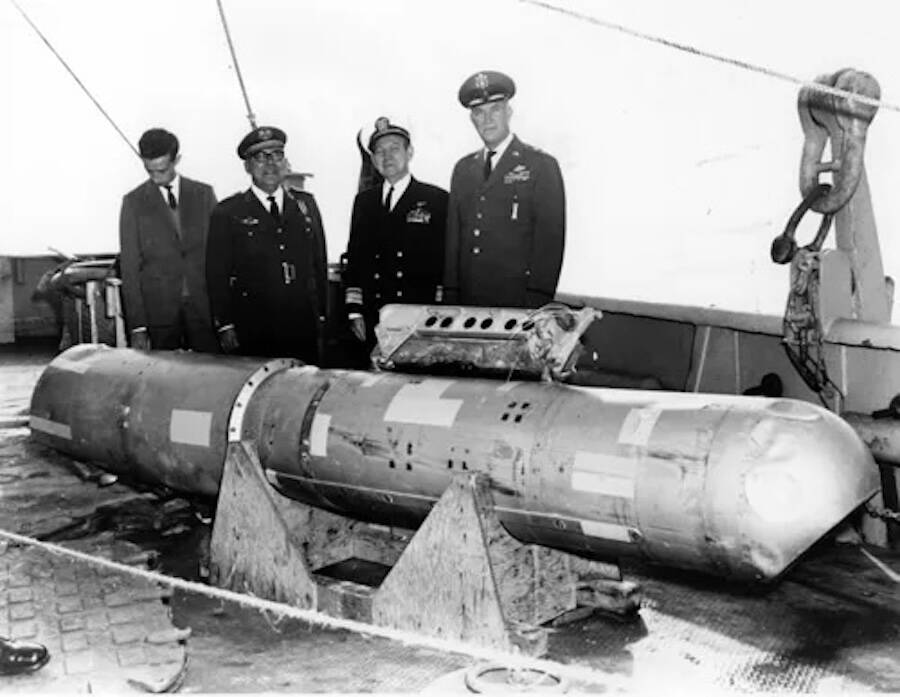
U.S. Navy, Courtesy of the Natural Resources Defense CouncilThe recovery of one of the hydrogen bombs dropped near Palomares, Spain in 1966. This device was recovered from 2,850 feet of water in the Mediterranean Sea and brought aboard the USS Petrel.At the height of the Cold War, U.S. bombers loaded with nuclear weapons were a common sight in the sky. They were meant to discourage the Soviet Union from launching a strike and they were prepared to attack at the first sign of a potential battle with the Soviets. But their presence ultimately led to a number of catastrophic accidents.One of the most infamous was the Palomares incident, which took place on Jan. 17, 1966. That day, an American B-52 bomber accidentally collided with a KC-135 jet tanker over Spain, killing seven airmen and dropping four nuclear bombs near the remote village of Palomares. None of those bombs were armed at the time of the accident, but explosive material in two of the devices still exploded upon impact when they hit the ground, leading to massive craters and the spread of toxic, radioactive plutonium dust.It wasnt the only incident of its kind during the Cold War. But even though the Pentagon eventually admitted to over three dozen accidents that involved bombers crashing or catching on fire, the Palomares incident continued to attract a notable amount of attention since it happened in a foreign country and it also impacted thousands of civilians.The resulting contamination meant that the U.S. and Spain had to launch a massive cleanup effort, and up to 1,750 tons of radioactive soil were shipped to America for disposal. But the cleanup was never fully completed, and shockingly, some of the land in the region remains contaminated to this day.How The Palomares Incident UnfoldedWikimedia CommonsA B-52 bomber refueling mid-air with a KC-135, like what was supposed to happen over Palomares in January 1966.In the early 1960s, the United States launched Operation Chrome Dome. The Cold War operation aimed to have nuclear-armed B-52 bombers in the air at all times. Specifically, they were supposed to be flying the bombers in locations that would allow them to strike the Soviet Union if necessary. Naturally, this meant that these planes would need to refuel often.In January 1966, one B-52 bomber was on its way back to its base in North Carolina when refueling became necessary. The aircraft tried air-to-air refueling with a KC-135 tanker plane, which should have been a routine process. But things went far from routine that day. U.S. Maj. Gen. Delmar Wilson, who was tasked with responding to the Palomares incident, later told the BBC: I believe what happened was the bomber was closing at a too-high rate of closure speed and he didnt stabilize his position, with the result that they got too close and collided.The result of the two planes colliding was catastrophic. The B-52 was ripped open, and the jet fuel that the KC-135 was carrying ignited. The subsequent explosion killed all four members of the KC-135 crew. Wikimedia CommonsA recovered thermonuclear bomb from the Palomares incident, displayed on the USS Petrel.The accident also killed two men in the B-52s tail section. A third man was able to eject out of the aircraft, but he unfortunately also died when his parachute failed to open. Meanwhile, four members of the B-52 crew were able to parachute to safety and survive the harrowing incident.The collision also meant that the nuclear weapons held onboard the B-52 aircraft came crashing to the Earth. As the dangerous cargo and the destroyed aircraft fell to the ground, a massive fireball emerged, but luckily, there was no nuclear explosion triggered by the crash.However, there was some explosive material in two of the bombs that exploded on impact, which created huge craters in the ground and leaked toxic, radioactive plutonium dust across Spains Mediterranean coast.The Impact Of The Nuclear Accident On Palomares ResidentsWikimedia CommonsAn exclusion zone in Palomares, Spain, pictured in 2019.Witnesses were horrified to see the collision of the B-52 and the KC-135 and the devastation that followed on the ground. One local woman known as Seora Flores remembered, My little girl was crying, Mama, Mama, look at our house, it is burning. Because of all the smoke I thought what she said must be true. There were a lot of stones and debris falling around us. I thought it would hit us. It was this terrific explosion. We thought it was the end of the world.A farmer named Pedro Alarcn recalled seeing an explosion unfold in his own tomato field, while he was out walking with his grandchildren. As Alarcn remembered: We were blown flat. The children started to cry. I was paralyzed with fear. A stone hit me in the stomach, I thought Id been killed. I lay there feeling like death with the children crying.Incredibly, no one from the village was killed. But in the aftermath of the Palomares accident, fear swarmed about the resulting radiation and contamination. According to a New York Times article from 1966, farmers in Palomares found their daily lives turned upside down after the incident.In the last two weeks, more than 1,000 persons from a population of 3,000 in the Palomares district have been checked for radiation, the article reported. Thus far, no signs of radiation have been detected.However, farmers in Palomares, which was known for its tomato crops, were prohibited from picking the produce in a 37-acre area around the scene of the accident. Before long, many markets were turning away all tomatoes that came from Palomares, even those picked outside of the crash site. The U.S. military claimed that they were willing to pay the farmers for any tomatoes destroyed in the accident or any tomatoes unable to be sold from the restricted area. But their attention would soon be turned to other issues. A Tumultuous Cleanup And Lingering Contamination At The SiteWikimedia CommonsBarrels filled with radioactive soil after the Palomares incident.Though one of the four bombs had landed safely in a nearby riverbed and was recovered still intact the next day, the situation with the other three bombs was far more perilous. Since two of the bombs had cracked open and spread the dangerous plutonium dust, the United States and Spain had to figure out how extensive the damage and radioactive contamination was.Authorities also had to find the last bomb, which was missing. It would ultimately take the U.S. military 80 days to recover the device, an agonizing process that involved carefully removing it from a depth of 2,850 feet in the Mediterranean Sea and later disarming it on the USS Petrel.But even with those concerns, both the American and Spanish governments were determined to keep the public calm. Francisco Franco, then the dictator of Spain, was especially eager to downplay the incident, as he feared it would have an impact on the countrys tourism industry.As part of the effort to prevent panic amidst the cleanup, Angier Biddle Duke, the U.S. Ambassador to Spain, swam in the sea near Palomares on camera. When a journalist asked Duke if any radioactivity had been detected in the water, he responded, If this is radioactivity, I love it!But while both American and Spanish officials tried to appease the press, a massive cleanup operation was underway. When workers found areas that were contaminated with radiation, they scraped up the first three inches of topsoil in the regions, sealed it in barrels, and sent it to the U.S. Many of these drums ended up at the Savannah River Plant in South Carolina.Ultimately, between 1,400 tons and 1,750 tons of contaminated soil were removed in this manner. From there, the Palomares incident was widely forgotten, especially after more infamous nuclear catastrophes unfolded, such as the Chernobyl disaster and the Fukushima nuclear accident.Eventually, however, the Palomares incident re-emerged in the news. Though the initial cleanup efforts may have appeared to be thorough, it was later revealed that the U.S. had missed some areas with contamination and may have even accidentally spread contamination further in some cases. As recently as 2025, it was reported that there were still some regions in Palomares that were fenced off due to the presence of plutonium. Sandia National LaboratoriesThe initial cleanup effort after the Palomares incident was later revealed to be incomplete.The long-term health impacts of the accident on local residents and the U.S. airmen recruited to help clean up remain the subject of controversy.Though many officials claimed that the health risk was minimal in the area, it was eventually revealed that the U.S. settled some 500 claims by locals who said their health was adversely affected. On the other hand, some residents have insisted that the anxiety around health in the town is over-exaggerated.One local bartender, Andres Portillo, said, Every time the story hits the media, it hurts tourism. A lot of people dont want to come here because they think the quality of life must be low, that cancer rates are higher, when thats not the case at all.However, in 2016, dozens of former U.S. airmen who were involved in the cleanup at Palomares came forward to publicly discuss their struggles with cancer and other serious health issues that they believed were caused by plutonium poisoning. By 2020, these Air Force veterans had won the right to sue collectively for health benefits, but sadly, many who had raised complaints in prior years had already died.Meanwhile, the cleanup in the Palomares region is still yet to be completed, despite Spain and the United States signing an agreement back in 2015 to properly clean up the area once and for all.Though the Palomares incident may not be as well known as other nuclear accidents, its clear that its troubling legacy extends far beyond the town itself. Next, go inside the story of Tsar Bomba, the biggest nuclear weapon in history. Then, read about the tragic and horrific death of Hisashi Ouchi, the man who suffered historys worst radiation burns.The post The Little-Known Story Of The Palomares Incident, When America Accidentally Dropped Four Nuclear Bombs On Spain appeared first on All That's Interesting.
0 Reacties
0 aandelen
22 Views

 English
 Arabic
 French
 Spanish
 Portuguese
 Deutsch
 Turkish
 Italiano
 Russian
 Romaian
 Portuguese (Brazil)
 Greek
Greek