A Farmer Plowing His Field On Scotlands Isle Of Bute Stumbled Upon A Tomb That Dates Back 4,000 Years
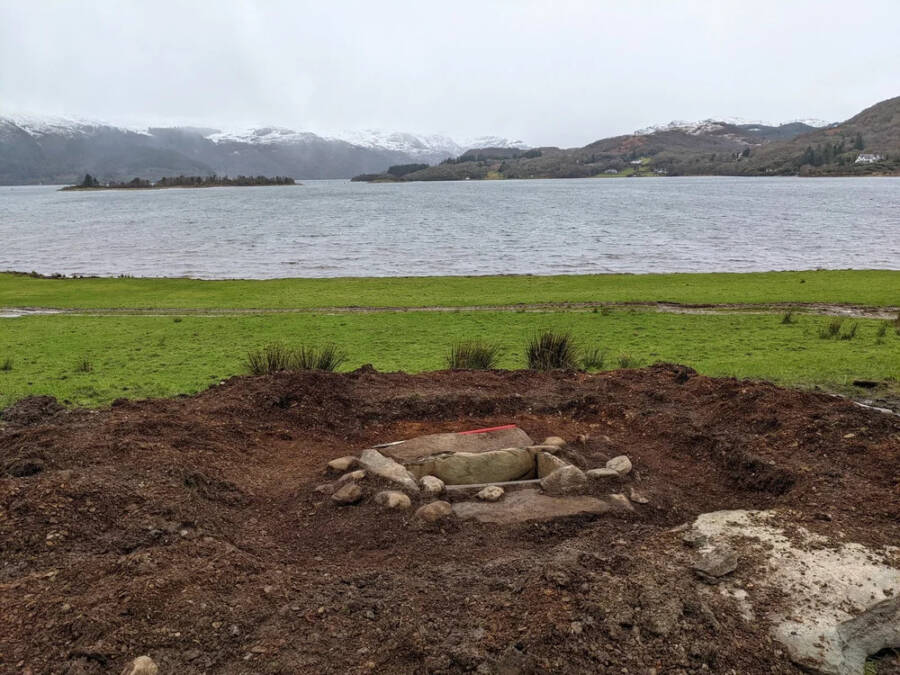
Historic Environment Scotland and AOC Archaeology Group/PA WireThe site of the Bronze Age cist on Scotlands Isle of Bute.While plowing his field on Scotlands Isle of Bute, a farmer accidentally unearthed the graves of a man and a young woman from the Bronze Age. The 4,000-year-old burial chamber had first been discovered in 1863, but it had been forgotten about and remained undisturbed until 2022.Since then, the site has been excavated and the bodies have been taken away for analysis. Now, researchers have shared details of that analysis, revealing more about the story of these two people who lived and died more than four millennia ago.The Discovery Of A 4,000-Year-Old Cist On Scotlands Isle Of ButeIn 1863, a human skull was discovered at Rhubodach on the Isle of Bute. It was sent to the Society of Antiquaries of London, but, for one reason or another, it was forgotten about and effectively lost to time.At the time, other remains were noted still in the ground but they were left, National Museums Scotlands Matthew Knight explained to The Scotsman. The skull, unfortunately, has now been lost, but rediscovery and re-excavation of these remains is allowing us to reinterpret and retell the story of this individual.The cist remained undisturbed for more than a century and a half, until the farmer plowing his field in 2022 once again came across the burial site. A subsequent excavation by AOC Archaeology Group confirmed the presence of two individuals remains within the 4,000-year-old cist. The individuals, not interred at the same time, were buried one on top of the other.Historic Environment Scotland and AOC Archaeology Group/PA WireThe tomb dates to around 2250 B.C.E.According to The Independent, the uppermost individual was found to be an adult male, aged between 35 and 50 at the time of his death. He stood around five feet, six inches tall and, by all accounts, appeared to have been in good health when he died. Buried beneath him were the remains of a female, likely an adolescent or young adult.Unfortunately, due to a 19th-century practice of only recovering skulls from sites like this, both individuals skulls were absent, and the whereabouts of both are still unknown.Analysis Sheds Light On The Bronze Age People Buried At RhubodachAnalysis of the remains revealed several notable discoveries. Both individuals diets lacked any substantial amount of marine protein, for example, and instead seem to have been terrestrial-based. The analysis did not, however, identify anything that could speak to the relationship between the man and woman, or the exact gap of time between their internment.The radiocarbon dates indicate that they died within the final quarter of the third millennium B.C.E., so after 2250 B.C.E. and that the uppermost individual probably was buried just after, or up to a few generations later than the lower individual, said Jess Thompson, Scotlands first curator of osteoarchaeology. And so this cist was used within the living memory of these individuals.Historic Environment Scotland and AOC Archaeology Group/PA WireThe relationship between the individuals is unknown.The remains were declared through the Treasure Trove Unit and allocated to NMS in September 2025. They are now among thousands of items being housed in a new facility at the National Museums Collection Centre in Granton, Edinburgh, which became operational in the fall of 2025.The facility, created as part of the Scotlands Archaeological Human Remains Collections (SAHRC) project, holds human remains of around 2,500 individuals collected from roughly 600 archaeological sites across Scotland, dating from the Mesolithic period through the 19th century.Knight said the purpose of the facility is to provide ethical care, ethical curation, and the best possible storage for archaeological human remains. Research into these remains, he said, can provide fascinating insights into the lives of ancient Europeans in addition to enhancing the modern understanding of the past.These are people who were once living, breathing humans, and we need to ensure that they are treated with the utmost respect.After learning about these Bronze Age burials found in Scotland, learn more about Scottish history by reading about the Fairy Glen, a valley so beautiful that legend says it was created by fairies. Then, learn about the tumultuous history of Scotlands famous Castle Stalker.The post A Farmer Plowing His Field On Scotlands Isle Of Bute Stumbled Upon A Tomb That Dates Back 4,000 Years appeared first on All That's Interesting.




 English
 Arabic
 French
 Spanish
 Portuguese
 Deutsch
 Turkish
 Dutch
Dutch
 Italiano
 Russian
 Romaian
 Portuguese (Brazil)