What Role Did Railroads Play in the Old West?
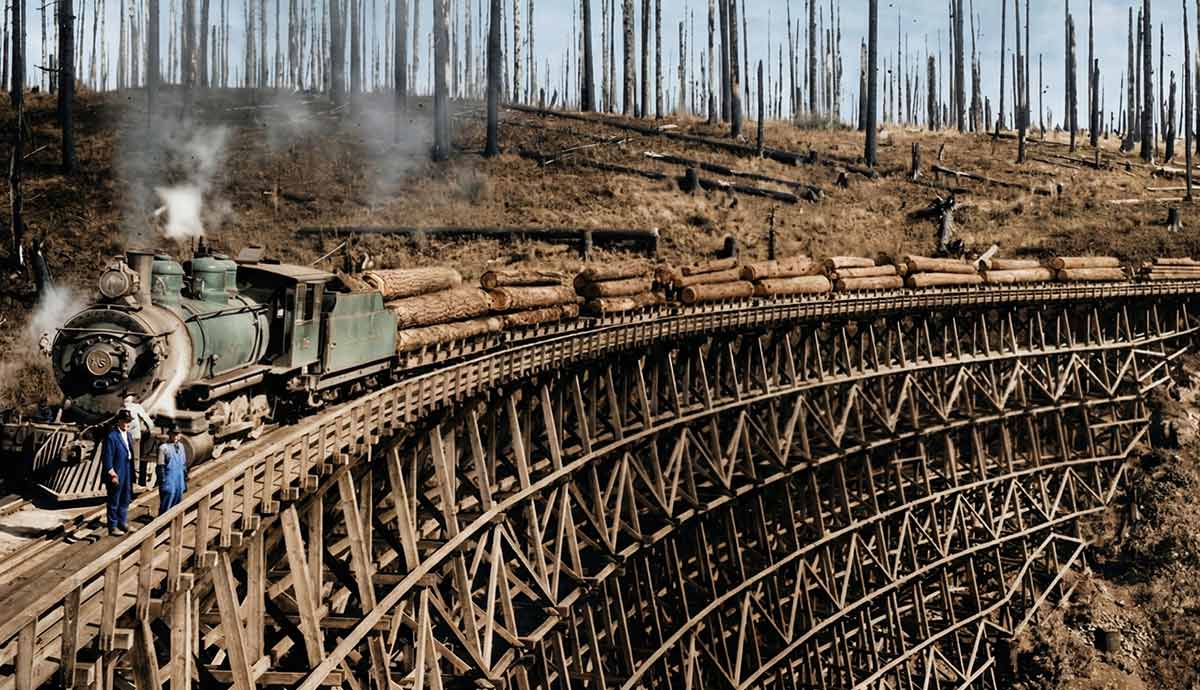
The rapid expansion of the railroad system west of the Mississippi River after the end of the Civil War is one of the defining characteristics of the Old West, and its development that joined the East and West coasts of America brought about the end of that legendary period of American history.Early Travel AccomplishmentsOld West settler wagons.Before the railroads made their way west, travel west of the Mississippi was accomplished either on foot, on horse, or by oxen. The wagon trains which became part of the American image of the Old West were commonly used to move families and cargo, but were slow, traveling only two miles an hour and only able to travel 20 miles in a day at most in good weather. Stagecoaches pulled by horse teams from one town to another were faster, but still would only cover about 80 miles in a day.The Transcontinental RailroadThe Driving of the Last Spike by Thomas Hill 1881. Source: WikipediaThe transcontinental railroad was a project to connect the eastern and western American railroad systems, constructed from 1863-1869. Its concept began in the 1840s, promoted by Asa Whitney, a New York merchant who spent significant time in China and wanted to travel and transport goods faster. He envisioned a railroad which extended west all the way to the Pacific Ocean, and pressed Congress to enact a measure to construct the railroad.The Pacific Railroad Act, 1862. Source: US History SceneWhile his specific idea was never enacted, the nation embraced the idea of a railroad extending from coast to coast. After several years of surveys (some overseen by Jefferson Davis) and proposals, Congress passed the Railroad Act of 1862, which provided the necessary authority to begin construction. On May 10, 1869, a golden spike was ceremonially driven to combine the east and west railroads at Promontory Summit in the Utah Territory.Train Robberies in the Old WestFilm still from The Dalton Gang, 1949. Source: ListallTrain robberies in the Old West were frequent enough to warrant significant measures on the parts of the railroads and financial companies (such as Wells Fargo) to protect money and goods from theft. The Jesse James and the James-Younger Gang, Butch Cassidy, and the Dalton Gang, among others, achieved a measure of fame through daring train robberies with significant amounts of money stolen. However, most were caught or killed eventually through efforts of law enforcement and such groups like the Pinkerton Detective Agency.Possemen unload their horses in Wilcox after the June 2, 1899, train robbery. (American Heritage Center, University of Wyoming)Over 200 train robberies took place during the period of the Old West, as trains were easy targets with significant amounts of money and valuables aboard. The largest train robbery of the period was the Union Pacific Big Springs Robbery, perpetrated by another notorious train robber, Sam Bass and his gang. Bass and the Black Hills Bandits stole over $60,000 in gold coins, a modern value of over $1.6 million dollars.Lasting EffectsCompletion of the transcontinental railroad. Source: Cove CollectiveThe railroad system allowed significantly cheaper and faster travel across the United States. Costs were reduced to one tenth the price of a stagecoach ticket, and long-distance travel which once took months was reduced to mere days. Cargo was also transported much faster and cheaper than previous methods, as was the mail. With the completion of the transcontinental railroad and the further expansion of the railroad system into the west, populations shifted further beyond the Mississippi, and the wilderness aspect of the American West was losing its mystique.




 English
 Arabic
 French
 Spanish
 Portuguese
 Deutsch
 Turkish
 Dutch
Dutch
 Italiano
 Russian
 Romaian
 Portuguese (Brazil)