


WWW.THECOLLECTOR.COM
What Did Lincoln Say in the Gettysburg Address?
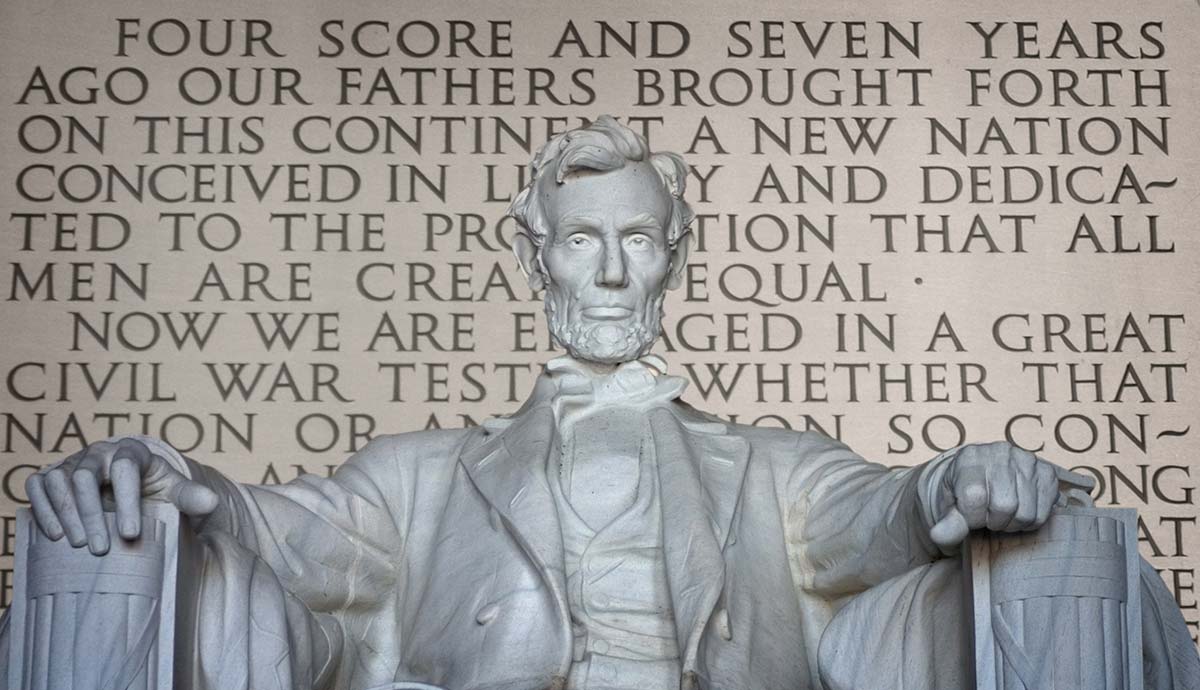
On November 19, 1863, following one of the bloodiest battles of the American Civil War, the Battle of Gettysburg, the 16th President of the United States, Abraham Lincoln, delivered a 272-word speech, which would become one of the most important speeches in American history. The speech connected the Declaration of Independence and the sacrifices of the Civil War in a way that inspired the hope for a new birth of freedom. Read on to learn what exactly Lincoln was trying to explain in the Gettysburg Address.The Battle of Gettysburg & President Lincolns AddressBattle of Gettysburg, print based on the painting Hancock at Gettysburg by Thure de Thulstrup, ca. 1887. Source: Library of Congress, Washington DCFrom July 1 to 3, 1863, the Battle of Gettysburg was fought between the invading Confederate Army and the Army of the Potomac in Pennsylvania during the American Civil War. Confederate General Robert E. Lee had launched a major offensive into Northern territory, hoping a decisive victory would pressure the Union into peace talks and gain support from European powers.The battle resulted in heavy casualties from both sides: 23,000 Union and 28,000 Confederate soldiers lost their lives, went missing, or were heavily wounded.Military historians consider the Battle of Gettysburg to be a pivotal turning point in the conflict. Though the Civil War stretched for another two years, General Lees army never again invaded the North. Gettysburg shifted momentum in favor of the Union.Most of the Union deceased soldiers were buried in Gettysburg in unmarked or scarcely marked graves. Several months later, at local attorney David Willss initiative, the idea of establishing a national cemetery at Gettysburg to honor the Union dead was born.The date of the cemeterys dedication was set for November. Edward Everett, a former president of Harvard College, senator, and secretary of state, was chosen as the key speaker.Field of Gettysburg, map by Theodore Ditterline, published by Philada. P. S. Duval & Son lith., 1863. Source: Library of Congress, Geography and Map Division, Washington DCJust two weeks before the occasion, on November 2, David Wills sent an invitation to President Abraham Lincoln, suggesting he formally set apart these grounds to their sacred use by a few appropriate remarks. President Lincoln accepted the invitation, viewing it as an opportunity to outline the significance of the Civil War to American society.The President left the White House on November 18. According to a claim by Lincolns private secretary, John Nicolay, most of the address and last-minute changes were made on the train to Pennsylvania.President Lincoln, tasked with choosing the perfect words to commemorate the soldiers who sacrificed their lives for the cause of the Civil War, would deliver a 3-minute speech before 15,000 gathered people. These words would become one of the most well-known speeches in American history.The Gettysburg AddressText of the Gettysburg Address. Source: Library of Congress, Rare Book and Special Collections Division, Printed Ephemera Collection, Washington DCPresident Abraham Lincolns address read:Four score and seven years ago, our fathers brought forth, upon this continent, a new nation, conceived in Liberty, and dedicated to the proposition that all men are created equal.Now we are engaged in a great civil war, testing whether that nation, or any nation so conceived, and so dedicated, can long endure. We are met on a great battle-field of that war. We have come to dedicate a portion of that field, as a final resting place for those who here gave their lives, that that nation might live. It is altogether fitting and proper that we should do this.But, in a larger sense, we can not dedicate, we can not consecratewe can not hallowthis ground. The brave men, living and dead, who struggled here, have consecrated it far above our poor power to add or detract. The world will little note, nor long remember what we say here, but it can never forget what they did here. It is for us the living, rather, to be dedicated here to the unfinished work which they who fought here, have, thus far, so nobly advanced. It is rather for us to be here dedicated to the great task remaining before usthat from these honored dead we take increased devotion to that cause for which they gave the last full measure of devotionthat we here highly resolve that these dead shall not have died in vainthat this nation, under God, shall have a new birth of freedomand that government of the people, by the people, for the people, shall not perish from the earth.There are five known manuscript copies of the Gettysburg Address, each different from the others. The above text is from the Everett version, now at the Illinois State Historical Library in Springfield.What Was Lincoln Trying to Explain in the Gettysburg Address?A crowd of soldiers and civilians listens to Lincolns speech in Gettysburg. A red arrow points to President Lincoln, photograph by Mathew Benjamin Brady. Source: Wikimedia Commons/National Archives at College Park, MarylandPresident Lincolns speech began by addressing the Founding Fathers of the United States, who established American independence and nationhood. Four score and seven equals 87 years. This date refers to the Continental Congresss adoption of the Declaration of Independence on July 4, 1776.The Declaration was the founding document of the United States, which successfully formalized the separation of the 13 original colonies from British rule. The 1776 document states: We hold these truths to be self-evident, that all men are created equal. In the opening section of the Gettysburg Address, Lincoln directly referenced the Declaration of Independence to remind his audience that the United States was built on the ideals of liberty and equality.Additionally, with this quote, Lincoln emphasized the key cause of the American Civil War, a conflict stemming from the dispute over the expansion of slavery, as well as the North and Souths opposing economic interests, political priorities, and moral beliefs. Many in the North viewed slavery as morally wrong and saw its spread as a threat to the nations democratic ideals. On January 1, 1863, the president had issued the Emancipation Proclamation, freeing all enslaved people in states still under Confederate control and turning the war into a fight for liberty.In the next section of his speech, President Lincoln focused on the significance of the Civil War. In particular, he emphasized how it would not only influence the future of the United States but also represent a test for any nation established through the values of liberty and equality, revealing whether such nations could survive a civil conflict. When Lincoln delivered the speech, the Civil War was still in full swing. Just a few months later, another bloody three-day battle would happen at Chattanooga, Tennessee, from November 23 to November 25, 1863.Dedication Ceremony, by Frank Leslies Illustrated Newspaper, December 5, 1863. Source: Friends of the Lincoln Collection, The Rolland Center, IndianaThe next part of the speech is dedicated to carving out the delicate connection between the soldiers killed during the Battle of Gettysburg and the hundreds of thousands of soldiers still fighting for the cause of the Civil War. By saying The world will little note, nor long remember, what we say here, but it can never forget what they did here. It is for us the living, rather, to be dedicated here to the unfinished work which they who fought here have thus far so nobly advanced, Lincoln shows respect and sympathy to the fallen. He urges the audience to acknowledge and honor those still on the fields by continuing the mission the fallen soldiers began through showing strength and dedication.In the final section of his address, President Lincoln highlighted the possibility of a renewal for the American nation, ending with probably the most well-known historical quote: and that this government of the people, by the people, for the people, shall not perish from the earth. Indeed, at the time, failure to preserve the Union could have left the United States politically fragmented and vulnerable, even open to foreign influence.Moreover, the government style of the United States, considered a great experiment at the time, still had to prove to the world that a nation that strives for equality and representation was a viable form of governance, serving as an example of a government of the people to the rest of the world.President Abraham Lincoln photographed by Alexander Gardner eleven days before the Gettysburg Address, November 8, 1863. Source: Wikimedia Commons/Mead Art Museum, Amherst, MassachusettsThe composition and structure of the Gettysburg Address features the biblical concepts of suffering, consecration, and resurrection, signaling the momentous nature and significance of the Civil War for the United States and the world, implying the message: Stay the course of a difficult war. If democracy wont work here, it wont work anywhere. Thus, Lincolns speech was also a momentous call for preserving self-government, liberty, and equality.Legacy of the Gettysburg AddressAmerican Civil War: First Battle of Corinth (Mississippi) April 29 June 1, by an unknown artist, undated. Source: MeisterdruckeThe Gettysburg Address remains one of the greatest speeches delivered by a President in American history to this day.Edward Everett himself, who delivered almost a two-hour long speech the same day, expressed his fascination with Lincolns address in a short note sent to the President following the event: I should be glad, if I could flatter myself that I came as near to the central idea of the occasion, in two hours, as you did in two minutes.However, various media outlets responded with mixed reactions. The London Times wrote: The ceremony was rendered ludicrous by some of the sallies of that poor President Lincoln. Similarly, The Chicago Times published: The cheek of every American must tingle with shame as he reads the silly, flat and dish-watery utterance of the man who has to be pointed out to intelligent foreigners as the President of the United States.Lincolns Gettysburg Address Memorial. Source: Wikimedia CommonsNevertheless, the audience felt inspired and even moved by Lincolns words. One of the attendees recalled: With a hot sun beating down on the immense throng packed together, it was rather long we perhaps all felt. But when Lincoln rose such a silence fell that we almost forgot to breathe. How he stood before us, gaunt, rugged, great.To this day, the address continues to inspire leaders and movements that struggle for freedom, equality, and democracy. Martin Luther King Jr., for instance, in his well-known speech I Have A Dream, delivered at the Lincoln Memorial, began his address with the following variation of the Gettysburg Address: Five score years ago, a great American, in whose symbolic shadow we stand today, signed the Emancipation Proclamation.Even though the speech was created for a specific political moment in 1863, it has acquired timeless significance. When the United States faced internal division or global uncertainty, the Gettysburg Address resonated, reflecting what the struggle is forequality, freedom, and democracy.
0 Commenti
0 condivisioni
5 Views

 English
 Arabic
 French
 Spanish
 Portuguese
 Deutsch
 Turkish
 Dutch
Dutch
 Russian
 Romaian
 Portuguese (Brazil)
 Greek
Greek