


WWW.THECOLLECTOR.COM
The Role of Artillery in the American Civil War
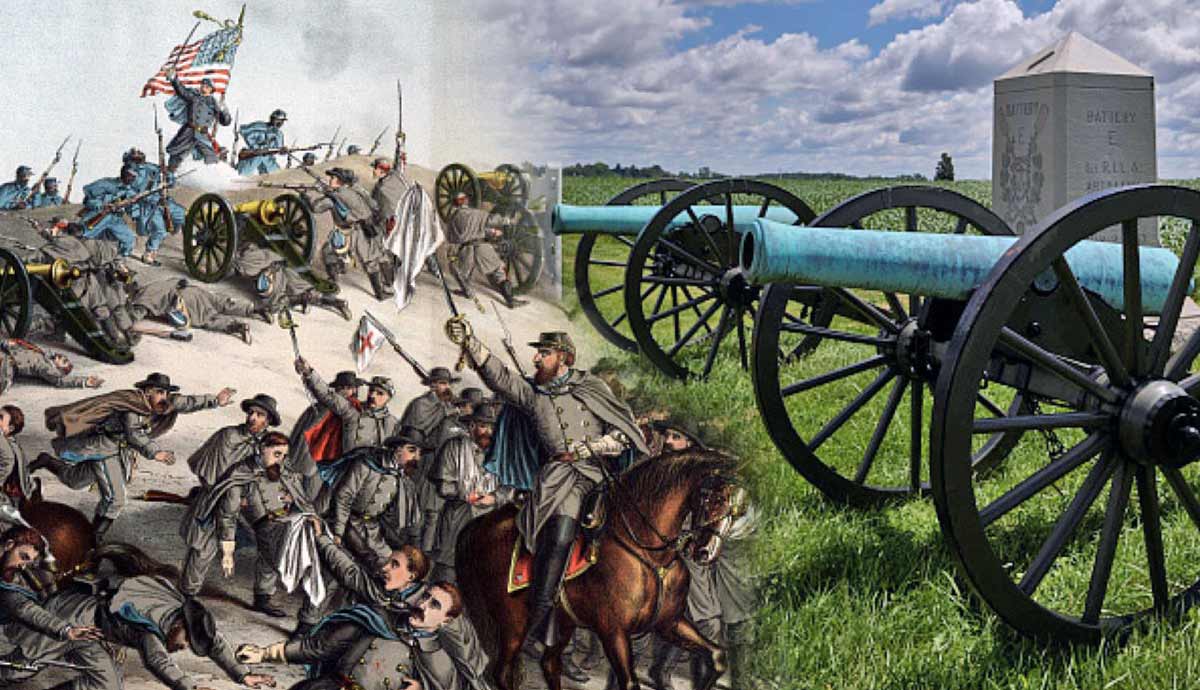
Prior to the American Civil War, most Americans primary political loyalty was to their state rather than the United States as a whole. The conflict played a major role in promoting the idea of a single political entity known as the United States rather than these United States. Facing succession from southern states over slavery, states rights, and economic differences, many factors played a role in the Unions ultimate victory over the Confederacy, but few had a greater impact than artillery on the field of battle.Technological AdvancementsDelafield 3.67-inch Banded Iron Rifle, 1862. Source: Smithsonian InstitutionBetween the War of 1812 and the American Civil War, one major advance in artillery technology was barrel rifling. Although invented for handheld firearms centuries earlier, rifling of cannon tubes was not widespread in the United States until the mid-19th century. As such, rifled artillery was first seen in action during the Civil War, where its benefits were clear. Projectiles could be fired through rifled tubes with a calculated spin, stabilizing their trajectories, increasing accuracy, and increasing range. Furthermore, gun crews armed with rifled weapons were able to deploy various munitions, including high explosives and solid shots, to penetrate better-armored targets.Three artillery pieces ruled Civil War battlefields. The first, the Parrott rifle, came in numerous calibers. Despite its reputation for reliable range and accuracy, Parrott rifles often injured their gunners due to a cast iron design that was vulnerable to exploding upon firing. The 3-inch ordnance rifle, however, corrected these issues by exploiting wrought iron manufacturing. While more expensive to produce, the Union overcame financial burdens due to its industrial advantage over the south. Lastly, the Whitworth rifle had a hexagonal bore which delivered destruction with remarkable accuracy over long distances and was primarily used by Confederate troops.New Observation MethodsWar balloon at a military exhibition, 1890. Source: Smithsonian InstitutionAside from accuracy, range, and weight limitations, artillery of the American Revolution and War of 1812 were restricted to firing at only what they could directly see. This setback, however, was remedied during the Civil War by hot air balloons in the President Lincoln-approved Balloon Corps. At 1,000 feet in the air, balloons fulfilled tactical and operational functions now replaced by modern targeting equipment, aircraft, and drones. Aerial observers in balloon baskets carried out reconnaissance of enemy movements, strength, and cohesion that would otherwise be unknown to battlefield commanders on the ground. Large balloons that could accommodate five soldiers were fueled using unique inflation wagons that generated hydrogen using local gas supplies.This new ability allowed field artillery commanders to strategically deploy artillery assets in ideal locations and fire at enemy troops without having direct sight of them. Now known as indirect fire, launching artillery at targets outside of the gun lines sight was accomplished through signal flags and telegraph communicators to refine desired coordinates and draw fire closer towards the enemy.Despite weather-induced challenges, tethered hot air balloons guided indirect fire observation with immediate impact in battle on the eastern front, and were also used to a lesser degree along the Mississippi River. During the 1862 Battle of Fair Oaks, aeronautics pioneer Thaddeus Lowe sent Confederate movement reports up Union communication channels, and this intelligence influenced General McClellans resulting Peninsula Campaign. Later that year, similar intel about Confederate movements helped shape the Battles of Gaines Mill and Fredericksburg, where targeting data from balloons allowed Union artillerymen to deliver accurate indirect fire.Early Artillery ImpactsHowitzer captured by Butterfields Brigade near Hanover Court House, 1862. Source: Library of CongressArtillery had a significant impact during the earlier years of the American Civil War. In February 1862, General Ulysses S. Grant utilized field artillery and both ironclad and wooden gunboats to bombard the Confederate outpost at the Battle of Fort Donelson, leading to the fortifications surrender. This conquest allowed the Union to open supply lines along the Cumberland River.Just seven months later, Union and Confederate troops exchanged indirect and direct fire in one of the most intense artillery duels of the war. During the Battle of Antietam in September 1862, over 500 cannons were employed. Union artillery enjoyed more strategically advantageous positioning on high ground on the Maryland battlegrounds rolling hills to hold off General Robert E. Lees Confederate Army of Northern Virginia.Although the Battle of Antietam is considered a bloody, tactical draw with 10,000 killed, wounded, and missing on each side, it was a strategic triumph for the Union as it forced Lee to retreat into Virginia. The battle gave President Lincoln the confidence to disseminate a preliminary Emancipation Proclamation on September 22, 1862, and gave northern troops a much-needed morale boost. The aftermath of the Battle of Antietam had significant international impacts as well. Prior to the fight, European powers including Britain and France contemplated officially recognizing and supporting the Confederate cause. The Unions success on the battlefield, however, dissuaded these powers from intervening in the conflict.Eyeing Ultimate VictoryCivil War cannons near Rhode Island artillery battery E monument at Gettysburg, Pennsylvania, 2019. Source: Library of CongressBy the middle of the war, artillery continued to make an impact during some of the bloodiest fighting of the conflict. General Grants artillery played a crucial role in the nearly two-month Siege of Vicksburg in 1863. Union forces bombarded Confederate defenses for weeks before securing the surrender of the strategic city. Despite the logistical difficulties in supplying field and artillery crews with tens and thousands of projectiles, the outcome was worth the sustained effort. Not only did indirect fire save hundreds of infantry soldiers lives during the assaults, but the victory also split the Confederacy into two by enabling Union forces to take control of the Mississippi River.Simultaneous to the end of the Siege at Vicksburg, Union and Confederate forces clashed at the Battle of Gettysburg in early July 1863. Union artillery batteries were deployed at key locations overlooking the battlefield including Cemetery Ridge, Culps Hill, and Little Round Top. Prior to General Picketts infamous failed charge, General Lee ordered an artillery bombardment against the Union lines.Led by General Henry J. Hunt, the Chief of Artillery for the Army of the Potomac, Union artillery fired haphazardly to trick General Lee into thinking his bombardment was successful. To the Confederates surprise, many of their shells overshot their targets due to faulty fuses, and the Unions 120 cannons overwhelmed Pickett and his charging infantry by switching to canister shot, which proved devastating at close range. Through effective strategy, tactics, and deployment, artillery enabled one of the most significant Union victories of the war.End of the WarA view inside Appomattox Court House where General Lee surrendered to General Grant, Major & Knapp Lithography Company, 1867. Source: Smithsonian InstitutionThe last significant battle of the Civil War prior to General Lees surrender to General Grant at Appomattox Court House in 1865 was the Siege of Petersburg, a ten-month campaign beginning in June 1864. By launching a relentless bombardment over extensive networks of enemy trenches from land and naval assets, the Union managed to neutralize enemy troops in harsh terrain that was unfavorable to infantry assaults.Again led by General Hunt, Colonels Wainwright and Tidball of the Union V and II Artillery Brigades, respectively, repulsed Confederate counterattacks and closed off potential supply lines. A division of over 3,700 African-American troops got their first taste of combat in the Civil War at the Siege of Petersburg. Positioned on the Unions left flank, they captured three artillery batteries and forced the Confederates to withdraw from a fourth. Today, a monument stands to honor the battle-proven black soldiers and memorialize their successes in neutralizing enemy artillery positions.After a series of climatic defeats, General Lee recognized that he had no option but to surrender. On the morning of April 9, 1865, the surrounded Confederate leader yielded to future president Ulysses S. Grant, marking an end to major hostilities. The Civil War, however, raged on into May with the Battle of Palmito Ranch in Texas, despite both sides being aware of Lees surrender a month earlier.LegacyPainting of the Battle of Nashville, Harry T. Peters, 1891. Source: Smithsonian InstitutionArtillery continued to have a widespread impact on civilian and military life after the Civil War. The type of technological innovations during the American Civil War influenced battlefield fortifications for decades. In the late 19th and early 20th centuries, concrete bunkers, underground trenches, and angled defenses became more popular in some of the worlds most significant battlefields.On the industrial front, Union factories that made guns and munitions transitioned to peacetime production. Returning soldiers worked in manufacturing plants to stimulate the economy and bring about a new era of economic prosperity. Meanwhile, the nations railroad network, which played a crucial role in transporting guns during the war, further catalyzed economic development in the north. The South, which was not as industrially developed as the North, struggled to recover from the devastation of the war.In 1869, General Grant was sworn in as president of the United States, leading America through a period of Reconstruction as the southern states were reintegrated into the federal union. General Hunt, the former Union artillery commander, authored a series of papers on military doctrine and served in Washington D.C. as the governor of the Soldiers Home, a veteran community center.
0 Commenti
0 condivisioni
15 Views

 English
 Arabic
 French
 Spanish
 Portuguese
 Deutsch
 Turkish
 Dutch
Dutch
 Russian
 Romaian
 Portuguese (Brazil)
 Greek
Greek