


WWW.THECOLLECTOR.COM
Did Children Really Go to War?
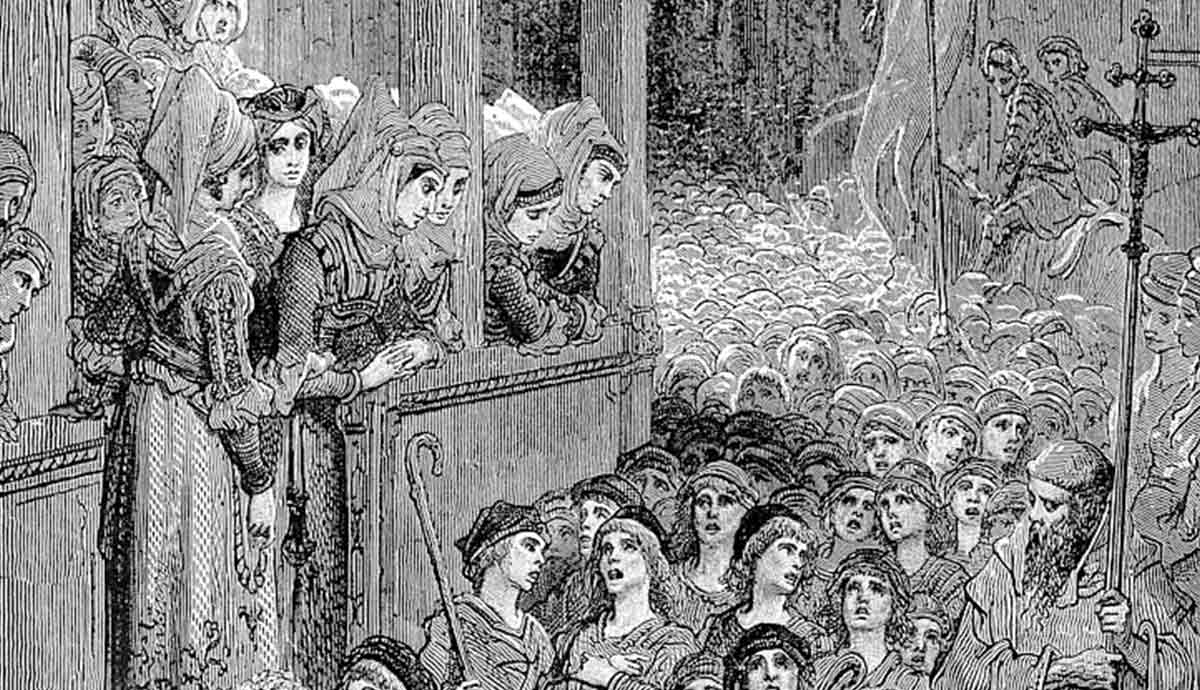
The Crusades were a series of military conflicts in the Middle Ages between Christians and Muslims battling for control of the Holy Land. There were many key crusades and key crusading figuresmen like King Richard I of England, Philip Augustus of France, Pope Urban II, Baldwin of Flanders, Saladinthe list goes on and on. But few have heard of this minor crusade. This article will delve into the Childrens Crusade, and how it came to be.Background to the Childrens CrusadeThe Childrens Crusade, by Gustave Dor, 1877. Source: The Open LibraryIn history, facts can become distorted. Facts can become myths, myths can become legends, and legends can disappear, only to resurface years later.In some ways, this is what happened with the Childrens Crusade. There are a few contemporary accounts, which date the events to around the year 1212which wouldve been 117 years after Pope Urban II called for the mighty First Crusade, over half a century since the disastrous Second Crusade, and 20 years after the raucous Third Crusade.Understandably, crusading fever was at an all-time high in Christendom. The Third Crusade included figures such as Richard the Lionheart of England, Philip Augustus of France, Guy of Lusignan, Frederick Barbarossa on the side of Christendom and the formidable Muslim leader Saladin on the side of Islam, or the infidel, as the Crusaders referred to them as.With huge names like these, it is little surprise that crusading fever reached its climax in Europe at that timeand especially in Western Europe, where the immediate effects of crusading were less prominent on the landscape than in Eastern or even Central Europe.Why Childrens Crusade?Peter the Hermit Preaching the First Crusade, by James Archer, 1883. Source Project GutenbergIt is little surprise then, with crusading fever hitting an all-time high, that even children got wind of it.It is important to place this event in the context of the timelife at that time was centered around the Church. The latest popular developments, political strife, and even scientific and technological advances were mentioned in and around the Church.The medieval Church was also funded largely by tithespeople would donate anything from money to agricultural produce to the Church, and it became an incredibly powerful institution. Hence the Pope became the most powerful man in Europe at the time.This meant that children were as aware of the goings-on in and around the Church as many adults wereand children who took religious fervor particularly seriously would undoubtedly have heard tales about crusaders and crusading. They would have heard about it as an honorable and good thingto reclaim the Holy Land rightfully for Christendom, and take it out of the hands of the infidel for good.Tales of King Richard the Lionhearts brave efforts at Acre, the first Crusaders at Antioch, the Kings of Jerusalem, and more wouldve turned from factual and bloodily horrifying accounts of medieval warfare into tales of chivalry and legendundoubtedly not just inspiring adults, but inspiring young children, too.This is the most likely explanation for how the Childrens Crusade came to bebut how did children organize such a major event?Nicholas of Colognes CrusadePope Innocent III, c. 1219. Source: Wikimedia CommonsThere were two main Childrens Crusades. One was led by a young French boy, aged around 12 years old, known as Stephen of Cloyes. The other was centered around a young German boy known as Nicholas of Cologne.Nicholas, whose exact age is unknown, but who was clearly no older than a teenager, was a shepherd from the Rhineland region of Germany. Nicholas was insistent that an angel had visited him and told him to start a crusade.However, rather than kill Muslims, Nicholas was insistent that the angel had told him that they would instead be converted from Islam to Christianity.Many people followed young Nicholass sermons and preaching, and this eventually culminated in people massing together in the German city of Cologne in the Spring of 1212.Nicholass plan was to lead his followers from Germany to Italy, believing that God would open up the sea for him as he had done for Moses in the Bible, thus marking an easy way to cross from Europe to the Holy Land.Reportedly around 7,000 people who had followed Nicholas arrived in the northern Italian port city of Genoa in late August 1212, meaning that Nicholas had successfully led thousands of people across the Alps which was a feat in and of itself.However, upon arriving at Genoa Harbor, many were disappointed that the sea did not open up for them. While many left, criticizing Nicholas, many more stayed, because it was unthinkable that God would simply not open the sea for such a just and worthy cause in the name of Christendom.It was not all bad, thoughthe Genoese authorities were so impressed by the Crusaders rigor and determination that they offered them citizenship in the citywhich many of the weary travelers gladly accepted.Childrens Crusade, Monogrammist LIW, Dutch, ca. 1550-80. Source: The MET, New YorkNicholas, determined to see his journey through, instead traveled to Pisa, with more and more followers abandoning him along the way. Interestingly, two ships that were set to go to Palestine allegedly embarked with some of the children, meaning that some children could potentially have reached the Holy Land.However, Nicholas continued onward to the Papal States, eventually meeting with the legendary medieval Pope Innocent III, which shows how serious word about this Childrens Crusade had become. After the pontiff told them to be good and return to their families back in Germany, many more children left.Nicholas, however, died on his return back to Germany while crossing the Alps. Nicholass father, upon receiving the news, was arrested and hanged for his part in allowing his son to take so many children across the Alps with him in the first place.While Nicholas never reached the Holy Land, it was reported that some of his most dedicated followers had reached places as far as Brindisi, but there were no confirmed accounts that any children had reached the Holy Land. The best chance is perhaps those who embarked on the ships bound for Palestine.Stephen of Cloyess CrusadePhilip II, Augustus, by Louis Felix Amiel, 1837. Source: French Ministry of CulturePerhaps the better-known of the two Childrens Crusades was the one led by a 12-year-old French boy known as Stephen of Cloyes.In June of the same year (1212), another shepherd boy, called Stephen of Cloyes, bore a letter to the King of France (King Philip II of France), which had been given to him by Jesus himself, disguised as a poor pilgrim.This claim attracted large groups of similar-aged children (as well as some adults), with some claiming that they could also perform miracles. Stephens following was larger than Nicholass, amassing some 30,000 followers at its peak.They headed to Saint-Denis, but Philip II ordered that these children should return home instead as they were not old enough to undertake a crusade. Philip was also not convinced of the alleged miracles that some of the children could perform and refused to take them seriously.Not to be dissuaded, Stephen began to preach his sermon at nearby abbeys, before traveling around France spreading the word of his crusade with many of his followers. His primary message was that he, the other children, and many followers were going to lead charges of Christ from France to Jerusalem and liberate the Holy Land once and for all. Many children were awed by his sermons, and many adults were equally as impressed.View of Jerusalem, by Konrad von Grunenberg, 1487. Source: Wikimedia CommonsBy the end of June, Stephen led his followers from Vendme to Marseille in the south of France, and while they were largely sustained by begging, many felt disheartened and had returned home, so his following shrunk.Unfortunately, it was also a sad end for Stephen and his followers, with no reported children ever reaching the Holy Land. Two French merchants in Marseille (William of Posqueres and Hugh of Iron) offered to take any children to the Holy Land for a small fee in their boats.Some of the children accepted but they never reached the Holy Land. There are two differing reportsone states that they were shipwrecked off the coast of Sardinia, while another claims that they were instead taken to Tunisia and sold into slavery there.The Legacy of the Childrens CrusadeLouis IX during the Seventh Crusade, by Guillaume de Saint-Pathus, c. 1350. Source: Wikimedia CommonsWhile both crusades came to sad ends (and some historians even question the legitimacy of them being called crusades because a pope never officiated them), it is important to recognize the social impact that both crusades had.While some elements have likely been exaggerated, it is still nevertheless impressive that two children managed to amass almost 40,000 followersmainly childrento go on a crusade to liberate the Holy Land in the name of Christendom.It can be argued that the children only knew the best bits of the Crusadesthe heroic chivalric momentsand not the harsh reality of medieval siege warfare and the horrors of war in general.The fact that both had meetings with key figures in the medieval worldPope Innocent III and King Philip II of France, respectivelyshows how serious they were about crusading, but also how serious the Church and the state took their ideas, even if they did both dismiss them in the end.The Childrens Crusade (or rather, crusades), should not be a forgotten corner of medieval history. Instead, the impact that the two boys had at the peak of crusading fever in medieval Europe shows just how far people (children) were willing to go in the name of Christianity.
0 Reacties
0 aandelen
24 Views

 English
 Arabic
 French
 Spanish
 Portuguese
 Deutsch
 Turkish
 Italiano
 Russian
 Romaian
 Portuguese (Brazil)
 Greek
Greek