


WWW.THECOLLECTOR.COM
The Real Historical Background of Sir Percivals Arthurian Legends
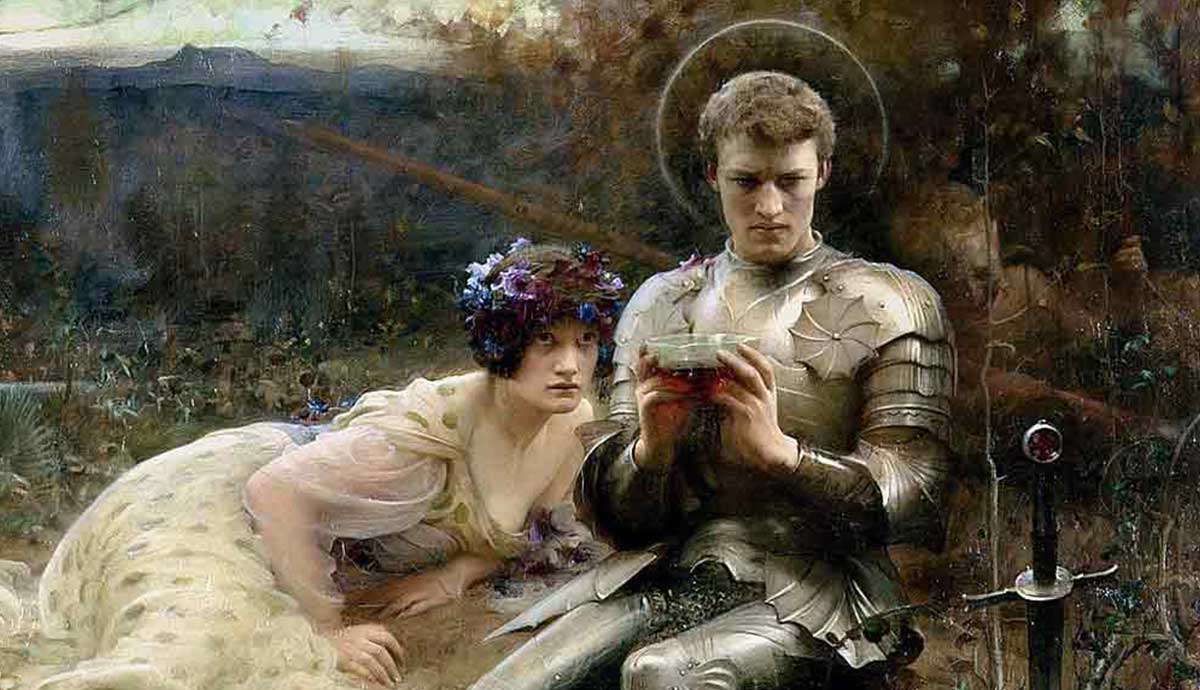
Sir Percival is a character in the legends of King Arthur, presented as one of the Knights of the Round Table. He is perhaps one of the most famous Arthurian characters today due to his connection to the quest for the Holy Grail. Many of the characters in the Arthurian legends are known to have been based directly on real figures from the 6th century, and this is true in the case of Percival. He can be identified with a figure from northern Britain who, although not appearing in any contemporary sources, is generally held by scholars to be historical. What do we know about him?What Is the Origin of Sir Percival?Temptation of Sir Percival, by Arthur Hacker, 1894. Source: Leeds Art GallerySir Percivals character appears in numerous medieval tales about King Arthur. Over the centuries, the legend evolved considerably, to the point that the later versions are dramatically different from the originals. Since we are interested primarily in the historical background of this legend, we will focus on what the earliest versions of the legend say about Percival.Percival first appears in a tale written by Chretien de Troyes, a French writer. The tale is known as Perceval, The Story of the Grail. This legend, written in the late 12th century, tells the story of Percival and his quest to find the Holy Grail. He was shown the Holy Grail at Grail Castle, the home of the injured Fisher King, who is awaiting the chosen one to heal him. However, Percival failed to ask a key question while being shown a procession of various marvelous objects within the castle, including the Holy Grail, and consequently, the Fisher King and his lands were not healed.Manuscript illustration of Percival arriving at a hermitage, from MS Franais 111, fol. 244v., c. 15th century. Source: Bibliothque Nationale de FrancePercival leaves the castle. Then, after being informed by a maiden that he had the opportunity to heal the Fisher King, Percival resolves to find Grail Castle again. He sets off on a quest, but at this point, Chretiens story ends. Writing shortly after Chretien, Robert de Boron wrote a finished version. In this version, Percival eventually finds Grail Castle. While watching the procession of marvelous objects for a second time, he asks about the Holy Grail.Upon doing so, the Fisher King is healed. This also heals his kingdom, which had been stricken along with the king. The Fisher King then appoints Percival as the new keeper of the Grail and departs from the earth, likely going to heaven. Simultaneously, it is important to note that Percival is presented as one of King Arthurs knights during this period of his life. He is the most virtuous, innocent, and holiest of all Arthurs knights, which makes him uniquely qualified to find and guard such a holy object.Percival in Welsh SourcesIllustration of the king receiving a severed head from the Welsh Tale of Peredur, in T.W. Rolleston, Myths and Legends of the Celtic Race, 1910. Source: Wikimedia CommonsAs mentioned before, Chretien de Troyes was a French writer. However, the Arthurian legends ultimately originate in Wales, since the stories come from the historical era in which the Britons waged war against the Saxons in the 6th century. Due to this, we often gain insight into the historical background of the legends when we look at Welsh sources, even when they post-date the earliest written French sources.Percival appears in various Welsh documents, where he is called Peredur. Some scholars, such as Rachel Bromwich, believe that Percival is a loose French approximation of this Welsh name.Some of the Welsh documents in which Peredur appears are versions of the Welsh Triads, collections of medieval traditions regarding the Arthurian period. In one version of Triad Four, Peredur is mentioned as one of the Three Well-Endowed Men of the Island of Britain. He is well-endowed in the sense of holding wealth or royal dignity and worth.Opening page of Peredur ab Efrog from The Red Book of Hergest, Jesus College MS 111, fol. 161v., c. 14th-15th century. Source: Bodleian LibrariesThere are a variety of other minor references to Peredur in Welsh texts. However, the most substantial source is the tale known as Peredur ab Efrog. This is essentially the Welsh version of Chretiens story. It generally follows what Chretien wrote, although with some significant differences. The most significant difference is that the Holy Grail does not appear. Rather, the special object that Peredur sees is a tray holding a mans severed head.The rest of the tale is devoted to Peredur embarking on a series of adventures, which culminate in him discovering that the severed head that he saw belonged to his cousin. He then works alongside Arthur in avenging his cousin, killing the Nine Witches, the group responsible for his cousins death. In this respect, it is quite similar in style to other early Welsh tales about King Arthur, many of which involve overtly magical enemies and few explicit references to Christianity. This distinguishes it from Chretiens version.Peredur, Son of ElifferPeredurs fathers name shown as Effrawc Iarll from The Red Book of Hergest, Jesus College MS 111, fol. 161v., c. 14th-15th centuries. Source: Bodleian LibrariesIt is significant that Peredur is called ap Efrog in the Welsh versions. This means son of Efrog, which was, itself, the name for York. Given that this was the name of a place, some scholars understand this to not actually be the name of Peredurs father. Rather, it was the name of the city ruled by his father. This is supported by the fact that the Welsh romance tale Peredur ab Efrog refers to Peredurs father as Effrawc iarll. This wording could be translated as Earl Efrog. However, it could have originally meant Earl of Efrog. In other words, Peredur was the son of the Earl of York.This helps us determine the historical background of this legend. As it happens, there is evidence of a historical figure active in Britain in the 6th century in what would later become the north of England. He is known as Peredur ap Eliffer. What do we know about him?Parish Church of St Michael and All Angels, Arthuret, where Peredur fought a battle against Gwenddoleu in 573 CE. Source: Wikimedia CommonsPeredur ap Eliffer appears in Harleian MS 3859, which contains the earliest surviving genealogical record of the medieval kings of the Britons. He also appears in the Annales Cambriae, a 10th-century Latin chronicle. For this reason, he is generally accepted as a historical figure. Peredur appears most frequently in association with his brother, Gwrgi. The Annales Cambriae records their deaths in the year 580.The Annales Cambriae also records that a war was fought between the sons of Eliffer and Gwenddoleu in 573. This was the Battle of Arfderydd, generally held to have been fought at modern-day Arthuret. Although this entry in the Annales Cambriae does not specifically say that Peredur was one of the sons of Eliffer involved in this battle, later documents make this claim, and there is no reason to doubt it.Since Eliffer was the son of a figure known as Arthwys ap Mar in the genealogies, it appears that Peredur can likely be linked to the kingdom of Elmet. This is very close to York.Peredur in Geoffrey of Monmouths Historia Regum BritanniaeManuscript of Geoffrey of Monmouths Historia Regum Britanniae, Peniarth MS 23c, fol. 13r., c. late 12th century. Source: National Library of WalesThe identification of Peredur, the Welsh version of Percival, with the historical Peredur ap Eliffer would be stronger if there were clear evidence that this historical figure was associated with King Arthur. As it happens, we find this evidence in the writings of Geoffrey of Monmouth. He wrote his Historia Regum Britanniae in c. 1137, several decades before Chretien wrote. In his account of Arthurs special coronation, he presents Arthur as having numerous allies attending the event. One of these is named Peredur, son of Eridur.The name Eridur is clearly a corruption of Elidir, an early form of the name of Eliffer. Hence, this shows that Peredur ap Eliffer was associated with King Arthur in the legends before Chretien de Troyes wrote about Percival. This, in turn, lends credence to the idea that Chretiens romance tale could have been based on stories circulating about Peredur ap Eliffer. Geoffrey went on to portray Peredur as a ruling king in the Vita Merlini, set after Arthurs reign. This is consistent with Chretiens portrayal of Percival as a youth when Arthur was already an experienced king.What Is the Historical Background to the Legend of Percival?Map of Britain showing the locations of Elmet (possibly Peredurs home territory) and the Battle of Arfderydd. Source: Wikimedia CommonsIn summary, we can see that the legendary figure of Sir Percival can be traced back to the historical figure known as Peredur ap Eliffer. Percivals name appears as Peredur in Welsh versions of his legend. Furthermore, the reference to his father as Earl Efrog is likely a mistake for Earl of Efrog, the Earl of York. Peredur ap Eliffers family was associated with that general region of the country, although their exact territory is unknown. In any case, the name, the chronology, and the geography generally support the conclusion that the Peredur of Welsh legend was the historical Peredur.On the other hand, the concept of Peredur searching for the Holy Grail does not seem to have any basis within Welsh tradition. It appears that the original story involved a journey across Britain to achieve vengeance against his cousins killers. Whether this story has any basis in the historical activities of Peredur ap Eliffer, we simply cannot say.
0 Commentaires
0 Parts
25 Vue

 English
 Arabic
 Spanish
 Portuguese
 Deutsch
 Turkish
 Dutch
Dutch
 Italiano
 Russian
 Romaian
 Portuguese (Brazil)
 Greek
Greek