Archaeologists Near Pompeii Just Discovered Vivid Frescoes Inside A Lavish Villa That May Have Belonged To Emperor Neros Second Wife
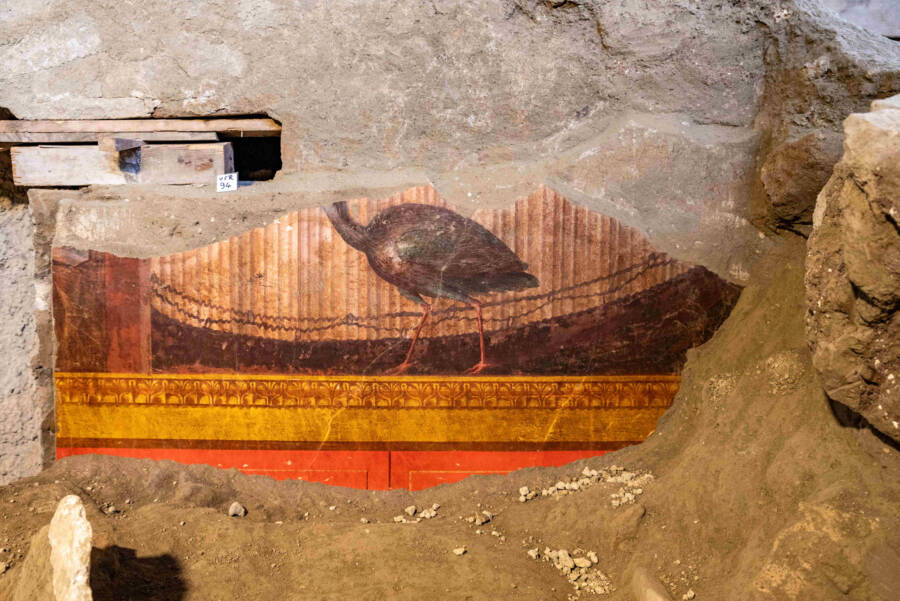
Parco Archeologico di PompeiA fresco fragment depicting a peahen that was recently uncovered at the Villa Poppaea in Pompeii.Ongoing excavations and restoration work at the Villa Poppaea near Pompeii have revealed new frescoes that feature vivid images of a peahen and a comedic theatrical mask.The Villa Poppaea is located between the ancient Roman cities of Pompeii and Herculaneum, which were both buried under volcanic ash during the eruption of Mount Vesuvius in 79 C.E. Whats more, the villa may have been the residence of Emperor Neros second wife, Poppaea Sabina.After the eruption of 79 C.E., the villa was buried under the massive pyroclastic flow, freezing these frescoes in time. Recent excavations have unveiled more than just these stunning frescoes, however. They also discovered four new rooms of the villa and the ashy shells of trees that used to sit in the villas garden.The Fresco Fragments Found At The Villa Poppaea Near PompeiiParco Archeologico di PompeiIts believed that the Villa Poppaea belonged to Emperor Neros second wife, Poppaea Sabina.The current excavations are focused on the villas so-called Hall of the Mask and the Peacock, according to a statement from the Parco Archeologico di Pompei. Archaeologists found fragments of new frescoes, only adding to the collection of frescoes for which the villa is already well known.One of these fragments featured a peahen, now missing its head due to damage. This mural is the sister piece to the peacock painting that had previously been found on the opposite wall.There were also several fresco fragments that depicted a theatrical mask. While other frescoes depicting masks have been found in the hall, this one stands out.Parco Archeologico di PompeiA fresco fragment showing a comedic theatrical mask of the character Pappus.This mask was used in the Atellan Comedy, a type of improvised farce popular in ancient Rome, whereas other frescoes depicting theatrical masks have all been from tragedies. Specifically, the fragments depicted the character of Pappus, an old man who tries to act young and gets mocked for it.Archaeologists also uncovered several fresco fragments that depicted a golden tripod, which sat within a circle. This matched a similar depiction of a bronze tripod found on another wall.The Villa Poppaea Excavations Revealed More Than Just FrescoesArchaeologists also identified the natural molds that had formed around the trees that once sat in the villas garden, created when ash and lava blanketed the area in 79 C.E. Researchers were able to determine the trees original positions, finding that their placement was in a similar ornamental scheme to other documented patterns in Pompeiian houses.Parco Archeologico di PompeiRestoration work is also taking place in some of the more ornately decorated rooms of the villa.While it is still unclear which exact species of trees were planted here, archaeologists hypothesized that they may be olive trees, which have been identified in nearby archaeological sites. Either way, like the so-called bodies of Pompeii, these trees serve as haunting reminders of what was lost during the disaster of 79 C.E.The recent excavations also revealed four new rooms of the villa. This discovery brings the number of known rooms of the Villa Pomppaea up to a whopping 103. Archaeologists also uncovered a seasonal stream that flowed near the property, which likely began after the 1631 eruption of Mount Vesuvius.These initial results offer new and promising research perspectives for understanding the villas layout, and for studying the long-term interactions between human settlement and the natural environment, Director of the Pompeii Archaeological Park, Gabriel Zuchtriegel, said in a statement.Restoration work remains ongoing at Villa Poppaea, specifically efforts to restore the decorative elements of some of the villas rooms. One of these spaces is the cubicula in the southwestern part of the villa.This room is covered in stucco, frescoed walls, painted vaults, and floor mosaics. The aim of the restoration is to restore the full legibility of the frescoes and mosaics poignant reminders of what life looked like in the shadow of Vesuvius in the era just before it erupted.After reading about the numerous discoveries at the Villa Poppaea, check out 33 of Pompeiis stunning frescoes. Then, learn about the elaborate Roman shrine found at Pompeii.The post Archaeologists Near Pompeii Just Discovered Vivid Frescoes Inside A Lavish Villa That May Have Belonged To Emperor Neros Second Wife appeared first on All That's Interesting.




 English
 Arabic
 French
 Spanish
 Portuguese
 Deutsch
 Dutch
Dutch
 Italiano
 Russian
 Romaian
 Portuguese (Brazil)
 Greek
Greek