Archaeologists In Sudan Have Discovered 1,400-Year-Old Mummies Of Nubian Children With Facial Tattoos
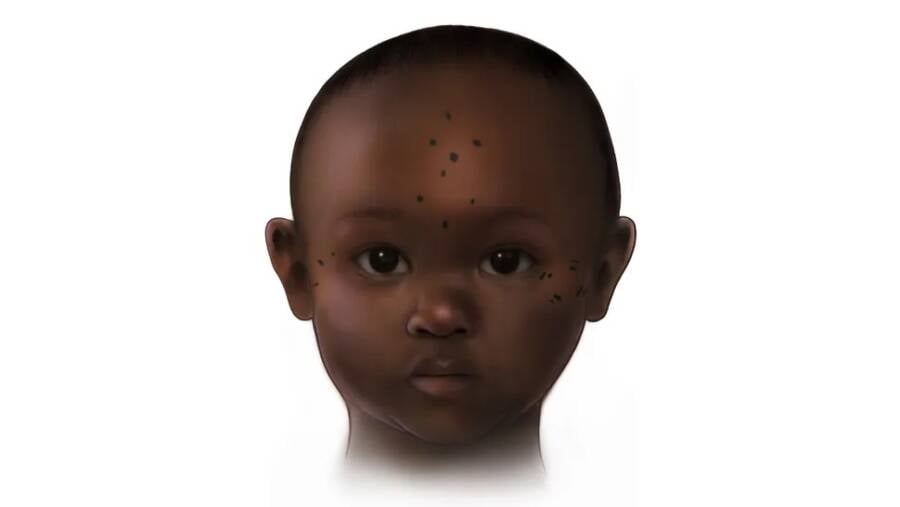
Mary Nguyen/UMSLAn artists reconstruction of the tattoos found on the forehead of a three-year-old girl.A new study has nearly doubled the known number of tattooed individuals from the ancient Nile Valley, revealing that the practice was far more widespread than previously understood. This includes evidence of tattoos even on children under the age of three.Researchers from Arizona State University and the University of Missouri-St. Louis conducted a systematic survey of 1,048 human remains from Sudan, dating from the Meroitic to medieval periods (around 350 B.C.E. to 1400 C.E.). Their findings, published in the Proceedings of the National Academy of Sciences, documented tattoos on 27 individuals of both sexes, ranging from infants to older adults. Multispectral Imaging Techniques Identify Otherwise Invisible TattoosThe study utilized multispectral imaging to identify tattoos on mummified skin from three archaeological sites: Semna South, Kulubnarti, and the Qinifab School site. The advanced imaging techniques allowed researchers to detect faint or invisible tattoos and analyze their motifs and application methods.We use near-infrared imaging, said USMLs Anne Austin. That infrared light allows us to look just slightly below the surface. Under the infrared, tattoos just emerge, and that gives us a way to detect them that makes it much easier to find tattoos than just with the naked eye alone.A significant shift in tattooing practices was observed during the medieval Christian period. At the Kulubnarti site, at least 19 percent of individuals examined had tattoos, the highest concentration found. Extensive tattooing at Kulubnarti attests to the earliest evidence for Christian tattoo traditions in northeast Africa and may be ancestral to modern Christian practices in the region, the authors wrote in the study.The presence of tattoos on very young children, particularly those under age three, has raised questions about the purpose of these markings. While the study does not definitively determine the reasons, it opens new avenues for understanding cultural and religious practices in ancient Nubia.Mary Nguyen/UMSLA reconstruction of some of the tattoo patterns identified in the study. Theories About The Purpose Of Tattoos In Ancient NubiaThis is the first time that I know of where we find such consistent evidence on really young children, Austin noted. We have somebody whos under one that possibly has tattoos, definitely a one-year-old with tattoos, and we find multiple children, even a child whos three, who has multiple tattoos, one over another, Austin continued. This is not just showing that they were tattooed, but it might have even happened multiple times during that really early period.The tattoos, which were likely made with knives instead of needles, were mostly clusters of dots and dashes. A particularly common pattern consisted of four dots in the shape of a diamond on a persons forehead, which Austin suggested may be a representation of the Christian cross. If so, it is possible the tattooing was part of a baptismal process. Austin et al., PNAS (2025)The tattooed forehead of a three-year-old Nubian child under near-infrared light.If the tattoos were a symbol of the wearers Christian faith, then it might have been important for parents to create permanent ways to mark their children as Christian, Austin told Live Science. That isnt the only theory researchers are investigating, though. Austin added that there might have been a medical reason for tattooing children in those days, potentially in an attempt to alleviate a childs headaches or fevers caused by malaria. If parents tattooed their children in order to protect them or for medical reasons, then maybe the high rate of tattooing in young children shows us that people at Kulubnarti were facing unusually high amounts of health issues, Austin said.While this research leaves many questions still unanswered, it adds another layer of proof of the importance of tattooing in ancient cultures in the Nile Valley.After learning about this analysis of tattoos from ancient Nubia, read all about Sudans Nubian pyramids. Then, meet tzi the Iceman, the oldest preserved human being ever found.The post Archaeologists In Sudan Have Discovered 1,400-Year-Old Mummies Of Nubian Children With Facial Tattoos appeared first on All That's Interesting.




 English
 Arabic
 French
 Spanish
 Portuguese
 Deutsch
 Turkish
 Dutch
Dutch
 Italiano
 Romaian
 Portuguese (Brazil)
 Greek
Greek