


WWW.THECOLLECTOR.COM
7 Architectural Masterpieces by Francesco Bartolomeo Rastrelli
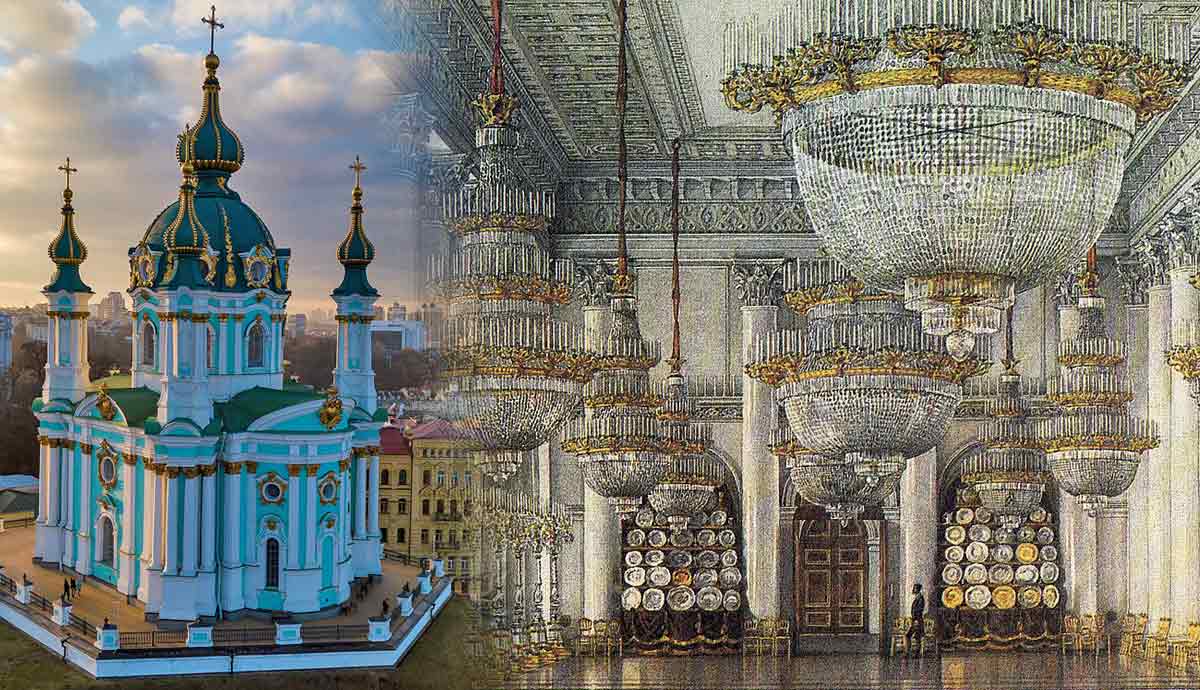
Many famous architectural monuments that appear quintessentially Russian were actually built by foreigners. The iconic walls of the Moscow Kremlin were built by Italian Renaissance architects, and later on, the Winter Palace in St. Petersburg was built by Francesco Bartolomeo Rastrelli. An Italian born in Paris in 1700 who accompanied his father Carlo Bartolomeo to St. Petersburg in 1716, Rastrelli is best known for the palaces he built in Russia for Empress Elizabeth of Russia. He began his career at the Russian court working for her predecessor, Empress Anna.1. Rundale PalaceRundale Palace, Latvia. Photograph by Jimmy Chen, 2015. Source: Jimmy ChenAn elegant Baroque palace with a yellow and white decorative scheme, Rundale Palace is one of the most iconic palaces in the Baltic region. Rastrelli was commissioned to build the palace by Empress Anna of Russia as a summer residence for her royal favorite, Ernst Johann von Biron. Prior to becoming empress in 1730, Anna had been Duchess of Courland, a Polish fief in present-day Latvia. When the ducal line of the House of Kettler became extinct in 1737, Anna encouraged the Courlanders to elect Biron as duke.Biron had acquired the site in 1735. An existing manor was demolished and its masonry used in the construction of the new palace. Work began in 1736 but gradually slowed down from 1738 as work on Jelgava Palace was prioritized. Shortly after Annas death in October 1740, Biron fell from grace and was exiled to Russia. Work on the palace was stalled until 1762, when Biron was restored to the duchy of Courland. Out of favor in Russia, Rastrelli supervised work at Rundale between 1764 and 1767, and the final works were completed by 1770.Biron spent his summers at the palace from 1768 until his death in 1772. His son Duke Peter preferred Vircava Manor near Jelgava as his summer residence. When Courland was formally annexed to the Russian Empire in 1795 following the third partition of Poland, the palace was given to Valerian Zubov, younger brother of Catherine the Greats lover Platon Zubov.Rundale was occupied by Napoleonic troops in 1812 and by German troops in World War I and suffered badly during the Latvian War of Independence in 1919. While a few renovated rooms were used for various purposes, in 1972, the Latvian Soviet government opted to fully restore the palace. The work was completed in 2014, and the palace is one of the most popular attractions in Latvia.2. Jelgava PalaceJelgava Palace, Latvia. Photograph by Jimmy Chen, 2015. Source: Jimmy ChenWhile construction work at Rundale was underway, in 1738, Rastrelli was commissioned to build a new palace for Biron in Mitau, the capital of Courland, now known as Jelgava. The old castle on the site, which had been built by the Livonian Order in 1265, was demolished to make way for the palace, which would become the largest in the Baltic states. The plans for the new palace included space for a crypt as the final resting place for Brion and his family. The sarcophagi of the Kettler dukes were also moved from the old church on the site, which had been demolished.Jelgava Palace shared a similar fate to Rundale Palace. Work stopped in 1740 and restarted in 1762, and the palace was completed in 1772, the same year of Duke Ernst Johanns death. It served as Duke Peters main city residence until his death in 1795, after which it was taken over by the Russian provincial administration. At the turn of the 19th century, the future Louis XVIII lived in the palace for a few years after being granted asylum by the Russian court. The palace also came under Napoleonic occupation and served as a military hospital.After suffering extensive damage during the Latvian War of Independence, the palace was renovated and given to the Jelgava Academy of Agriculture in 1939, shortly before the palace was ruined again during the Second World War. Reconstruction efforts began in 1957, and in 1961, the palace returned to the Latvia Academy of Agriculture, which became the Latvian University of Agriculture in 1990 and the Latvia University of Life Sciences and Technologies in 2018. The university supervised further reconstruction works between 2001 and 2018. While most of the palace is used for academic purposes, visitors can access the burial vault of the Dukes of Courland, managed by the Rundale Palace Museum.3. Peterhof PalacePeterhof Palace, Russia. Photograph by Jimmy Chen, 2015. Source: Jimmy ChenIn 1714, Peter the Great commissioned the construction of a palace at a site a few miles west of his new capital of St. Petersburg called Peterhof (German for Peters Court). In keeping with his own restrained tastes, the original palace was initially a modest affair, but the tsar intended to dazzle the foreign dignitaries he received at the palace with extensive gardens featuring a Grand Cascade and a canal leading into the Neva Bay. The main decorative element of the cascade, known as the Samson Fountain, was designed by the architects father Carlo Bartolomeo Rastrelli and installed in 1735 in honor of Peters victory over the Swedish Army at Poltava in 1709.Peters daughter, Empress Elizabeth came to the throne in 1741 after overthrowing her infant cousin Ivan VI in a military coup. Her tastes were far more extravagant than those of her father, and in 1745, she commissioned Rastrelli to transform the palace to suit her style. Rastrelli proved equal to the task, adding one floor to the main palace and extending it outwards by building two wings and symmetrical chapels on either side to fill the width of the gardens. Rastrellis creation came to be known as the Grand Peterhof Palace.Catherine the Great was less enamored with the Baroque, and during the 1760s and 1770s the interiors were overhauled in the more austere Neoclassical style. The interiors of the eastern wing were remodeled again in the 1840s by Tsar Nicholas Is daughter Olga Nikolaevna. Like many of Rastrellis palaces outside St. Petersburg, Peterhof was destroyed by the Germans in the Second World War. Reconstruction work began shortly after the war. In 1964, the first rooms were reopened to the public.4. Saint Andrews Church, KyivSaint Andrews Church, Kyiv, Ukraine. Photograph by Konstantin Brizhnichenko, 2019. Source: Wikimedia CommonsRastrellis commissions for Empress Elizabeth were not solely restricted to St. Petersburg and its environs. In 1744, the empress commissioned a new palace in Kyiv from Rastrelli. Part of the scheme involved the construction of a church on a hill where, according to the Tale of Bygone Years (also anachronistically known as the Russian Primary Chronicle), St. Andrew the Apostle had placed a cross and prophesized the emergence of a great city. Several churches dedicated to St. Andrew had occupied the site over the centuries. Rastrellis design envisaged a church with a central dome topped with a spire, and four smaller spires at each corner. The church was to be accessed via a large ramp leading up to the main entrance. Due to the steepness of the hill, this became a staircase.Empress Elizabeth was present at the laying of the foundation stone of St. Andrews Church in September 1744, and work on the structure continued until 1757. The interior decoration took another decade to complete. The church was built under the personal supervision of Russian architect Ivan Michurin, who surveyed the site and built deep foundations into the hill to maintain the integrity of the building.The churchs blue walls, white columns, and green roofs form an iconic part of Kyivs skyline. St. Andrews Church also preserves Rastrellis interiors, including a three-tier baroque red and gold iconostasis. The church continued to operate following the Russian Revolution but was closed in 1932 and turned into a museum. Services were restored during World War II but stopped again in 1961. The church was transferred to the Ukrainian Autocephalous Orthodox Church in 2008, but before its annexation by the Moscow Patriarchate in 2018, it was gifted to the Ecumenical Patriarchate of Constantinople.5. Smolny ConventSmolny Convent, St. Petersburg, Russia. Photograph by Jimmy Chen, 2015. Source: Jimmy ChenIn 1744, Rastrelli was commissioned to build the Smolny Convent. Located on the banks of the Neva, the site had previously been occupied by a summer palace belonging to Peter the Greats second wife Empress Catherine I. As the daughter of Peter and Catherine, Empress Elizabeth had spent much of her childhood at the palace but rarely visited after seizing the throne. When a fire destroyed much of the palace in 1744, Elizabeth decided to build a convent on the site for aristocratic girls. The empress also envisaged potentially retiring to the monastic complex herself.Rastrelli initially submitted a design in a Roman baroque style with a single-domed church and a four-story belltower. Not long after work started in 1748, the empress ordered Rastrelli to modify his design to conform to Russian architectural traditions. Rastrelli accordingly submitted a revised plan in the form of a conventional Greek cross with a central dome and four smaller belfries in the corners. Under the new plan, the belltower was now to be in five tiers and reach 140 meters in height. After the design was approved, Rastrelli added a further tier to extend the belltower to 170 meters, which would have made it the tallest building in Europe.Empress Elizabeths court dress displayed in the Catherine Palace. Photograph by Ivonna Nowicka, 2013. Source: Wikimedia CommonsWork on the cathedral began in 1751 and proceeded quickly, but the outbreak of the Seven Years War in 1756 diverted resources away from the project, which ground to a halt. The complex remained unfinished by Elizabeths death in January 1762. In 1764, Rastrelli was dismissed as court architect by Empress Catherine, who appointed her favored architect Yury Felten to convert the buildings to house educational institutions for noble girls. At the beginning of the 19th century, the Smolny Institute of Noble Maidens moved into a purpose-built structure next door, which served as the headquarters of the Bolshevik Party during the October Revolution of 1917.During the 1820s, Tsar Nicholas I ordered Vasily Stasov to finish the cathedral, which was consecrated as the Cathedral of the Resurrection of Christ in 1835. Rastrellis plans for the belltower were never realized. The cathedral was shut during the 1920s following the Russian Revolution, and services did not resume until 2010.6. Catherine PalaceCatherine Palace, Pushkin, Russia. Photograph by Jimmy Chen, 2015. Source: Jimmy ChenThe Catherine Palace in Tsarskoye Selo (Tsars Village) owes its name to Empress Catherine I, who had a stone palace on the site built in 1723. Naturally, the palace could not accommodate Elizabeths extravagance, and around 1743, work began on enlarging the existing palace. Rastrelli assumed responsibility for the work on the Catherine Palace in 1748, and in 1752, Elizabeth gave approval for the reconstruction of the original palace.Rastrelli embellished his blue-and-white faade with red gold (a gold and copper alloy), which sparkled in the sunlight. Gold gilding was also used extensively in the interiors, particularly in Rastrellis Golden Enfilade. This suite of rooms extended the full length of the palace, beginning with an antechamber leading to the Great Hall, an airy space of over 800 square meters for balls and other formal events. During the day, light flooded in from the gardens on one side and the courtyard from the other, and in the night, the room was illuminated by 696 candles.The suite also includes the famous Amber Room, gifted by King Frederick William I of Prussia to Peter the Great in 1716. During World War II, the contents of the room were taken by German forces to Knigsberg. While the fate of the original Amber Room remains a mystery, the Soviet authorities decided to rebuild the Amber Room in 1979, and the reconstructed room was opened to visitors in 2003.Alexander Pushkin recites his poem before Derzhavin at Tsarskoye Selo. Painting by Ilya Repin, 1911. Source: Tsarskoye Selo Lyceum via Wikimedia CommonsDuring the 1770s, Catherine II commissioned the Scottish architect Charles Cameron to redecorate her apartments in her preferred Neoclassical style. Cameron was also responsible for the construction of a sculpture gallery known as the Cameron Gallery. The empress also ordered the exterior gilding to be repainted in drab olive green, resulting in a muted effect. Catherine commissioned a number of monuments in the gardens to celebrate Russias successes during the Russo-Turkish War (1768-1774), and in 1792, she commissioned the Italian Neoclassical architect Giacomo Quarenghi to build the Alexander Palace for her favorite grandson, the future Alexander I.In 1811, Tsar Alexander founded the Imperial Alexander Lyceum, an educational institution for noble boys housed in a new wing of the Catherine Palace beyond Rastrellis chapel. The poet Alexander Pushkin and the diplomat and statesman Alexander Gorchakov were among the Lyceums first intake. In January 1815, the 15-year-old Pushkin recited his Memories in Tsarskoye Selo before the distinguished poet Gavrila Derzhavin during his oral examinations. Derzhavin approved of the teenagers verses, which celebrated Russias military victories under Catherine the Great, as well as the latest victories over Napoleon in 1812. These exploits were also commemorated by a suite of rooms and a Triumphal Arch designed by Vladimir Stasov in 1817.Following the Russian Revolution, the adjacent town of Tsarskoye Selo was renamed Detskoye Selo (Childrens Village). In 1937, it was renamed Pushkin in honor of the poets connection to the town. After its destruction during World War II, reconstruction work on the Catherine Palace began in 1957. While parts of the palace were reopened to the public in 1980, work continues on the reconstruction of Catherine the Greats suite designed by Charles Cameron.7. Winter PalaceWinter Palace, St. Petersburg, Russia. Photograph by Jimmy Chen, 2015. Source: Jimmy ChenThe Winter Palace, on the banks of the Neva in St. Petersburg, served as the official residence of Russias monarchs between 1732 and 1917. The palace stands on the original site of a humble log cabin which served as Peters first residence in the city. In 1711, Peter commissioned a small palace from Domenico Trezzini. The palace was overhauled by German architect Georg Johann Mattarnovi in 1721, and Peter died in the palace in 1725. In 1728, Peters grandson Tsar Peter II ordered Trezzini to enlarge the palace.After Empress Anna came to the throne, she took residence in the neighboring Apraksin Palace, which had belonged to the recently deceased General Admiral Count Fyodor Apraksin. In 1732, she ordered Rastrelli to completely rebuild the Apraksin Palace and incorporate the adjacent Winter Palace into the scheme. Rastrelli continued to work according to the plan following Empress Elizabeths accession to the throne. Elizabeth preferred to live in Rastrellis Summer Palace on the Fontanka River, but in 1753, she commissioned an ambitious design from the architect.Rastrellis new plan involved a quadrangular palace on a monumental scale. Elizabeth spared no expense on the palace and was keen to see it finished quickly, and funds were still allocated to the project during the Seven Years War. Work proceeded so rapidly that workers often had to wait for the arrival of new building materials. By 1759, the palace was mostly complete, but Elizabeth did not live to see the completion of the palace in 1762.The Nicholas Hall at the Winter Palace. Painting by Konstantin Ukhtomsky. Source: Wikimedia CommonsThe palace became the favored city residence of Catherine II, who ordered Ivan Starov and Giacomo Quarenghi to overhaul Rastrellis interiors, creating the Neva enfilade consisting of three grand state rooms. The centerpiece was the Great Hall, the largest room in the palace measuring over 1,000 square meters, which was later renamed the Nicholas Hall in honor of Nicholas I.The only parts of the palace that correspond to Rastrellis original design are the grand Jordan Staircase and the palace chapel. Catherine also extended the palace eastwards with the construction of two palaces known as the Small and Large Hermitages, as well as the Hermitage Theatre. Catherine intended these new spaces as a private retreat to entertain close associates and admire her growing art collection, which she put together by instructing her agents to buy up major private collections from Western Europe.During the 1820s, Tsar Alexander I conceived of the Military Gallery of 1812, containing over 300 portraits of generals who served in the recent war against Napoleon. After the palace was heavily damaged by fire in 1837, Tsar Nicholas I ordered the rebuilding to be completed within a year, though the extensive works took more than two years to complete.Footage from Eisensteins film October depicting the Storming of the Winter Palace. Source: Wikimedia CommonsThe Winter Palace has witnessed some of the most important events in Russian history. In March 1881, the dying Alexander II was brought to the palace after having his legs torn off by an assassins bomb. His bloodstained uniform is exhibited in the Grand Church. In January 1905, Palace Square witnessed the killing of peaceful protestors by palace guards in Bloody Sunday, leading to the 1905 Revolution. After the incident, Tsar Nicholas II and his family preferred to stay away from the city center and retreated to the Alexander Palace in Tsarskoye Selo.During the October Revolution of 1917, Bolshevik Red Guards entered the Winter Palace to arrest members of the Provisional Government. The original storming of the palace was in fact a rather restrained and farcical affair, with the Red Guards breaking into the palace through a nondescript back door. In 1920, a far more dramatic reenactment was staged on the third anniversary of the event. This, in conjunction with Sergei Eisensteins dramatization in his 1927 film October, transformed the event into one of the most iconic scenes of the Russian Revolution.Now part of the State Hermitage Museum, the Winter Palace attracts millions of visitors each year. The striking green-and-white decorative scheme on the palace exterior is actually relatively recent. The palace was initially decorated in a pale yellow according to Rastrellis original design, reminiscent of the decorative scheme of Rundale Palace. By the turn of the 20th century, the exterior was dark red. The palace only acquired its current color scheme in 1946.
0 Commenti
0 condivisioni
17 Views

 English
 Arabic
 French
 Spanish
 Portuguese
 Deutsch
 Turkish
 Dutch
Dutch
 Russian
 Romaian
 Portuguese (Brazil)
 Greek
Greek