Archaeologists Excavating A Bog In Sweden Just Came Across A 5,000-Year-Old Dog Burial
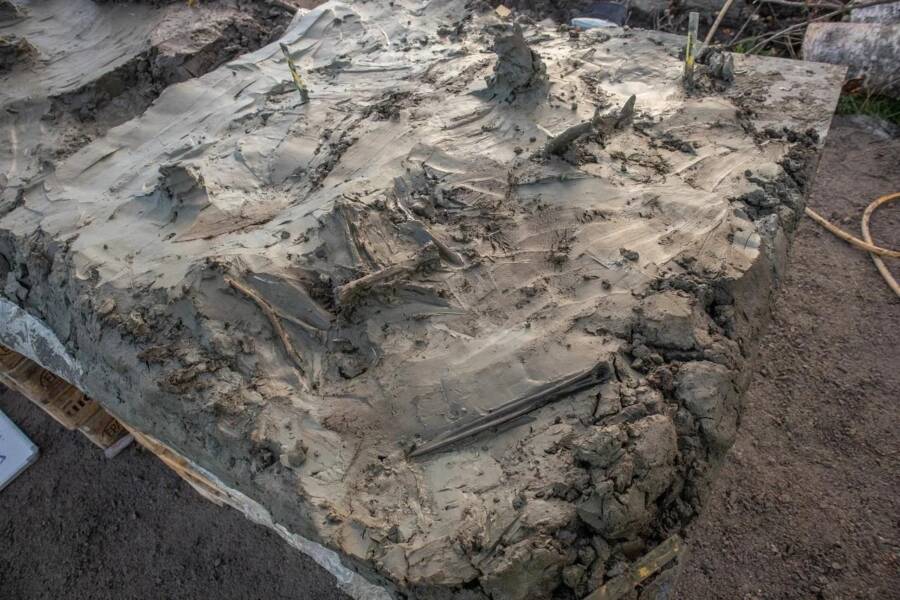
Arkeologerna, SHMMuddy sediment encases the body of the dog and the bone dagger, which is visible at the bottom of the frame. Ahead of the development of a high-speed railway near Gerstaberg, Sweden, archaeologists recently excavated a bog that was once a lake. During their dig, they came across two surprising artifacts: a bone dagger and the remains of a dog that was seemingly sunk into the water intentionally. The two objects, which are roughly 5,000 years old, offer a tantalizing glimpse at funerary practices during the Stone Age. Whats more, archaeologists believe that prehistoric people once had a thriving lakeside settlement nearby.The 5,000-Year-Old Dog And The Bone Dagger Found In A BogArkeologerna, SHMArchaeologists excavating the bog, which was a shimmering lake some 5,000 years ago.According to a press release from Arkeologerna, a Swedish archaeological consulting firm, the dog and the dagger were found near Gerstaberg during excavations ahead of the Ostlnken railway development project.While digging in the bog which was a deep lake 5,000 years ago during the Stone Age the archaeologists came across the remains of a dog with a crushed skull buried alongside a bone dagger. The dagger, which is roughly 10 inches long and made of elk or red deer bone, was placed in direct connection to the paws of the dog, suggesting that they were deposited together.Finding an intact dog from this period is very rare, and the fact that it was deposited together with a bone dagger is almost unique, archaeologist and Arkeologerna project manager Linus Hagberg remarked.Arkeologerna, SHMThe crushed skull of the dog is visible here, sticking out of the mud. Though archaeologists are hoping to conduct further tests to learn more about the dog, theyve so far determined that it was a large and powerful male with a shoulder height of roughly 20 inches. The dog was around three to six years old when it died and had seemingly lived an active life. It had been deliberately lowered to a depth of [roughly five feet] and about [100 to 130 feet] out into the lake. The use of dogs in ritual practices during this period is a known phenomenon, Hagberg explained. He added that radiocarbon dating, isotope analysis, and DNA analysis of the dogs remains will also tell researchers about when the dog lived, its age, and what it ate. This, in turn, can tell archaeologists more about the people who lived alongside the dog. But archaeologists have already uncovered a few clues about the Stone Age settlement that once existed on the edge of the lake.A Once Thriving Lakeside Settlement From The Stone AgeArkeologerna, SHMEvidence of a Stone Age fish trap that archaeologists found at the site. In addition to the dog remains and the bone dagger, archaeologists also found evidence of a lakeside settlement that existed at the site from roughly 3300 B.C.E. to 2600 B.C.E.Specifically, they found well-preserved wood material, including stakes and posts that might have once formed wooden piers along the shore. They also uncovered deliberately placed stones, which could have served as anchors and net weights, as well as a prehistoric fish trap made of interwoven branches. Adjacent to the fish trap are trampled areas where it is possible to see that people have stood and moved about on the lakebed, Hagberg remarked. These appear as patches in the mud. Perhaps they were checking their traps.Though many questions about the dog burial in the Swedish bog remain, its far from the first time that archaeologists have found evidence of prehistoric humans burying canines. In recent years, archaeologists have also uncovered the 8,400-year-old burial of a man with a dog in Sweden, the 2,700-year-old ritual burial of four dogs in Turkey, and the 1,100-year-old burial of a Viking woman who was seemingly laid to rest with her dog in Norway.For now, archaeologists are still puzzling over why the dog was sunk in the lake with the bone dagger in Sweden. And though exact answers remain elusive, further testing may offer exciting insights into the Stone Age community where the dog once lived. After reading about the Stone Age dog burial that was uncovered in Sweden, discover the stories of 11 famous dogs who earned the title of mans best friend. Or, learn about some of Europes most famous bog bodies that have been preserved in marshlands for centuries. The post Archaeologists Excavating A Bog In Sweden Just Came Across A 5,000-Year-Old Dog Burial appeared first on All That's Interesting.




 English
 Arabic
 French
 Spanish
 Portuguese
 Deutsch
 Turkish
 Dutch
Dutch
 Italiano
 Romaian
 Portuguese (Brazil)
 Greek
Greek