


WWW.THECOLLECTOR.COM
The Rise and Fall of Victorian Pleasure Gardens
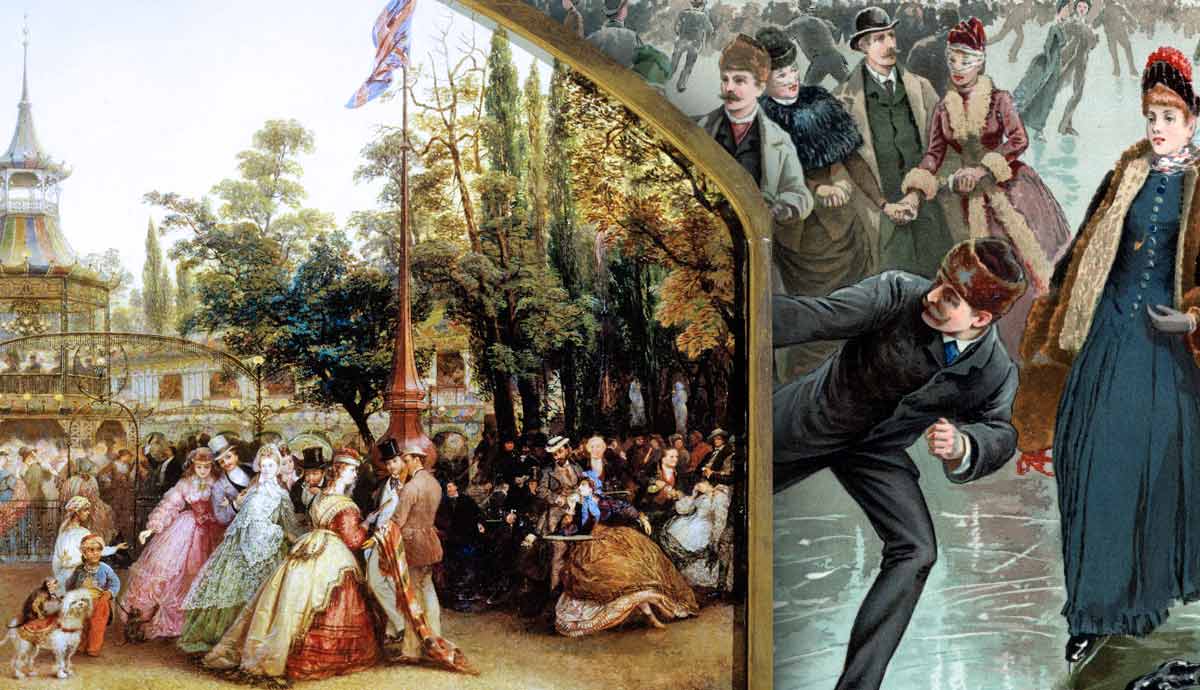
From the baths of ancient Rome to modern-day recreation centers and parks, people have always loved a good outing. In 18th- and 19th-century London, and especially for the Victorians, this often included pleasure gardensoutdoor spaces that served as venues for concerts, zoos, and other entertainment.Life in the Victorian EraGin Lane by William Hogarth, 1751. Source: Metropolitan Museum of Art, New YorkCharles Dickens famous portrayals of life in Victorian England as rough, dirty, and usually impoverished were typically spot onthe average lifespan was only 42 years. Unless one were fortunate enough to be born into a middle- or upper-class family, such as that of a doctor or wealthy business owner, most individuals ended up as factory workers or, if they were women, as domestic servants.Both of these roles exploded in popularity around the Victorian era as a result of the rising middle class. Also referred to as the bourgeoisie, a term coined by contemporary thinker and economist Karl Marx, this new-money class emerged as a result of a strong currency and cheap labor. With most of Britains population moving to big cities, fine goods such as silverware, jewelry, and glass became more accessible than ever. The luxuries of the rich were not exclusive to the aristocracy anymore, and the Victorian era was arguably one of the golden ages of the middle class. However, as demand for goods and services rose, so did that for laborers.Unlike their middle- and upper-class counterparts, working- and lower-class Victorians did not have access to luxuries. Poverty and mistreatment were rampant, and the crime rate was extremely high. Pressure from long hours and terrible living conditions drove many to drink excessively or use drugs, and the cities were dirty, often dangerous places.Thanks to the growing population and the rapid industrialization of England, the countryside began being developed to accompany factories, housing, and urbanization. This left a lot of peopleespecially upper-class and aristocratic individualslonging for a simple, picturesque country life. A harsh city life meant that many were eager to find escape through recreation such as sports, crafts, and travel.Outdoor Recreation in Victorian EnglandSkating, Henry Sandham, 1885. Source: Library of CongressThe Victorians were active people. Because passive entertainment such as radio or television shows had not yet been invented, sports in almost all forms were the pastimes of choice for many Victorian men. Bear baiting and cockfighting, two popular blood sports, were banned under Queen Victoria, but the advent of the locomotive was changing sports by allowing teams to travel. This meant that organized sports could now be played at a national level, leading to agreed rules and tournaments.Two of the eras most popular sports were football (soccer) and croquet. The Football Association Challenge Cup was created in 1871, and the FA Cup remains the oldest football tournament in the world. Football was intended as a game simply meant to keep people healthy, but within a few years, rules such as penalty kicks were needed in order to establish order in the wildly popular sport.Whereas football was exclusively for men, croquet was enjoyed by everyone. The Victorians did not hold a flattering view of women, believing them to be inherently weaker and less skilled than men. As a result, they were not accepted in many sports, but croquet was seen as being simple and unskilled enough for anyone to play, and thus became popular as something men and women could do together.In spite of these perceptions, however, plenty of Victorian women participated in sports. Activities such as rifle shooting, long-distance swimming, and golf tournaments were all very popular, and many schools even formed girls sports teams. Women became more and more visible outside of the domestic space, and the popularity of outdoor activities, especially sports, contributed to the changing image of women in society.The Origins of the Pleasure GardenThe Hanging Gardens of Babylon. Source: iStockFinding pleasure in nature as part of entertainment came long before the Victorians. Although humans have enjoyed the natural world for thousands of years, the first depictions of nature as a form of entertainment specifically date back to 1500 BCE. One of many famous examples is a mural of patrons sitting leisurely, surrounded by trees, musicians, and dancers that was created for the Tomb of Nebamun, roughly around 1350 BCE. Likewise, many Victorians were familiar with classical history, including the Hanging Gardens of Babylon, one of the Seven Wonders of the Ancient World, created by King Nebuchadnezzar II for his homesick queen.The Walls and Hanging Gardens of Babylon, W. T. Copeland & Sons, 1898. Source: Metropolitan Museum of Art, New YorkThe ancient Romans also enjoyed pleasure gardens, and likely served as the inspiration for their Victorian counterparts. Gardens were a popular place for gatherings, especially for women, and often featured music, dancers, games, and sports. As space in Roman cities grew scarcer, wealthy Romans crafted their luxury gardens to show off their status and to offer a refuge from urban life.Among Romes most famous gardens was Caligulas Horti Lamiani. Known for his violence and eccentricity, Emperor Caligula ruled over Rome from 37 CE until his assassination in 41 CE. As part of his massive residence, he crafted a garden of exquisite plant life and exotic animals, which he adorned with statues of colored marble and a full bathhouse. Caligula also kept animals in his private garden for entertainment, including deer, peacocks, and lions. Keeping animals was a feature that would continue to the Victorians, who built zoos in their gardens.The Victorian Pleasure GardenVauxhall Gardens by Thomas Rowlandson, 1784. Source: The Yale Center for British ArtThe rising popularity of outdoor recreation, as well as the sense of claustrophobia and longing for country life brought on by industrialization, created a market for the Victorian-era pleasure garden. Although these private gardens had been around for quite some time, they experienced a unique explosion of popularity with the Victorians. They were often the highlight of the summer nightlife and provided their wealthy guests with dancing, music, and plenty to eat and drink under the stars. The cost to enter such a party, however, was too high for the average laborer. Two of Londons most well-known gardens, Vauxhall and Cremorne Gardens charged one shilling each for entryfor reference, in 1834, most laborers only earned about 10 shillings per week.The Dancing Platform at Cremorne Gardens by Phoebus Levin, 1864. Source: Wikimedia CommonsFor those more fortunate, however, the pleasure garden provided elegantly landscaped views that were described as being filled with, fine pavilions, shady groves, and most delightful walks, illuminated by above one thousand lamps by the English Gazetteer in 1751. Prominent artists also used the gardens as a place to display their latest works. Painters including William Hogarth and Francis Hayman were exhibited at Vauxhall, a show that is now considered Britains first public art gallery. Likewise, the architecture was created by artists inspired by settings around the globe because travel was becoming a more popular and accessible form of leisure. Gardens featured buildings such as Chinese-influenced pavilions and Italian piazzas, where nighttime entertainments were featured.Drinking, dancing, and dining were the most frequent forms of entertainment found in a pleasure garden. Masquerade balls, filled with luxurious costumes, were popular at the time and often attracted prominent contemporary musicians. In 1764, an eight-year-old Wolfgang Amadeus Mozart performed a concert benefiting a hospital at the Ranelagh Gardens in Chelsea. But newer, more novel forms of entertainment also became popular as time went on. Exciting acrobatic performances, hot air balloon rides, fireworks, and zoos were among the attractions offered by gardens as they struggled to keep their wealthy clientele following the decline of the fads popularity.Notable GardensDescent of Madame Saqui, surrounded by fireworks by Thomas Kelly, 1822. Source: New York Public LibraryVauxhall Gardens was the first true pleasure garden, having opened in 1732. Much unlike modern parks and gardens, Vauxhall did not open its gates until five or six PM and would remain open until the last visitors leftwhich could be as late as the next morning. However, during the day, some parts of the gardens were open to families, where they could take a walk or play in the park.It was only when night fell that the park revealed its most famous attraction: thousands of glass lamps. The garden also hosted a number of world-famous guests, especially in the Victorian era, when managers were strategizing new and more exciting ways to attract visitors. Among these celebrities was tightrope walker and dancer Marguerite-Antoinette Lalanne, also known as Madame Saqui. Already a world-renowned sensation, Madame Saqui performed frequently at the gardens and was known for her spectacular finale, where she ran a tightrope across the gardens as fireworks exploded in the background.Vauxhall Gardens shewing the Grand Walk by Benjamin Cole. Source: Yale Center for British ArtTen years after Vauxhalls opening, Ranelagh Gardens came into operation. Set near Chelsea Hospital, patrons to this garden could arrive by foot or carriage via the roads, or by boat, as the garden overlooked the River Thames. Although Ranelagh also offered beautiful natural landscapes, it set itself apart with the construction of a massive rotunda, where events could be held even in poor weather. The rotunda was heated, which meant Ranelagh was able to stay open significantly longer in the year than strictly outdoor gardens. Around the rotunda, the gardens featured a Chinese pagoda, a canal, and a temple of Pan.All this luxury came at a price, howeverthe entrance fee to Ranelagh was more than double that of Vauxhall, a steep price of two shillings and a sixpence.Londons third garden was Cremorne Gardens, which opened officially in 1845. Previously, the gardens had been the house of Viscount Cremorne, and they had changed hands and purposes several times before becoming Cremorne Gardens.Like the other gardens, Cremorne offered a competitive array of entertainment to attract its guests. Aside from the gardens, there was an American bowling alley, a circus, a marionette theater, and weekly fireworks shows. However, Cremornes later years earned it a less-than-flattering reputation as home to a seedier crowd. In spite of the owners best attempts to keep the gardens reputation intact with renovations and competitive attractions, it was heavily criticized as being in the possession of Lost Women and their male friends and abettors, and a pamphlet circling in 1876 referred to it as nursery of every kind of vice.What Happened to Pleasure Gardens?An inside View of the Rotundo in Ranelagh Gardens by Nathaniel Parr after Antonio Canaletto. Source: The Yale Center for British ArtPleasure gardens began to decline in popularity as Victorians moved on to other forms of entertainment, such as casinos and art galleries, and the trend died out as many often do. Additionally, as was the case with Cremorne, many fell into a state of disrepair, and became hotspots for criminals; others were damaged during bombings in the world wars. The expansion of the railroad also changed Victorian life, giving people a new, faster, and now more accessible mode of travel. Although public parks are now a staple of daily life, the flashy entertainment, lavish guests, and grand parties of pleasure gardens are a relic of the Victorian age.
0 Commentaires
0 Parts
39 Vue

 English
 Arabic
 Spanish
 Portuguese
 Deutsch
 Turkish
 Dutch
Dutch
 Italiano
 Russian
 Romaian
 Portuguese (Brazil)
 Greek
Greek