


WWW.THECOLLECTOR.COM
The Horrors & Legacy of the Transatlantic Slave Trade in the Americas
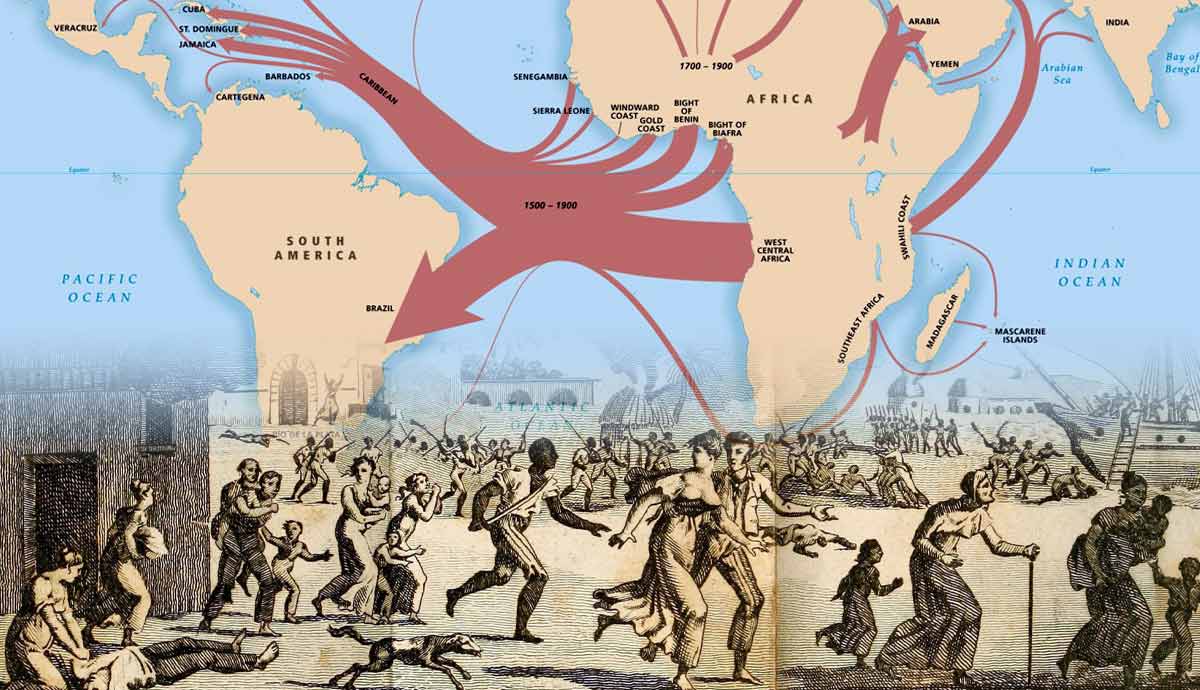
After Christopher Columbus arrived in the Caribbean in 1492, kicking off the era of European colonization on the American continent, the Indigenous population forced to labor for the colonial project started to shrink rapidly due to foreign diseases, abuse, and maltreatment. As a result, millions of African people were kidnapped, shipped across the Atlantic Ocean, and forced into servitude during the following centuries. The transatlantic slave trade lasted for three centuries, finally being abolished in 1867.European Colonization of the AmericasIllustration showing the geographical distribution of European colonial empires in the Americas. Source: MacmillanThe 16th century marked the beginning of European colonialism, which expanded in different directions around the globe, spreading, often forcibly, their way of life and beliefs surrounding civilization, progress, and evangelization. Countries like the United Kingdom, Portugal, Spain, Italy, Germany, Belgium, and the Netherlands were among the leading expansionist powers.This process lasted until the 19th century in the Americas, generating a significant loss of Indigenous lives because of newly introduced foreign diseases, the abuses resulting from forced labor, and the rapid transformation of native peoples territories through dispossession and exploitation of natural resources. Spain expanded in Central America, South America, and some Caribbean Islands; Portugal in Brazil, and France in Canada and the Caribbean. The Dutch and the Swedish expanded in North America, while the Russians, Scottish, and Germans ultimately failed to establish colonies on the American continent.While natural resources, diseases, and technology were transported from the Americas to Europe in what is known as the Columbian Exchange, Africans were being traded as slaves. It is calculated that during the transatlantic slave trade, a total of 12.5 million Africans were forced to cross the ocean, while 1.8 million died on the way. African slaves were kidnapped from Senegambia to Benin and from Western Nigeria to West-Central Africa. Forty-five percent disembarked in Brazil, 37% in the Caribbean, 11% in Central and South America, and 4% in North America.Conducting the Slave TradeIllustration showing the major slave trading regions in Africa by Benjamin Thomas, 2009. Source: Wikimedia CommonsSlavery is defined as the process through which a human being is deprived of freedom and subjected by force to someone elses ownership. It often involves the exploitation of their labor for domestic or economic activities. Slavery originated in hunter-gatherer societies and was present in many ancient civilizations, such as the Roman, Greek, Egyptian, and Islamic.In the 16th century, a well-established slavery market was already present in Africa, which facilitated the integration of European buyers once they arrived in Africa, often offering higher payments than Arab buyers. Before Europeans started to ship Africans to their new colonial settlements, 18 million Black slaves had been traded to the Islamic world between 650 and 1905, a number even greater than the total ultimately traded by Europeans.Photograph of an exhibit of the work of Ghanaian sculptor Kwame Akoto-Bamfo at the EJIs Legacy Museum in Montgomery, Alabama, which serves as a memorial of African slaves who died during the transatlantic slave trade. Source: The IndependentThe colonial powers settled in the Americas and demanded primarily adult males for work. The first traders were the Portuguese, who began transporting slaves from West Africa to sugar plantations shortly after the discovery of the Americas. The Spanish, among the first colonial powers to experience labor shortages in the Americas, followed the Portuguese in 1502. During the 1600s, the Dutch dominated the slave trade, followed by the English and the French, who were taking slaves from the region of Senegal and Niger.Overview of the periods and migration routes of the transatlantic slave trade from 1500 to 1900 by David Elits and David Richardson, 2010. Source: United NationsBy the 1690s, the number of slaves transported across the Atlantic Ocean reached 30,000 per year and 85,000 one century later. Most of the slaves shipped across the Atlantic to Barbados, Jamaica, or Cuba ended up on sugar plantations. In the US, slaves were first brought to Virginia in 1619 and worked on tobacco and cotton plantations in Alabama, Louisiana, Texas, Mississippi, and South Carolina. Most of these Africans were taken from West Africa, while those who ended up in Brazil were taken from Angola.Southwards, in the Spanish and Portuguese colonies, Black Africans were introduced to replace the rapidly decreasing Indigenous workforce. In many places, slaves were used for mineral mining, and in Brazil, they were used in coffee plantations.The demand for slaves was influenced by the rapid development of plantation agriculture, which ultimately peaked in the 18th century in French, English, Dutch, and Danish colonies but not until the 19th century in Cuba and Brazil. Although in many places, the population of Black slaves decreased because of high mortality, in the US, demographic growth occurred.Horrors of the Slave ShipsPlan and section of a slave ship. Source: National Library of ScotlandThe ships used to transport slaves from Africa to the New World ranged in size and capacity and were able to carry between 30 and 700 enslaved Africans. Because of the many people being transported, the ships were overcrowded and unsanitary. Slaves were packed below decks in tight divisions with low ceilings for trips that could take weeks to months. In such tiny spaces, people were forced to crouch or lie down while being chained together.In some cases, slaves were separated into men, women, and children and could have more freedom of movement if the ship was not too overcrowded. As a form of exercise, slaves would be encouraged to sing and dance, which, although many were in manacles and shackles, allowed, to some extent, the preservation of their culture. The breathable air was little, hot, and putrid, which favored the spread of disease. Because of this and the fear of revolt, slaves might be allowed to go up on deck to breathe fresh air. Slaves were forced to eat twice per day; the dead were thrown overboard.Conditions on these ships were so inhumane that historians calculate that 15% to 25% of those onboard died during the trip. Besides diseases such as smallpox and dysentery, affecting both slaves and merchants, atrocious maltreatment, including whipping, the use of thumbscrews, and sexual abuse, was not uncommon. This led many to refuse to eat or even jump overboard.An illustration of Elmina Castle, on the coast of Ghinea, the first European slave trading post in Sub-Saharian Africa by Johannes Vingboons. 1665. Source: Australian National LibraryBecause of the stress slaves were forced to experience, fear of rebellion was pervasive. Although the ships were designed to keep them captive, when slaves were still able to see their lands, uprisings were common, individually or collectively. Because of the need to keep the cargo of slaves alive during the long trip and the potential for attempted insurrection, traders implemented a violent system of imprisonment.Moreover, traders tried to keep slaves from the same region in separate areas of the ship to prevent communication in the same language and minimize the potential for revolt. While some rebellions were successful, such as the one that happened on the ship Clare in 1729, others led to the deaths of everyone onboard.Illustration of slaves onboard a slave ship, unknown artist, 1835. Source: El PasAfrican slaves had to endure the painful separation from their lands and communities, as well as being separated onboard from their friends or families, and yet again, being separated on shore when they were ultimately sold. Slaves arriving in North America would also be given new English names, a further rupture from their identity and culture.Cultural and Social Impacts of the Slave TradePainting illustrating the ethnic mixing between a Spaniard and a Black woman, unknown artist, 18th century. Source: Wikimedia CommonsThe trade of Black slaves over the Atlantic Ocean is considered to be the most significant human migration in history. It changed the social, cultural, and ethnic composition of different colonial societies that imposed systems of racial differentiation between white, Indigenous, and Black people.The Spanish, for example, established a system of castes to categorize the different ethnic groups existing in the colonies and the specific racial variations resulting from their unions. In Spanish America, Black Africans were assigned to the lowest level of this hierarchical system, together with Indigenous people. This system established racial divisions that are still present in many countries of the Americas.A handbill advertising the selling of slaves, 1769. Source: Wikimedia CommonsSimilarly, in North America, the slave trade ultimately created a system of social segregation based on race. After slavery was abolished with the passage of the 13th Amendment, so-called Black Codes were enacted in 1865 to control recently freed Black people.Although finally liberated from the horrors of enslavement, Black people were still excluded from social, professional, and educational rights by these discriminatory laws. The 13th Amendment ended the enslavement economy and permitted servitude solely as a punishment for crimes, but violence and injustice against Black people remained and created an ethnic division that persists today.Abolishing Slavery in the AmericasAn illustration showing an uprising of Black people in Haiti, unknown artist, 1815. Source: Archive.orgHaiti was the first country to become independent from European powers and to abolish slavery in 1794. In the US, after the American Revolution (1765-1783), the abolition of slavery became an essential point on many activists agendas. However, many Southern states, with a higher concentration of enslaved people, were in strong opposition. In 1808, the importation of slaves was outlawed; however, smuggling slaves from the Caribbean was still common.In Britain, King George III outlawed the slave trade in 1807, and enslavement was abolished in 1833 with the Slavery Abolition Act. Britain became an anti-slavery advocate and fought against slave ships in the Atlantic. Slavery was abolished in Portugal in 1869 and in France in 1848. In South America, slavery was abolished in Mexico in 1810, Chile in 1823, Colombia in 1851, Peru in 1854, and Brazil in 1888.Legacy of the Slave Trade: Division and DiscriminationA map of the slave trade in Africa showing the regions with the most intense activity, by Eding Bartholomew and Sir H. H. Johnston, undated. Source: Digital Public Library of AmericaThe forced migration of slaves from Africa to the developing European colonies in the New World implied the displacement of millions of Africans, who were shipped under inhumane conditions, provoking the deaths of many along the way.While destabilizing and tearing apart societies in Africa, the introduction of Black people to the Americas simultaneously reshaped the continents demographics. American populations were regulated by European powers through the establishment of social systems based on racial differentiation and segregation. Throughout the hemisphere, Africans and Indigenous people occupied the lowest levels of these hierarchical organizations. These divisions underpinned the structure of societies and have continued to shape them to the present day. Discrimination, prejudice, and violence against these communities are still a critical issue.The slave trade had an immense human cost, showcasing the brutality exercised against Africans. This provoked a profound loss of their identity and their communities. However, resistance was always present, and in some cases, such as the insurrection of Africans on slave ships or the uprising of Haitians that led to their independence from France, demonstrated a profound resilience that influenced later successful abolitionist movements across both Europe and the Americas.
0 Commentarios
0 Acciones
41 Views

 English
 Arabic
 French
 Portuguese
 Deutsch
 Turkish
 Dutch
Dutch
 Italiano
 Russian
 Romaian
 Portuguese (Brazil)
 Greek
Greek