At Least 32 Skeletons Have Been Found At A 16th-Century Gallows In France Where The Dead Were Publicly Displayed After Execution
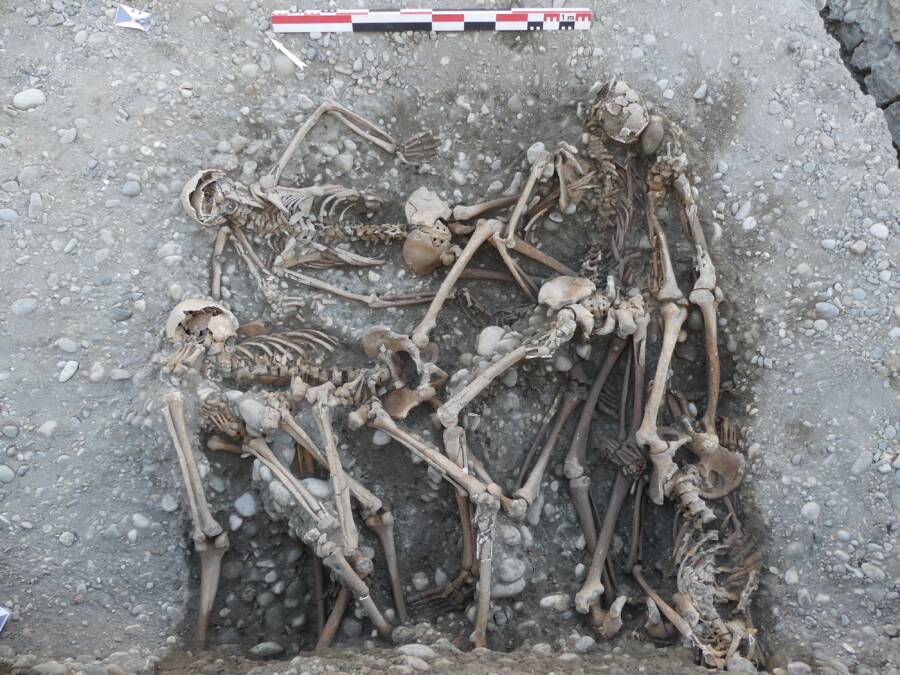
Anne-Galle Corbara/INRAPJust some of the nearly three dozen skeletons unearthed at the site in Grenoble.Archaeologists have unearthed a public execution site from the 16th century in Grenoble, France, revealing a grim chapter of religious persecution during the countrys Wars of Religion.The discovery at the citys Grande Esplanade includes the remains of 32 people and the stone foundation of a gallows structure, known as a gibbet, that once stood as a warning to those entering the city.How The Grenoble Gallows Public Displays Served As Grim WarningsAnne-Galle Corbara/INRAPThe stone foundation of the gallows.Researchers from Frances National Institute for Preventive Archaeological Research (INRAP) found the site during 2024 excavations near what was historically the citys northern entrance at Porte de France.This area along the Isre River was marshland until the 17th century, once valued for its sand and wood, though it was gradually occupied thereafter. The new excavation, though, has shown other ways in which this spot was put to use before it was developed.The stone structure found here initially puzzled researchers, who believed it may have been a religious building or hermit cabin, until archival research in departmental records identified it as the gibet du Port de la Roche.Cdric Jean/Departmental Archives of IsreA 16th-century plan for the framework of the gallows found in Grenoble.Historical documents show that this gallows was constructed in 1544 with eight stone pillars supporting a wooden frame that sat more than 16 feet high. It was the human remains found around that structure, however, that told the full story.They are buried without any care, without any care in the ornamentation and in the way of managing, archaeologist Nicolas Minvielle-Larousse told Radio France. The bodies can be moved, mutilated and put back in other places.Anne-Galle Corbara/INRAPA double burial found in one of the pits uncovered at the site.The remains included 30 men and two women. At least one individual showed clear evidence of decapitation. They were executed in a public square the Place aux Herbes in Grenoble before their bodies were displayed on the gibbets outside the city for varying lengths of time, a common execution practice centuries ago, intended to deter crime and dissent.Public gallows typically stood at city gates or crossroads, positioned for maximum visibility. The Grenoble structures location at the northern entrance would have ensured that merchants, pilgrims, and other travelers witnessed the consequences of defying civil or religious authority.The timing of the gallows construction also coincided with intensified persecution of Protestants in France, offering a macabre reminder of the tension during the French Wars of Religion.The Tense Period Of Religious Persecution In 16th-Century FranceAnne-Galle Corbara/INRAPA decapitated skeleton uncovered at the site.Grenoble, located in the Dauphin region of southeastern France, became a hotspot during the French Wars of Religion that ravaged the country from 1562 to 1598.The French Wars of Religion pitted Catholics against Huguenots, as French Protestants were known, in a series of brutal conflicts that left hundreds of thousands dead. The wars ended with the Edict of Nantes in 1598, which granted Huguenots substantial rights and freedoms, though religious tensions persisted for decades.Archival records link the Grenoble site to notable victims of this religious conflict. Protestant rebel Benot Croyet, who was accused of attacking Grenoble in 1573, was among those executed there. Charles Du Puy Montbrun, the Huguenot military leader of Dauphin, was also beheaded, and his body was displayed at the gallows in 1575 after his capture by Catholic forces.Anne-Galle Corbara/INRAPSeveral burials found in one of the outer pits at the Grenoble gallows.The discovery provides rare physical evidence of judicial practices from the period. While historical records document hundreds of execution sites across medieval and Renaissance Europe, few have been preserved or located by archaeologists.This excavation site, like many others, has been transformed multiple times over the centuries. The marshland was drained and developed in the 1600s, eventually becoming part of the citys urban landscape. The gallows itself was likely dismantled in the early 17th century as the area was repurposed which makes the discovery all the more remarkable.INRAP researchers are continuing to analyze the skeletal remains to learn more about the lives of the condemned before their executions. Such analysis might reveal information about their age, health, diet, and the precise details of how they died almost five centuries ago.After reading about this grim discovery in France, learn about some of the most horrific medieval torture devices. Then, read about some of the strangest medieval customs.The post At Least 32 Skeletons Have Been Found At A 16th-Century Gallows In France Where The Dead Were Publicly Displayed After Execution appeared first on All That's Interesting.




 English
 Arabic
 French
 Spanish
 Portuguese
 Deutsch
 Turkish
 Italiano
 Russian
 Romaian
 Portuguese (Brazil)
 Greek
Greek