


WWW.THECOLLECTOR.COM
What Kind of Money Did People Use in Feudal Japan?
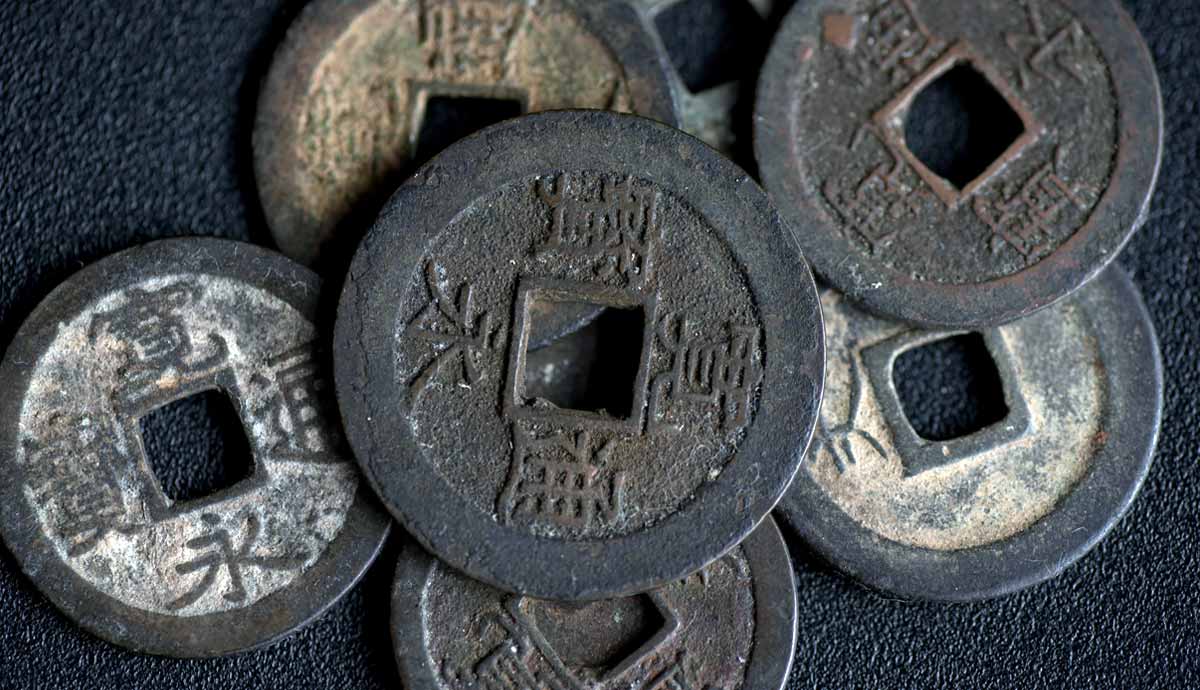
On July 3, 2024, the Japanese government redesigned the 1,000-yen, 5,000-yen, and 10,000-yen banknotes to make the bills harder to counterfeit. At the time, it was considered a big step for the Central Bank of Japan. But it barely registers in the history of Japans monetary system. During the Edo Period (16031868), money was far from a picture of stability, always changing in a multitude of ways. Even if money does not make the world go round, it could make your head spin during Japans feudal era.From Square Holes to the Three MetalsWadokaichin Coin at the British Museum Room 68, Paul Hudson, 2015. Source: Wikimedia CommonsFor the longest time, it was believed that the copper wadokaichin, minted in 708, was Japans first official coin. It was round with a square hole in the middle, a design most likely borrowed from Tang Dynasty China where the roundness represented the heavens and the square the earth. It seems that even 1,300 years ago, money meant the world to some people. However, excavations conducted in 1998 revealed an earlier coin, the fuhonsen, which featured a similar design and was also made from copper. Although, there is a passage in the Nihongi, one of the oldest chronicles in Japan, quoting the 7th-century Emperor Temmu: Henceforth copper coins must be used, and not silver coins. This suggests that early fuhonsen were possibly made from silver.The quote may also refer to the mumonginsen, unadorned disks of silver that predate the fuhonsen but whose status as proper currency is still hotly debated among historians. Things changed a lot during the following millennium, and by the Edo Period, feudal Japan was using a tri-metallic system based on gold, silver, and copper. Gold, which was used for substantial transactions, was divided into various units like the ryo, oban/koban, bu, and shu. Silver, on the other hand, was found in the chogin or mameita-gin coins. It was also measured in monme, which was both a currency and weight unit. Copper (and occasionally iron) coins were used for everyday purchases and came in the form of mon, kanmon, or sen, which were often strung together in groups of 96 or 960 (Dunn, C. J., p. 88).The Price of Money in Feudal JapanKoban Evolution During the Tokugawa Period, World Imaging, 2007. Source: Wikimedia CommonsThe Edo government attempted to control the value of its money by occasionally increasing or decreasing the amounts of precious metals in gold and silver coins. This often led to inflation and social dissatisfaction. Ultimately, the value of each unit of currency was dictated by the market. So while the government might declare that, say, one ryo of gold was equal to 60 monme of silver or 4,000 mon of copper, it was the moneychangers who set the final price.Edo (modern-day Tokyo) operated primarily on gold while Osaka, Japans kitchen and an important financial center, preferred doing business in silver. If a person from eastern Japan wanted to buy or sell things out west, they needed to exchange their gold for silver first. This is where the moneychangers or ryogaesho came in. From humble beginnings as currency handlers, they quickly evolved into powerful financial institutions that eventually became Japans first banks. Merchants depended on the moneychangers not only to convert currency but also to provide them with credit lines, introduce them to trading partners, and, above all else, provide much-needed stability.Oban & Koban & Ichibuban in Edo Period, PHGCOM, 2007. Source: Wikimedia CommonsThe country looked to Osaka, specifically the Ten Menten families who advised the government and were involved in finances since the 1660sto determine the value of money at any given time (Dunn, C. J., pp. 91-92). They did not operate entirely independently. Their weights, measures, and scales (which were made by only two families) were constantly inspected to ensure that the exchange rates had a basis in reality. The Osaka moneychangers were so important to maintaining Japans monetary system that the government granted the Ten Men the right to carry swords, a sign of great honor for non-samurai.The changing value of money in feudal Japan also makes it nearly impossible to provide the equivalent of, for example, one ryo in modern dollars. However, a common trope in Japanese revenge literature during the Edo Period was to use 50 ryo to indicate an outrageous amount of money (Jones, S. and Watanabe K., p. 41).The Rise of PaperYamada Hagaki First Japanese Banknote Circa 1600, PHGCOM, 2008. Source: Wikimedia CommonsAnother service provided by the Osaka moneychangers was the issuance of furitegata, which were promissory notes that acted a lot like modern checks. It was essentially a piece of paper with written instructions for a ryogaesho to pay the holder a certain amount of money. The original issuer of the furitegata would of course need to first have an account with the proto-banks. The notes allowed merchants to conduct business without cash, but the furitegata were not always redeemed immediately. They were often traded between people like modern paper money and became a sort of currency. In the end, they could be traded in for silver or gold or for merchandise the same value as the amount on the note. They made the occasional appearance in Edo but were primarily circulated in Osaka and its surrounding area.However, they were not feudal Japans first paper money. The oldest examples of that are probably the Yamada Hagaki, which appeared around 1600, a few years before the unification of Japan under the Tokugawa Shogunate. It is also the same year that the show Shogun (9919) takes place. Similarly to the furitegata, they were promissory notes, but in this case, they were issued by the priests of the Ise Grand Shrine in modern-day Mie Prefecture.Hansatsu from the 1700s, Donald Trung, 2022. Source: Wikimedia CommonsDedicated to the sun goddess Amaterasu (9742), Ise has long been one of the most important places of Shinto worship in Japan. The shrines reputation is what allowed the Yamada Hagaki to be traded for small amounts of silver by local merchants, eventually becoming a kind of local currency. It is important to note that this is basically how modern fiat money works as well. It works because we all agree on the value of a piece of paper (or, in the case of dollars, linen and cotton) backed by our faith in the government. Without faith, paper money cannot exist, so it makes sense that, in Japan, it originated at a shrine.Then there were the hansatsu notes issued by the lords of individual domains. Before Tokugawa Ieyasu unified Japan, the country was in a state of near total civil war during the Sengoku Period and every fief was essentially its own semi-independent kingdom. While they operated on silver and gold, sometimes, due to metal shortages or other reasons, they would issue their own promissory notes, which survived until the Edo Period where they thrived alongside cold, hard cash. At the peak of hansatsu, 80% of Japanese domains were issuing their own notes to their retainers and merchants. The hansatsu were only good within their specific domain, and they tended to devalue fast, so the government was always fighting to squash them, but with little to show for it.Rice and the First Commodity Futures Market in the WorldRice Harvest of Japan, Elstner Hilton, 1911. Source: Wikimedia CommonsIt could be said that rice was the first currency in Japan thanks to a system called suiko that emerged before the widespread use of coins. Under the system, farmers would borrow seed rice in the spring to plant crops, and then pay back the loan after the harvest, in rice and with interest. It was essentially an agricultural form of credit that stabilized rice production and was a precursor to Japans financial system. With time, suiko became heavily codified, but by the Edo Period, it had been abandoned. This does not mean, however, that rice was no longer making appearances in the Japanese world of finances.It all starts with koku, a Japanese unit of volume equal to about 150 kilograms (330 lb), or roughly how much rice an adult could eat in a year. In feudal Japan, it became the measure of a domains power, which was determined by how much koku of rice it could produce. During the Edo Period, those lords with the highest koku counts were known as daimyo, lit. Big Names. It was also common for fiefs to pay their retainers a rice stipend. Since the majority of samurai resided in Edo, a large quantity of rice was transported from the country to the capital.Ukiyo-e of the Djima Rice Exchange, Yoshimitsu Sasaki, 1880. Source: Wikimedia CommonsAll the collected rice went into central granaries so it could be paid out three times a year, on the second (25%), fifth (25%), and tenth month (50%) of the year (Dunn, C. J., p. 96). However, many samurai took a cash payment instead of actual rice from the granaries, initially for a little bit above the market value, but eventually less. The system eventually became so complicated that rice brokers stepped in to help. They evolved from owners of teahouses set up around granaries where samurai could spend the entire day waiting for their stipend. So, one day, the teahouse owners came upon an idea, offering to deliver rice or money (for a fee) to the samurai so they would not have to spend an entire day down at the granaries. Even hundreds of years ago, people were willing to pay a premium for convenience and soon the rice brokers grew into powerhouses of Japans world of finance.Barring a sudden drought or other extreme weather, the rice deliveries were punctual and solid. Therefore, some lords started selling the rice merchants their future rice that would be delivered in a few months or even next year. This opened up possibly the worlds first futures commodity market in Osakas Dojima district, which in the late 17th century became the site of the Dojima Rice Exchange. Officially recognized by the shogunate in 1730, the DRE was a place where traders could buy and sell notes promising the delivery of an amount of rice at a future date. Changes in supply could radically alter the price of rice, so a lot of speculation happened at the exchange, not unlike during the Dutch tulipmania. The traders reportedly relied on a complex system of flag signals and couriers to get the information about the most recent prices as fast as possible to gain an advantage in dealmaking.Birth of the YenYen Coins, Astelus, 2020. Source: Wikimedia CommonsJapans old monetary system went away after the start of the Meiji Period (18681912). An 1871 act created the yen (which was originally divisible into 100 sen or 1,000 rin) and in 1882, the Bank of Japan became the only issuer of banknotes in Japan, marking the end of the convoluted feudal financial system. Given that Japan is now the fourth largest economy in the world, it would be fair to say that the switch worked out in the countrys favor.Works citedJones, S. Watanabe K. (eds.) (2013). An Edo Anthology, Literature from Japans Mega-City 17501850. University of Hawaii Press.Dunn, C. J. (2008). Everyday Life in Traditional Japan. Tuttle Publishing.
0 Comentários
0 Compartilhamentos
25 Visualizações

 English
 Arabic
 French
 Spanish
 Deutsch
 Turkish
 Dutch
Dutch
 Italiano
 Russian
 Romaian
 Portuguese (Brazil)
 Greek
Greek