


WWW.THECOLLECTOR.COM
Walt Whitmans Lessons to Fellow Americans
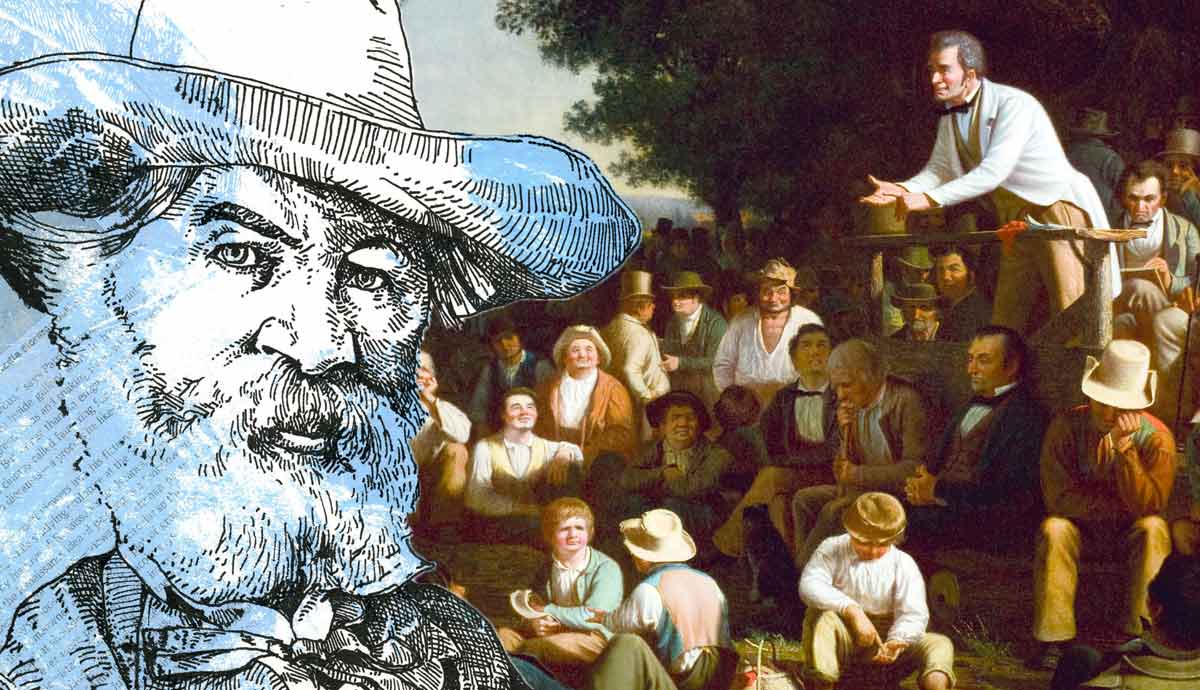
At the time Walt Whitman published the first edition of his famous collection of poems, Leaves of Grass (1855), his homeland was in a dire state. Rampant political corruption and the ensuing Civil War were indicators that the United States was experiencing a crisis. The American poets work was an attempt to amend the situation by reminding fellow Americans of the nations core values instilled by the Founding Fathers. Whitmans lessons on democracy, individuality, freedom, and solidarity are topical today as much as they were a century and a half ago.Why Not Blades of Grass? Walt Whitmans VisionPatch of Grass, by Vincent van Gogh, 1887. Source: Krller-Mller Museum, OtterloThe first edition of Leaves of Grass contained only 12 poems without a title. The final edition, which was published in the year of Walt Whitmans death (1892), had some 400 poems. Although the number of poems increased substantially, the title of the collection had remained the same.However, why didnt Whitman choose to use the collocation blades of grass, which would be the accurate botanical term? Simply put, it did not align with his poetic vision. Blades are sharp, while the word leaves has a softer feel to it. Blades are also more rigid than leaves, which sway in the wind, adapting to severe weather conditions.These are all reasons why leaves were intended to symbolize individual human beings. A cluster of leaves forms a turf, or in Whitmans symbolism, individuals form nations. They stand as individuals, but together they stand for a united nationthe American nation. The poet believed that the future of his homeland lay in striking the perfect balance between the individual and the collective.Democracy Is Natural and UniversalPortrait Daguerreotype of Henry David Thoreau, by Benjamin D. Maxham, 1856. Source: Northeast University Library, Boston (MA)Walt Whitman was not the only intellectual of the era who used herbaceous metaphors. In his essay On the Duty of Civil Disobedience, Henry David Thoreau recorded that if a plant cannot live according to nature, it dies; and so [does] a man. The American transcendentalist philosopher also noted the connection between nature and types of government, most notably, democracy. Therefore, Whitmans symbolism of grass was not limited to the American continent, but it pertained to humanity in its entirety. Just as leaves of grass grow all over the world, democracy can find fertile ground across the globe.The United States has lived out this segment of the Good Gray Poets legacy in the latter half of the 20th century. Whether it was through military interventionism or economic soft power, the United States of America has promoted the democratic system globally, having emerged as a superpower in the aftermath of World War II.American culture spread throughout the world like a wildfire because all people had an innate capacity to understand democracy. Despite this, even Americans periodically need to remind themselves of what democracy truly is, as was the case in Whitmans lifetime.America Is Bigger Than Political PartiesStump Speaking, George Caleb Bingham, 1853-1854, Gift of Bank of America. Source: Saint Louis Art Museum, St. Louis (MO)Despite his firm belief in democracy, Whitman was all too aware of its fallacies, namely, the institutional format of democracy. The poet was a member of the Free Soil Party, active during the late 1850s and early 1860s, whose primary goal was to stop the expansion of slavery west of the Mississippi River.Free Soilers would go on to be one of the fractions that formed the Republican Party. On his part, Whitman soon became disappointed with the party system, concluding that America has outgrown parties; henceforth it is too large, and they too small. This thought is more than a century and a half old, but it appears as topical as ever. In a country where people vote predictably, it has become essential to defend the individuals democratic capacity, separate from party affiliation.An Illustration of Walt Whitman, by Jonathan Twingley, 2021. Source: Southwest Review, Dallas (TX)During his journalism years, Whitman witnessed firsthand widespread corruption that was threatening the countrys foundations. For example, this was the time of Lincolns predecessor, James Buchanan, whose presidency was an interlude to the Civil War.It was only natural for Whitman to advise the American youth to stay informed, engage in politics, vote, but most importantly, to disengage themselves from parties. The reasoning behind this advice was that the true strength of democracy lay not in party members but in voters. In modern terms, only Americans who disassociate themselves from bipartisanship can become true keepers of the Founding Fathers democratic ideals. They are simple, yet often overlooked: America is the goal, and parties merely the means.Religious DemocracyFreedom of Worship, Norman Rockwell, 1943, Gift of Holly and Nick Ruffin. Source: Smithsonian American Art Museum, Washington, DCReligion is not a concept that first comes to mind when discussing Walt Whitmans legacy. However, his parents were Quakers of Dutch and English descent, so it is not surprising that his poems display a distinct, Quakerish note. Whitman was against organized religion, such as the Catholic Church, as he argued in favor of greater individual liberty. His concept of democracy was wide enough to include religion as well, often labeling it as Religious Democracy.In fact, true democracy is so all-encompassing that it does not need to stand in opposition to religion. This was in stark contrast to other forms of government, such as communism, which were openly hostile toward it. In Whitmans view, Americans did not have to renounce their religious beliefs to practice democracy. After all, the first European colonies in the New World were established by religious minorities fleeing persecution in their homeland. Religiousness was just one segment of the great multitude that the United States was meant to be.I Stands for America, Not Only for Walt WhitmanWalt Whitman by Samuel Hollyer, engraving of a daguerreotype by Gabriel Harrison, 1854 (original lost). Source: The Walt Whitman Archive, Lincoln (NE)Whitmans most well-known poem, I Hear America Singing, opens with the first person singular. This is no coincidence, since individualism lies at the very essence of his poetry. The building block of America and its democracy is the individual. We need to be cautious when interpreting this term, as it cannot be equated with egoism. The flamboyant I is a celebration of an individual who is not unrestrained but rather a continuation of the land they have been brought up in.In the poem Full of Life Now, the poet elaborates on this in the line: I, forty years old[,] the eighty-third year of the States. By equating his age to that of the United States, Whitman sends the message that every Americans life is inseparable from the life of their country.The I from the lauded poem does not only represent an individual but an entire people. At the time Whitman passed away, there were some 60 million people living in the United States. Fast forward to today, achieving unity in a country of 340 million people is easier said than done.Solidarity Is the KeyLunch atop a Skyscraper, by Charles Clyde Ebbets, 1932. Source: Wikimedia Commons/Bettman ArchiveToday, social cohesion in the United States is often a topic for debate. For Whitman, the issue was clear: strong individuals need to have solidarity in order to form strong bonds. This aspect of his legacy is often overlooked by critics and the general public, but without it, his concept of democracy does not hold water.The Serbian Nobel laureate in Literature, Ivo Andri, summed up this pretty well: Whitman perceived the task of his democracy in generating a grand and a free personality out of every individual, but at the same time generating a powerful sense of solidarity in that individual.A lack of sympathy for other human beings was precisely what was wrong with the Old World. Once the bond between the individual and the collective is severed, democracy cannot thrive. That is why nurturing solidarity within every individual is just as important as encouraging their individualism. Albeit metaphorical today, Benjamin Franklins famous words still echo as a warning: We must, indeed, all hang together or, most assuredly, we shall all hang separately.You Learn Democracy Your Entire LifeJohn Adams (1735-1826), John Singleton Copley, 1783. Source: Wikimedia Commons/Harvard Art Museums, Cambridge (MA)Functional literacy and digital literacy are some of the buzzwords of our age. If Whitman were alive, he would add a third type of literacy: democratic literacy. None of us is born with the knowledge of how to read or use a smartphone; we learn it as we grow up and mature as human beings. The same can be applied to democracy: we are born with an aptitude toward it and then learn it throughout our lives. The American poet intended Leaves of Grass to be an instructional book in democracy. Whitmans readers are, really, his pupils, who are learning how to incorporate democratic principles into everyday life.Defining democracy as a process, rather than a one-time goal, had been embedded in the countrys foundations. John Adams, a Founding Father and the second US president, wrote early on that children should be educated and instructed in the principles of freedom. Even though he took an active part in the formation of the United States, the statesman did not believe it was a rounded-up process.In the following century, Whitman would convey the very same message: every generation must learn anew what American democracy is and how to successfully exert it on a daily basis. Otherwise, democracy is in danger of becoming just a word, rather than a concept worth living for.The True Meaning of FreedomStand Your Ground, by Don Troiani, 1976. Source: Wikimedia Commons/The National GuardAlthough poetry brought him fame, Whitman also wrote prose. The collection of essays, Democratic Vistas, published in 1871, gives us a deeper insight into the freedom that Americans fought for during the Revolutionary War. The poet reminisces: The old men, I remember as a boy, were always talking of American independence. What is independence? Freedom from all laws or bonds except those of ones own being, controld by the universal ones.Just as I stands for America, independence is a term that Whitman understood on a deeply personal level. Countries are independent from foreign factors, while humans are free from bonds imposed by society and (unjust) laws. However, personal freedom is not unhinged. The universal bonds the American poet mentioned are the ones most lacking today.
0 Комментарии
0 Поделились
20 Просмотры

 English
 Arabic
 French
 Spanish
 Portuguese
 Deutsch
 Turkish
 Dutch
Dutch
 Italiano
 Romaian
 Portuguese (Brazil)
 Greek
Greek