


WWW.THECOLLECTOR.COM
Pope Gregory VII and the Investiture Controversy That Shook Medieval Europe
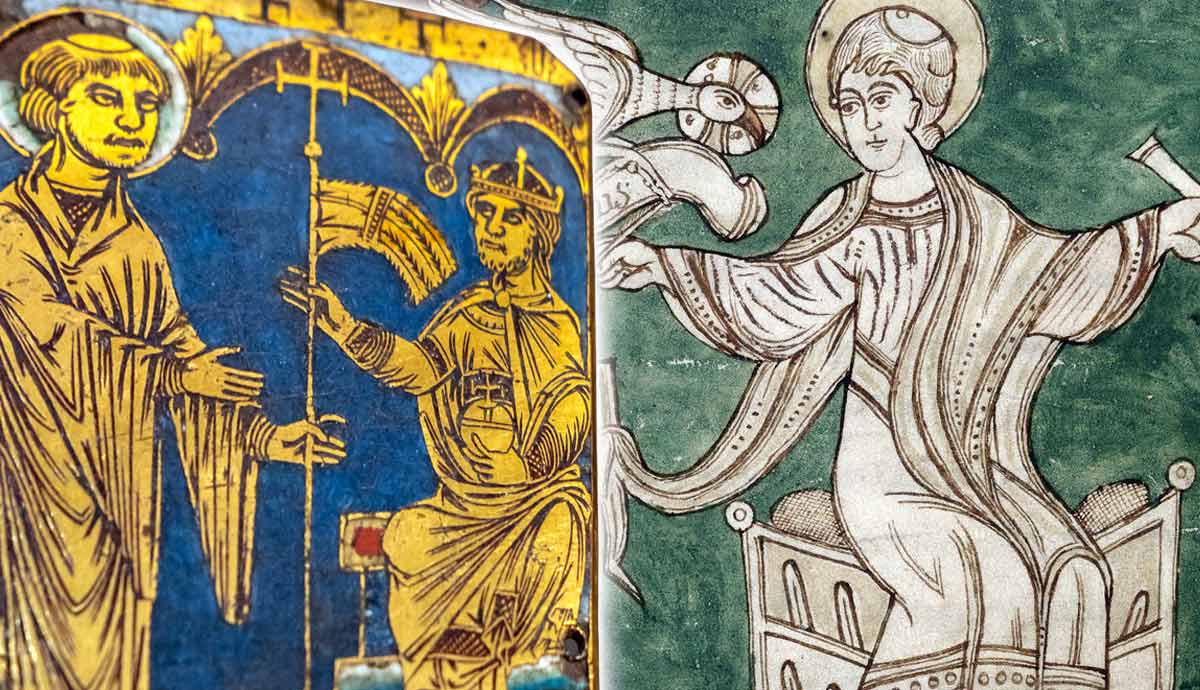
One of the most evocative scenes of the Middle Ages has the emperor of Germany, Henry IV, clothed in simple garments, kneeling in the snow before the residence of Pope Gregory VII, beseeching the holy father for forgiveness. This was the denouement of the Investiture Controversy.The Sacred and the SpiritualA mosaic of Constantine the Great in the Hagia Sophia. Source: The Hagia SophiaTo understand the Investiture Controversy and its impact on European power structures, we need to grasp the relationship between the Church and secular powers prior to the late 11th century. Essentially, the notion of the spiritual and the secular as two independent and opposing spheres is one that emerged out of the Investiture Controversy, as the Church claimed a monopoly upon the entire spiritual realm.Emperors and kings had long been understood as figures in whom the spiritual and the worldly intermingled. This is not just to say that these rulers were seen as being appointed by God, but that they were expected to play an active role in defending and furthering the Christian religion, and had as great or greater religious authority than any bishop.The Roman Emperor Constantine the Great (reigned 306-337), the first Christian ruler, called and presided over the Council of Nicaea. As a Christian emperor, he presided over the Empire and the Church in equal measure. His Christian successors also ruled as deeply religious figures, seeing no distinction or separation between their role as rulers of the Roman world and as the guardians and leaders of the Christian religion. After the fall of the Western Empire, this concept continued in the East, where the emperors in Constantinople were deeply religious figures. Indeed, the Orthodox Church has never had a true equivalent to the Latin pope, and this is partially due to the fact that the Byzantine Emperor, who presided over the East until 1453, never ceded their religious authority to the Church.A plaque depicting Christ receiving Magdeburg Cathedral from Otto I, 962-8 CE. Source: The Met MuseumIn the West, the fall of the Roman Empire gave rise to a variety of kings and emperors who would lay claim to religious authority much as Constantine and his successors had done. This reached its apogee in the figure of Charlemagne, who resurrected imperial authority in Europe when he was crowned emperor by the pope in Rome in 800. It is important to understand the extent to which Charlemagne and his successor Louis the Pious were religious leaders as well as worldly leaders, and the fact that their contemporaries would have seen little distinction between these roles.The mantle of Charlemagne was picked up in the mid-10th century by Otto the Great. After his defeat of the pagan Magyars in 955 on the Lechfeld River, Otto was seen as the standard-bearer for Christendom in Europe. His coronation in Rome in 962 as emperor established a German imperial dynasty that presided over the German lands and Italy. It was to be these emperors who would clash most violently with the Papacy, which existed in an uneasy relationship of dependence with its northern protector.The Ottonians, like the Carolingians before them, embodied a spiritual as well as temporal rulership. They appointed Popes and exercised full control over the appointment of abbots and bishops throughout their lands. The emperor did more than nominate clergy, however. Otto III (reigned 983-1002), Henry II (reigned 1002-1024), and Henry III (reigned 1028-1056) in particular took a leading role in reforming the Church at all levels, and pushed imperial dominance of the Church to new heights. They did not just engage with and grant support to the Church, but their personal piety set a powerful example and marked them out as deeply spiritual men. These spiritual emperors cast a long shadow over the bishop of Rome.The PapacyPope Gregory I (590-604) was one of the few very influential Popes of the early Middle Ages, 12th century. Source: British LibraryPrior to the late 11th century, the Roman pontiffs influence over Latin Christendom was, for the most part, marginal. Though widely acknowledged as the foremost bishop in the Church (though in the East this was a grudging acknowledgment, where it was made at all), the pope was very much a reactive figure.Where matters of theology or the Church were put to the pope, his judgment was mostly considered decisive. But the pope had very little ability to actively direct the affairs of the European Church. Monasteries were founded and bishops and abbots were appointed by lay rulers without any papal dispensation whatsoever.Certain popes had been important figures in Christendom, such as Gregory the Great (590-604). However, in the 10th century, the papacy had become the plaything of Roman noble families. Popes provided little spiritual or ecclesiastical leadership.By the 11th century, the winds of religious renewal were sweeping Western Europe. They came not from Rome but from all across Christendom. The Abbey of Cluny was spearheading monastic reform, and bishops and lay rulers from across the Latin West were demanding higher standards from the clergy and the Church as a whole. The particular focus was on Simony (the buying and selling of ecclesiastical offices) and the issue of clerical celibacy.Ironically, it was the intervention of the German Emperor Henry III in Roman affairs in the mid-11th century that liberated the Papacy from the clutches of the Roman nobility and allowed it to become the leader of the Christian reform movement.An important reformer: Pope Leo IX, from a 17th-century engraving. Source: British MuseumHenry IIIs intervention in 1046 initiated the reform movement in Rome. The emperor appointed the first reforming Pope, Leo IX (1049-54), and he brought into the papal administration a cadre of men who shared his vision for the reinvigoration of the Church and the Papacy. Leo was from Lotharingia, on the Franco-German border, and thus came from outside the toxic world of Roman papal politics.Leo looked back to an idealized past, based upon the forged document, the Donation of Constantine, in which the pope was recognized by the emperor as the supreme spiritual and temporal force in the Latin West. This issue of papal primacy stood alongside simony and clerical celibacy as the key goals of the reforming party.Unlike his predecessors, Leo was keen to travel throughout Western Christendom, holding synods as he went through Italy, France, Germany, and Hungary to encourage reform and manifest the power of the Papacy beyond the walls of Rome.Leo was also eager to promote canonical acclamations by the people and the clergy. According to the Church laws written by the greatest early theologians, the Church Fathers, the nomination of a bishop to their office was to be carried out by the clergy and the people of the diocese. Yet for many centuries, this process had been carried out solely by appointment from kings and emperors. Leo encouraged bishops to gain acclamation from their people and their clergy before taking up their office, as he himself did when he first entered Rome to become pope.Pope Leo IX, St Fides, Alsace. Source: Wikimedia CommonsLeo pursued clerical marriage and simony with vigor, demanding obedience to papal decrees and reinforcing the necessity for clerical celibacy, and declaring all consecrations of clergy found to have paid for their position as invalid. Though these issues may appear somewhat trivial, they were deeply important to reformers in this period, both clergy and lay people, as they represented the taint of worldliness on a Church that was meant to be a sacred vehicle for taking the souls of ordinary people to Heaven.If the Church and its clergy were mired in earthly sin, how could they help save the souls of Christians? For the reformers, the solution was to elevate the Church and its clergy by separating it from worldly sins and worldly power structures. The grasp of emperors and kings on the Church came increasingly to be seen as a malign influence holding back the Church from its elevation towards God.Escalating Tensions Between Church and EmperorThe East-West Schism of 1054 saw the end of Church unity embodied in the Council of Nicea. Source: Wikimedia CommonsIn Germany, the pious emperor Henry III died in 1056, leaving his six-year-old son Henry IV as sole ruler. The death of Henry III left something of a spiritual power vacuum in the lands of Germany and Italy, and during the long regency of Henry IV, the Roman popes grew in confidence and stature as the imperial throne was vacant, and the king of Germany was a child. It was this zeal for papal supremacy that led to the final split between the Eastern Orthodox and Western Roman Church in 1054, when, after refusing to acknowledge the popes claims of supremacy, the patriarch of Constantinople was excommunicated.Seizing the advantage of the young Henry IVs regency, in 1059, a synod in Rome headed by Pope Nicholas II reformed the way in which senior clergy were appointed. The papal bull In Nomine Domini vested authority for the election of the pope with a group of cardinal-bishops. This was the origin of the college of cardinals that continues to elect the pope in the present day. Imperial participation in the election process was pushed to the background.Papal reform at its outset did not create conflict between the Papacy and the emperor. However, an increasingly strident pope was always bound to clash with the great spiritual and temporal power in Italy. This conflict, which has become known as the Investiture Controversy, came to life when a talented protege of Leo IX, an Italian monk by the name of Hildebrand, became pope in 1073 as Gregory VII. Under Gregory, papal pretensions reached new heights, and the influence of his pontificate on the Church was momentous as he ushered in an era of papal monarchy.Gregory VII, from a 17th-century engraving. Source: HistoryofthegermansBy the time Gregory VII came to the Papacy in 1073, the aims of the reformers had shifted towards a greater focus on expelling lay influence from the Church. This manifested itself in attention on the appointment of bishops and abbots by lay rulers, and the lay control over ecclesiastical property. Rhetoric attacking lay influence in the Church had been circling for much of the 11th century, but it was under Gregory that the sentiment was channelled at the highest echelons of the Church. At the end of the reign of Gregorys predecessor, several of Henry IVs advisors were excommunicated, and so tensions between Henrys court and the papal curia already existed at Gregorys accession.Enamel panel from Cologne featuring the investiture of a bishop, 12th century. Source: Wikimedia CommonsGregory did not seek to challenge Henrys authority over the Church right away, but followed the approach of Leo IX. Nevertheless, Gregorys character was fierce, passionate, and strong-willed. Even prior to his election, he had shown himself as a hardline revolutionary and a critic of compromise. Gregory was a deeply spiritual man and saw himself as embodying the spirit of St Peter. Obedience to God in Heaven, in his view, necessitated obedience to the pope on Earth.Gregorys efforts to conquer lay influence over the Church manifested itself in two major issues: his claiming of the right to depose secular rulers, and his opposition to lay investiture of clerical positions. It is the latter issue which gives its name to the struggle between pope and emperor: The Investiture Controversy.The right of investiture was a customary right of rulers to oversee a ceremony in which the ruler installed the bishop or abbot, granting them symbols of their office. The word investiture comes from the Latin to dress. It describes the cleric being presented with the vestments that symbolize their office. This ceremony was an expression of the rulers control over the appointment of Church positions, and of their oversight of the bishops or abbots whilst the churchmen were in office.The Road to CanossaHenry at Canossa, by Eduard Schwoiser, after 1852. Source: Wikimedia CommonsThe spark came when King Henry IV (he had not yet been crowned emperor), no longer a child, installed his chaplain, Tedald, as archbishop of Milan in 1075, in opposition to Gregorys preferred candidate. The pope responded by excommunicating five of Henrys advisors. In the same year, Gregory had issued a statement at the Lenten synod claiming the right to depose emperors and kings and prohibiting lay investiture.At the German city of Worms in January 1076, Henry IV responded by renouncing obedience to the pope, addressing him as the false monk Hildebrand, and calling for the election of a new pontiff. At the same Diet in Worms, two archbishops and a majority of the German bishops also withdrew their obedience to Gregory. A month later, the bishops of northern Italy did the same.Gregorys response was immediate. At a synod in 1076, he excommunicated the king and the bishops who had renounced him. In a dramatic declaration, Gregory absolved all of Henrys subjects in Italy and Germany from their oaths of fidelity to the king and prohibited them from serving him.An important contextual point is that Henry was already facing serious rebellions from his subjects in Saxony, who resented what they felt was Henrys misrule. The popes declaration poured fuel on aristocratic revolt, and the German bishops soon turned against Henry and reconciled with the Pope.Map of the Holy Roman Empire in the 10th century. Source: Wikimedia CommonsThe scale of the initial rebellion forced Henry by the summer of 1076 to negotiate with his opponents and with papal legates, and he agreed to give satisfaction to the pope. The bishops and nobles, meanwhile, invited the pope to an assembly in Augsburg planned for 1077, to judge a dispute between Henry and the rebellious nobles.As he came to comprehend the scale of the opposition against him, Henry IV made the decision to undertake the treacherous journey across the Alps in the winter of 1076-77, in order to seek penitence from Pope Gregory. More than anything, Henry needed to buy time in order to marshal his forces to combat the revolt he faced in Germany.Henry IV, the Holy Roman Emperor, waiting for three days in Canossa with his wife and child, by John Foex, 1563. Source: Wikimedia CommonsIn the winter of 1077, Gregory was residing in the castle of the Countess Matilda at Canossa, Northern Italy, as the pontiff had been intending to travel north into Germany. Here we come to one of the most famous scenes of the Middle Agesa scene that evokes the great power struggle between Church and monarch that was to dominate so much of the Medieval Period and beyond, and a scene that encapsulates the extent of the papal revolution of the 11th century.In January 1077, Henry IV appeared outside the gates of Canossa in rough penitential clothing, and standing in the snow, he beseeched the pope for forgiveness. After three days, the pope allowed Henry to be reconciled with the Church, and Henry, in return, promised to abide by papal judgment.The meaning of Henrys penance at Canossa was disputed by medieval chroniclers and has been debated by historians. Commentators closer to the pope emphasized Henrys humiliation and underlined the point that a great secular ruler had submitted himself to the judgment of the bishop of Rome.Those close to Henry played down the extent of his penitence and stressed what the king gained from his reconciliation with the pope. The pontiff abandoned his plans for an intervention in Germany, and Henry gave himself time to consolidate his forces and reassert his rule in Germany.Nevertheless, it can be argued that the notion of the sacral kingship embodied by rulers like Charlemagne and Otto died forever at Canossa. The Church would not be cast into shadow by secular rulers again until the Reformation in the 16th century.An artistic impression of Emperor Henry IV at Canossa, by Ubaldo Gandolfi, ca. 1770-75. Source: Met MuseumWhilst Henry had been seeking penitence at Canossa, his enemies in Germany had elected a new king in his place. However, Henrys absolution from Pope Gregory and the popes subsequent refusal to recognize the rival anti-king Rudolf had restored Henry IVs reputation to a large degree, and he was able to restore his power in Germany after the death of the rival king Rudolf at the Battle of the Elster.Gregory did eventually decide to reaffirm Henrys excommunication and deposition in 1080; however, by this time, Henrys authority in Germany was largely restored, and the war-weary German nobility lacked the will or the momentum to act upon the popes decision. Henry IV thus decided to go on the offensive against the pope, and in June 1080, the king formally deposed Gregory at a synod in Brixen in the presence of 27 German and Italian bishops, and nominated Archbishop Wibert of Ravenna as the new pope.Henry then moved to besiege the city of Rome. Gregorys obstinate refusal to consider any form of compromise with the German king lost him support within the papal curia. In 1083, thanks in part to bribes sent to Roman aristocrats, Henrys army entered the Eternal City, and Gregory was forced to withdraw to the papal stronghold at the Castel SantAngelo.Taking possession of the Lateran Palace, Henrys antipope established himself in Rome and won over many cardinals to his side, as Henrys growing power now seemed irresistible. In 1084, the antipope Clement III crowned Henry IV as emperor. Meanwhile, Gregory VII was rescued from his castle by his Norman allies, but their plundering of a great part of the city forced Gregory to flee Rome. He died under Norman protection in May of 1085, having made no attempt to reconcile with Henry.Gregory VIIs LegacyThe Castel St Angelo in Rome, which was a papal fortress for centuries. Source: Wikimedia CommonsDespite its ignominious end, Gregorys energetic pontificate had left a lasting impression on the papal reform movement, injecting it with a zeal and an obsession over the investiture issue that would last for some time. Moreover, his challenging of kingly authority helped to establish a firm wedge between the secular and the spiritual powers of Europe that would only grow with time. Henrys brief control over the Papacy did not last, and the reform movement soon elected new reformist popes to carry on the legacy of Gregory VII.Urban II was the greatest of Gregorys predecessors. He took a more conciliatory approach than Gregory, attempting to raise the stature of the Papacy without provoking all-out conflict with the emperor. However, the pope and emperor remained at odds, with Henry IV continuing to support his antipope Clement, based in Ravenna. Yet Urban II is best remembered for preaching the First Crusade, a mass movement driven by religious fervor that led to the capture of Jerusalem in 1099. The Crusade demonstrated how far papal power had come. No European kings were involved in the Crusade, speaking to the ability of the pope to reach over the heads of secular rulers and spark a religious movement among the masses of Christendom.The Investiture Controversy is often said to have ended with the Concordat of Worms in 1122 between Pope Callixtus II and Emperor Henry V. This compromise allowed bishops and abbots to be chosen by the clergy, with the emperor being authorized to decide contested elections. Whilst this may have resolved the specific issue embodied in the Investiture Controversy, the wider significance of the controversythe clash between secular and spiritual powerswas to continue to rage throughout the Middle Ages and on into the present day.
0 Commenti
0 condivisioni
16 Views

 English
 Arabic
 French
 Spanish
 Portuguese
 Deutsch
 Turkish
 Dutch
Dutch
 Russian
 Romaian
 Portuguese (Brazil)
 Greek
Greek