


WWW.THECOLLECTOR.COM
4 Byzantine Emperors Who Did Everything to Win Power
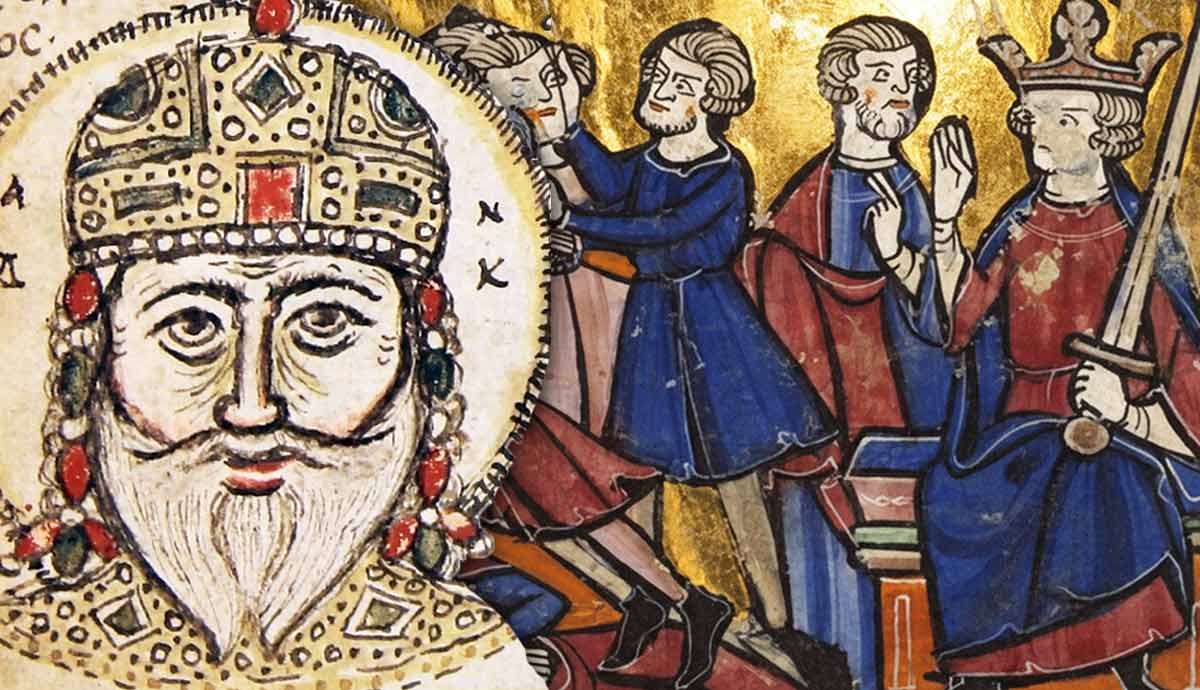
As the continuation of the Roman Empire, the Byzantine Empire also did not have a clear order of succession. The emperor was seen as Gods representative on Earth. In theory, anybody could have become emperor if it was Gods will. As a result, the Byzantine state is famous for its countless civil wars and succession crises. There were many dynasties throughout Byzantiums long history, but most of them did not last very long. In this article, we present four examples of the Byzantine emperors whose rise to power was marked by political intrigues, conspiracies, and civil wars.1. Bloody Comeback: Rises and Falls of Justinian II (685695 and 705711)Coin of Justinian II with Jesus Christ on the obverse, c. 692695 CE. Source: Dumbarton OaksAlthough not as famous as his namesake Justinian the Great, the life of Justinian II represents one of the most intriguing stories. He was one of the only two Byzantine emperors who had two separate reigns. The first reign was very eventful, despite the fact that he was only 16 or 17 years old when he came to power. He fought many campaigns against Arabs, Slavs, and Bulgars. These wars were very expensive, which often came at the cost of the aristocracy, whom he forced to fund his campaigns and lavish building projects.A strong discontent with his rule ended in a coup in 695, led by Leontius, who became the next emperor (695698). As punishment, Justinians nose was cut off, and he was exiled to Cherson in the Crimea. Justinian II spent the next ten years in exile with only one thing on his mindrevenge and return to power.Mutilation of Justinian II, from a 15th-century French manuscript. Source: Wikimedia CommonsMeanwhile, a general named Apsimarus took the Byzantine throne and ruled as Emperor Tiberius III (698705). Justinian fled from Cherson in 702/703 CE to seek an alliance with the Khazars. He even married the Khagans daughter, who converted to Christianity and took the name Theodora. Emperor Tiberius III bribed the Khazar ruler to conspire against Justinian. They sent two assassins, whom Justinian personally strangled after his wife informed him about the plan. After that, they fled to Bulgaria, where Justinian acquired the help of the Bulgarian Khan Tervel.In the spring of 705 CE, Justinian II and Tervel showed up in front of the walls of Constantinople with a strong Bulgarian and Slav army. Justinian knew that the walls of Constantinople were unbreachable, so he took another approach. Along with some of his men, he entered the city through an underground water pipe. They staged a coup, and Justinian II regained the throne, despite the fact that he was mutilated.Emperor Philippicus sends his men to execute Justinians son Tiberius, from a 14th-century Bulgarian manuscript. Source: Wikimedia CommonsHe awarded Khan Tervel with the title of Caesar, making him the first non-Roman to hold that title. The second reign of Justinian II was marked by blood and repression. His predecessors, Leontius and Tiberius, were publicly humiliated and beheaded. Ecumenical Patriarch Callinicus was blinded and exiled to Rome. He also ordered a punitive expedition against the city of Ravenna because of the anti-imperial sentiment. The whole city was raided in the brutal campaign. Because of his brutality and repression, Justinians rule became increasingly unpopular.The final end of Justinian II started in the same city he was first exiled to, Cherson. The soldiers he sent to put down the rebellion turned against him. In 711 CE, Justinian II was captured and beheaded by the general Bardanes. His head was sent to Italy to be paraded in Rome and Ravenna. Bardanes was proclaimed as Emperor Philippicus (711713). In Constantinople, Justinians son was captured and slaughtered, putting a bloody end to the dynasty of Heraclius.2. From Peasant to Emperor: Basil I, Macedonian (867886)Basil I, underdrawing from a 9th-century Byzantine manuscript. Source: Bibliothque nationale de FranceWhen young Basil came to Constantinople in c. 840 CE, he was just a poor and illiterate village boy looking for a better life. 27 years later, he became the emperor of the Romans. Basils early life and rise to power are obscured by the popular legends and tales spread during the reign of the Macedonian Dynasty.Byzantine sources described young Basil as handsome and beautiful, so it is not difficult to imagine that he used his charm to get what he wanted. We do know that he eventually became a groom in the service of Theophilitzes. Theophilitzes was a relative of Caesar Bardas, uncle of the Emperor Michael III, and one of the most powerful men in the empire. One day, while he accompanied Theophilitzes in the city of Patras, Basil caught the eye of a wealthy widow, Danielis. It seems that he influenced her so much that she gave him great fortune.As the story goes, the emperor noticed Basil when he defeated a Bulgarian champion during a wrestling match. Because of his abilities, Basil soon became the emperors personal horse tamer and a bodyguard.Basil defeats a Bulgarian wrestler, from a 12th-century manuscript. Source: Library of CongressWhile at the court, Basil managed to exert a great influence on the young emperor Michael III, and the two became close companions. Basil even divorced his wife in order to marry the emperors mistress, Eudokia Ingerina. However, the emperor kept a relationship with her. At the same time, Basil was involved with Thekla, the emperors sister.Basils main opponent was Caesar Bardas, so he decided to put him away. He managed to convince the emperor that Bardas was plotting against him, so the two of them conceived a plan to kill Bardas. A supposed campaign against Arabs was organized, only to get Bardas out of Constantinople. One day, Bardas was brutally slaughtered by Basil and his companions in the presence of the emperor in 866 CE. With Bardas dead, Basil became the most influential man in the court. Not long after these events, Michael III publicly crowned Basil as his co-emperor.Murder of Caesar Bardas, from a 12th-century manuscript. Source: Library of CongressIt is important to note that much of the bad reputation of Michael III stems from propaganda spread during the Macedonian Dynasty. Because of that, Michael was remembered as a reckless drunkard. Some of his decisions might seem strange, but we do not know the whole truth. It appears that Michael III saw through Basils intentions as he started to mistrust him. He even publicly mocked his proclamation as co-emperor on one occasion.One night in 867 CE, when the emperor was sleeping drunk in his chambers, Basil and a few of his companions brutally slaughtered the emperor, who was only 27 years old. Since Michael III did not have any children, Basil automatically became the sole Emperor of the Romans. The occasion marked the bloody beginning of the Macedonian Dynasty, which would rule the Byzantine Empire until 1057 CE.Controversy marked Basils ascension. Nevertheless, his reign was stable and successful. He issued many new laws, which were later collected in the Basilika, one of the most important works of Byzantine law. He pursued an active policy in the West, which improved Byzantine positions in southern Italy.3. From Rogue Prince to Ruthless Tyrant: Andronikos I Komnenos (11831185)A miniature of Andronikos I Komnenos, 15th century. Source: Estense Digital LibraryThe reign of the last emperor of the Komnenos Dynasty was short and bloody. In contrast, his life before coming to power was full of rebellious adventures, scandalous love affairs, and political intrigues. Andronikos grew up with his cousin and the future Emperor Manuel I Komnenos (11431180). Although the two were great friends, their relationship soon turned to rivalry.In the early 1150s, Andronikos entered into a relationship with Eudokia, his and Manuels niece. At the same time, he plotted against Manuel together with Geza II, King of Hungary. Because of this, Manuel imprisoned Andronikos in 1155. He managed to escape in 1159, only to be caught and imprisoned again. He escaped for a second time in 1164 and fled to Prince Yaroslav of Galicia to seek an alliance against Manuel. However, Manuel soon formed an alliance with Yaroslav, and Andronikos had to reconcile with his cousin. Only two years had passed, and Andronikos was banished from Constantinople. He refused to swear an oath to Prince Bela III of Hungary, who was designated as heir to the Byzantine throne at the time. He was given a post in Cilicia, far away from the capital.Andronikos I blinds his enemies, miniature from a 13th-century French manuscript. Source: Portail BiblissimaFrom Cilicia, Andronikos fled to Antioch, where he had another scandalous affair. This time, he seduced Philippa of Antioch, who was the sister of Manuels wife, Maria. They soon fled to the Kingdom of Jerusalem, where Andronikos left Philippa for Theodora, daughter of his cousin Isaac Komnenos. Andronikos and Theodora had a long-lasting relationship, which produced two children.Emperor Manuel ordered Andronikos to come back to court, but he refused and fled Jerusalem with Theodora. Two of them wandered through Anatolia and the Caucasus for several years. During that time, they were welcomed to the courts of many different states. After Manuels officials captured Theodora in 1180, Andronikos was forced to come back to Constantinople and beg for forgiveness. Manuel I made him a governor of Paphlagonia, where he lived with Theodora for the next two years.After Manuel I died, he was succeeded by his underage son Alexios II (11801183). The real power was in the hands of his mother, Maria, who ruled as regent. Andronikos came to Constantinople in 1182 at the invitation of Maria, who faced substantial opposition in the capital.Death of Andronikos I, miniature from a 15th-century French manuscript. Source: Portail BiblissimaAndronikos soon turned against Maria and even forced 13-year-old Alexios II to sign a document that condemned her to death. Although Andronikos presented himself as a savior of Alexios II, that did not stop him from ordering his murder in 1183. To boost his legitimacy, Andronikos married eleven-year-old Empress Agnes of France, wife of the late Alexios II.Andronikos had a lot of internal enemies, many of whom he blinded or executed. Nobles were especially hostile towards his rule because of his anti-aristocratic policies, which were enforced brutally. Although his reforms did improve the lives of the peasantry, Andronikoss reign is mostly remembered for political purges and the reign of terror. Ultimately, his reign greatly destabilized the empire. Many nobles who escaped persecution sought aid from the Empires enemies. In the end, Andronikos was captured in Constantinople during the uprising against him. He was publicly tortured for several days. After he died, his remains were left unburied for several years.4. Master of Political Intrigue: Michael VIII Palaiologos (12591282)A miniature of Michael VIII Palaiologos, 15th century. Source: Estense Digital LibraryThe early life and career of Michael Palaiologos remain largely unknown. His father, Andronikos, served as a megas domestikos (commander-in-chief) of the Nicene Empire. Michael is recorded as a governor of two important towns in Thrace in c. 1246. It seems that Emperor John III Vatatzes (12221254) became suspicious of Michael, as he accused him of treason. As suggested by the Metropolitan Bishop Phokas of Philadelphia, Michael was put on trial by ordeal, with a red-hot iron used to prove his innocence or guilt. Apparently, Michael avoided the trial by suggesting that he would gladly accept the red-hot iron if Metropolitan Phokas would give it to him from his own hands.Because Michael had considerable support from the army and political elites, charges were soon dropped. After the trial, Michael was given command of the Latin mercenaries. When Emperor John III died in 1254, he was succeeded by his son Theodore II Laskaris (12541258). A new emperor took a particularly harsh stance against the aristocracy, which he mistrusted.Seal of Michael VIII Palaiologos, c. 12611282. Source: Dumbarton OaksMichael fled to the Seljuk Sultanate of Rum, where he commanded Christian mercenaries. His motives are unclear, but it is possible that he sought Seljuk assistance to overthrow Theodore II. However, his plan failed when Theodore II settled a peace agreement with the Seljuks, and Michael had to return to Nicaea. Theodore II died in 1258, leaving his eight-year-old son, John IV Laskaris (12581261), as the new emperor. In his testament, Theodore II appointed his protovestiarios, George Muzalon, as a regent and guardian for his son. He was soon killed in a conspiracy led by Michael, who replaced him as Johns regent.From this point onward, Michaels rise only accelerated. By November of 1258, he was given the titles of megas doux and despotes, and on January 1, 1259, Michael Palaiologos was crowned co-emperor. In 1261, one of Michaels generals managed to get into Constantinople and retake it after 57 years of Latin rule. Michael VIII triumphantly entered the city and was crowned again, this time in Hagia Sophia. The main obstacle to his power was the young John IV, who was blinded and detained in a castle.Miniature of Emperor Michael VIII Palaiologos, 14th century. Source: Munich LibraryMichael VIII used diplomacy against the numerous enemies of his restored empire. He managed to secure the East from the Mongols by marrying his illegitimate daughters to Mongol rulers. His main enemy and rival was Charles of Anjou, who had just become the King of Sicily in 1266. Just as ambitious as Michael, Charless main goal was restoring the Latin Empire.In order to stall Charless plans, Michael attempted to negotiate a Church union with Pope Gregory X (12711276). While these negotiations bought time, they also caused a significant internal division. By 1281, Charles had gathered a large naval force for the attack on Constantinople. Ultimately, Michael VIII was victorious.The old Byzantine emperor conspired with Peter III of Aragon to overthrow Charles from Sicily, which eventually happened after the rebellion called the Sicilian Vespers. Michaels Italian ambassadors took an active role in instigating a revolt. Despite his success, Michael VIIIs reign came at a cost to his successors, who couldnt prevent the Byzantine Empire from declining again.
0 التعليقات
0 المشاركات
20 مشاهدة

 English
 French
 Spanish
 Portuguese
 Deutsch
 Turkish
 Dutch
Dutch
 Italiano
 Russian
 Romaian
 Portuguese (Brazil)
 Greek
Greek